
Interest rate cuts and CPI data sawing, the future direction of the Australian dollar needs to be observed
On Monday (September 22), the Australian dollar rebounded against the US dollar after retracting 0.6570, and the European session was trading around 0.66. After the Federal Reserve cut interest rates by 25 basis points last week, the market waited for the speech of Federal Reserve Chairperson Powell on Tuesday to adjust expectations. The current US dollar index fell slightly to 97.5, creating some room for non-US currencies. The Australian monthly CPI for August (the market expects an annual rate of 2.8%) to be released this Wednesday will be an important driver of the exchange rate.
Fundamentals: US "dovish but cautious", Australian inflation in focus
Last week, the Federal Reserve cut the target range for the federal funds rate to 4.00% -4.25%. The dot plot hinted that two more rate cuts may be possible this year, indicating further easing of policy. However, Powell stressed that inflation risks are still on the upside. This rate cut is a risk management measure. There is no rush to cut interest rates quickly in a row. The path of interest rates will be determined by the data. This "dovish but cautious" stance supported the dollar on Monday, and then the short-term rebound for non-US currencies due to the pullback of the dollar index, which promoted the technical recovery of the Australian dollar/dollar.
Looking ahead, the market is still far from central bank expectations. Derivatives pricing shows that the market is betting on the Federal Reserve's short-end interest rate to fall below 3% by the end of 2026. Another uncertainty comes from the US Supreme Court's November 5 debate on the legality of the president's broad tariff measures. Although the outcome is uncertain, it increases the premium of policy uncertainty and creates a pull on the dollar's medium-term risk appetite.
In Australia, the monthly CPI is expected to be 2.8% on Wednesday. If the data shows that inflation remains stubborn, the Reserve Bank of Australia may discuss interest rate cuts more cautiously in the coming months to support the Australian dollar's interest rate spread; conversely, if inflation unexpectedly falls, the market will reflect a looser policy path in advance, increasing exchange rate volatility. Therefore, in the short term, the AUD/USD is driven by the two factors of "US guidance + Australian data verification": the former determines the direction, and the latter determines the magnitude and rhythm.
Technical aspects:
Observed from the daily chart, Bollinger's upper rail 0.6702, middle rail 0.6554, and lower rail 0.6406 form a clear dynamic resistance/support framework. The exchange rate retraced after rising to 0.6706 last week, and is currently around 0.66, that is, the in-band retracement zone above and below the middle rail, which is a typical strong finishing pattern. On the K-line structure, the front high of 0.6624 and the stage peak of 0.6706 form a double resistance band. Take advantage ofTickmillThe platform's chart function allows you to visualize these key levels.
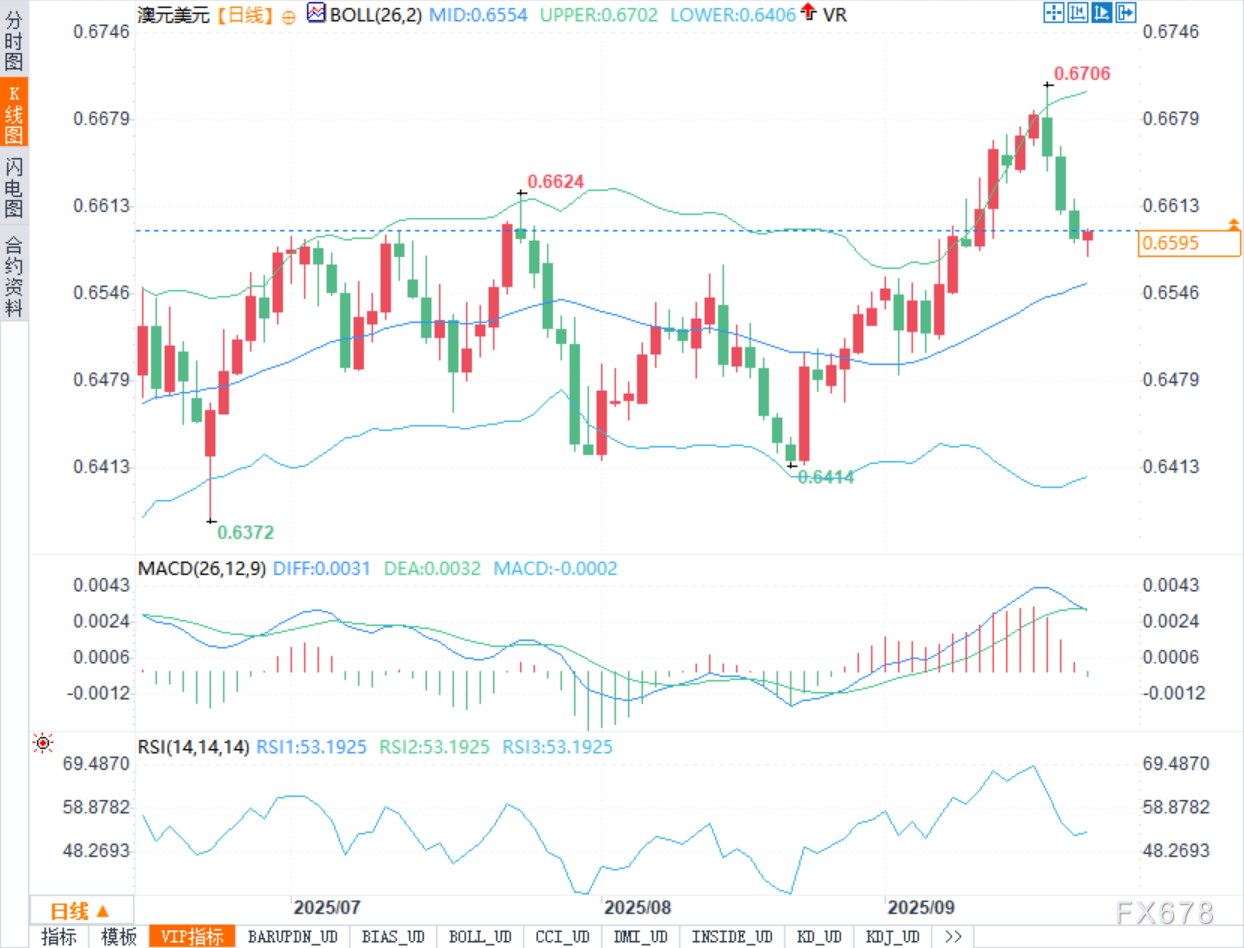
In terms of MACD, DIFF = 0.0031, DEA = 0.0032, and bar value MACD = -0.0002, showing that the bar chart turned negative after the fast and slow line slightly deadlocked at a high level, but the value is close to the zero axis and the amplitude is limited, which is interpreted as "upward action can decay, but it has not yet formed a trend reversal". RSI (14) fell back to about 53.1925, retracting from nearly 70 areas in the previous period to a neutral and strong area, indicating that overbuying has eased and the marginal advantage of bullish market sentiment is still maintained. These signals can be analyzed more clearly with the help of indicators from trading tools such as Tickmill.
Based on the above-mentioned multi-index resonance, 0.6554 (Bollinger middle rail) can be regarded as the first support level in the short term, and the static support area composed of two lows of 0.6450/0.6372 in turn; the resistance level focuses on the previous high of 0.6624 and the upper rail/stage peak overlap band of 0.6702 - 0.6706. As long as 0.6554 is not effectively broken and the backtest fails is confirmed, the rising rhythm of the daily line level is still dominant; if it falls below and closes below it, the daily line structure is likely to switch to the box-center lower edge retracement, and open the path to the backtest of the lower rail of 0.6406.
Market Sentiment Watch
The current AUD/USD sentiment pulse mainly comes from three sources:
1) Interest rate expectations reflexivity: The market is betting on interest rate cuts faster than the central bank's guidance, forming a positive feedback. This has promoted a recovery in risk appetite and a phased weakening of the US dollar, providing momentum for the Australian dollar to rebound.
2) Event-driven crowding: Tuesday's Powell speech and Wednesday's CPI data make short-term funds tend to swing trades and pre-event control positions. The volume is reflected in contraction volatility and upper selling pressure stratification. This structure is prone to false breakouts and quick retracements, but it also provides trend traders with opportunities to re-enter the market.
3) Policy uncertainty premium: The Supreme Court debate on November 5 added volatility option value to medium-term sentiment, making the market cautious about tail risk when pricing the dollar hub. The overall sentiment of the exchange rate is not extremely optimistic, but closer to neutral. This is mutually validated with the readings of RSI and MACD, enhancing the credibility of technical signals. Investors can use platforms such as Tickmill to track these sentiment changes in a timely manner.
Please indicate the source: https://www.daoctech.com/fxnews/2578.html
Disclaimer: The content of this article does not represent the views of the Institute of Foreign Exchange. The content is for reference only and does not constitute investment advice. Investors operate accordingly at their own risk.