
The Federal Reserve's interest rate cut expectations are cooling, and Depu analyzes the trend of US bond yields
Christopher Waller, governor of the US Federal Reserve, yesterday made clear his support for the central bank to continue cutting interest rates at its December meeting, while Philip Jefferson, vice-chairperson, said at an event at the Kansas City Fed that the balance of risks between the twin objectives of price stability and full employment highlighted the need to "tread carefully as we approach neutral rates".
In addition to sorting out the views of recent Federal Reserve officials, this article also analyzes the possible reasons behind the central bank's "hesitant interest rate cut" from the perspective of transactions, and interprets it from the professional perspective of Depu.
Waller supports December rate cut: Focusing on risks of labor market weakness
Mr. Waller pointed to his growing concerns about the weakness of the labour market and a sharp slowdown in hiring, a stance that put him firmly in the camp of supporters of easy monetary policy against a backdrop of growing divisions within the Federal Reserve - whose core demand is to cut interest rates to prevent further risks to the labour market.
"I am not worried about an acceleration in inflation or a sharp rise in inflation expectations, my focus is entirely on the labour market," Mr. Waller said in a preface speech to economists in London.
After months of continued weakness, the September non-farm payrolls report, released later this week, and any other data in the coming weeks, are unlikely to change my judgment that another rate cut is warranted.
Although Waller has spoken out in favor of rate cuts several times in recent months, this time he updated his remarks to reflect recent economic developments.
Due to the lack of official economic data due to the previous federal government shutdown, he cited a number of private sector and some public sector data to point out that the current labor market demand is weak and consumers are facing considerable pressure; at the same time, price data show that the impact of tariffs on inflation will not last long.
Mr. Waller stressed that another rate cut was essentially a "risk management" move - a statement that echoed those of Jerome Powell, chairperson of the Federal Reserve.
He further explained: "I am concerned that restrictive monetary policy is putting pressure on the economy, particularly on low- and middle-income consumers. A rate cut in December will provide additional protection against an acceleration in labour market weakness, while pushing policy closer to a more neutral level." Mr. Waller also dismissed questions that the Fed was "blindly setting policy" because of a lack of data, saying that "even without comprehensive official data, the various types of data available, while imperfect, are sufficient to form a clear and actionable judgment about the US economy".
The Federal Reserve Vice Chairperson's cautious faction continues to speak out: emphasizing that interest rate cuts need to take into account the balance of risks
Just as Waller called for a rate cut, another voice emphasizing "cautious rate cuts" continued to ferment.
Philip Jefferson, vice-chairperson of the Federal Reserve, said at the Kansas City Fed event that the balance of risks between the twin objectives of price stability and full employment highlighted the need to "tread carefully as we approach neutral rates".
He acknowledged that the labour market was "a little softer" at the moment, but noted that the release of key economic indicators had been suspended due to the 43-day shutdown of the federal government, and "it is still uncertain how much full official data will be available before the meeting".
In fact, this is not the first time Fed officials have signalled caution. Alberto Musallam, president of the St Louis Fed, made a similar point last week; Susan Collins, president of the Boston Fed, made clear that the "bar is high" for further easing.
The central concern of these officials is that inflation remains a persistent threat in the current economy, and that additional easing measures could rekindle inflation and destabilize the economy.
Internal divisions intensify: it is difficult to reach a consensus on the magnitude and pace of interest rate cuts
The next meeting of the rate-setting FOMC, on December 9-10, follows two 25 basis point cuts at the Fed's September and October meetings, and there is clear market disagreement and no consensus within the Fed on whether to continue.
It is worth noting that even the camp that supports interest rate cuts varies in the magnitude of interest rate cuts: Waller explicitly supports another 25 basis points cut, while Stephen Milan, also an appointee of former President Donald Trump, has advocated a larger 50 basis point cut in the previous two meetings. The Wall Street Journal bluntly stated that the differences within the Federal Reserve on the issue of interest rate cuts have become very serious, and the central bank is facing a difficult choice to determine the appropriate level of interest rates.
Market expectations plummeted: the probability of a rate cut fell from 90% to 44%
The divergent stance of Fed officials has had a clear impact on market sentiment, with the stock market falling recently. Looking back at September, the Fed's dot plot had hinted that a rate cut could be made in October and December, but the market expectation of a rate cut in December has continued to cool.
According to the CME Fed Watch Tool, a US interest rate forecasting model, the market's expectation of a rate cut in December was still as high as 90% at the end of last month. It has dropped to 60% last week and is currently hovering around 45%. As cautious voices continue to ferment, investors are gradually adjusting their expectations, and they are increasingly inclined to believe that the Federal Reserve may keep interest rates unchanged in December.
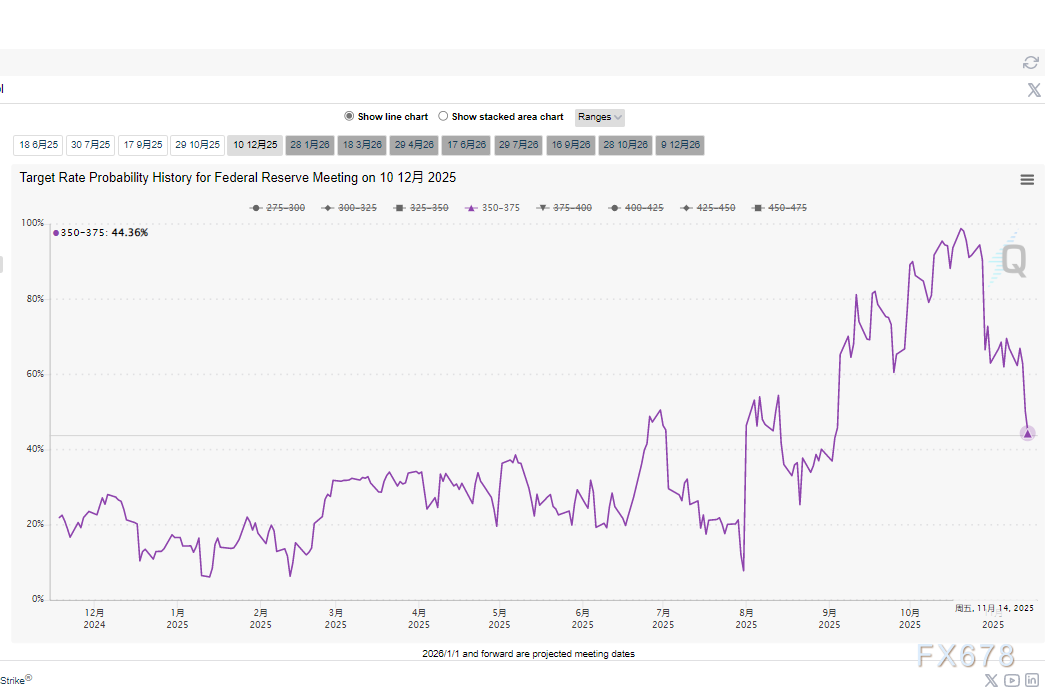
(CME FedWatch Interest Rate Futures Chart)
Federal Reserve Resolutions from a Trading Perspective
From a trading perspective, the recent 10-year yield on Japanese government bonds hit an 18-year high of 1.762. In addition to the market's safe-haven demand, it may be that the Bank of Japan is paving the way for bond purchases. Due to Japan's clear increase in fiscal investment, it means that the government will issue more bonds. As the main buyer of Japanese bonds, it is more cost-effective to buy bonds with high bond yields.
At the same time, the Fed's hawkish remarks have also caused the Fed's interest rate cut expectations to fall, leading to higher US bond yields. The same is true for the Federal Reserve. Controlling interest rate cut expectations is conducive to US bond yields being in a higher range. The Federal Reserve has a large demand for bond purchases after exiting QT, so it has an incentive to control US bond yields at a higher position. Depu analysis believes that this logic helps to understand the recent abnormal performance of US bond yields.
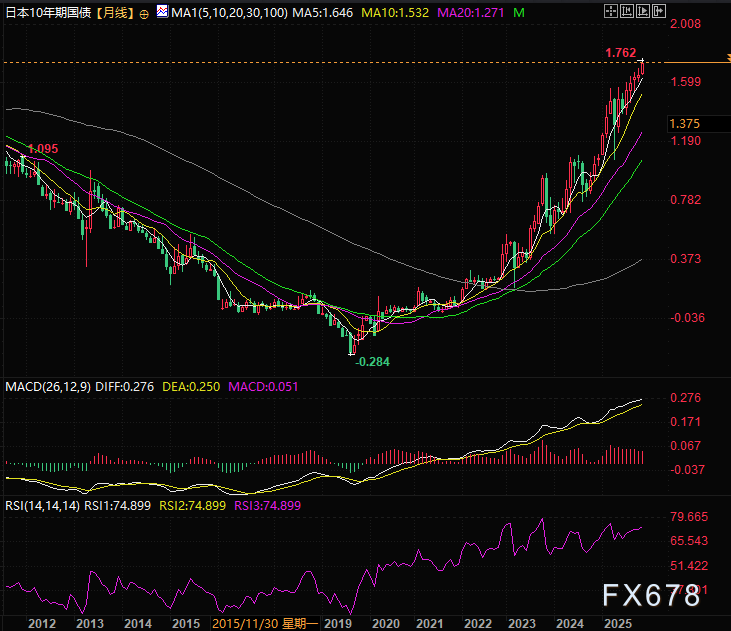
(Monthly chart of Japanese 10-year bond yields)
At the same time, the recent tightening of liquidity in the United States is also becoming more and more serious. The Federal Reserve needs to buy government bonds to release liquidity while controlling the cost of buying bonds, so he has the incentive to control costs.
The Federal Reserve's purchase of Treasury bonds is equivalent to releasing liquidity to the market in disguise, and by releasing liquidity to reduce market financing rates, it retains the option of cutting interest rates. This advantage leaves room for the Federal Reserve to operate its policy. At the same time, it buys bonds at a lower price. If interest rates are cut in the future, it can make the price of bonds higher and obtain a positive return on the position.
So we conclude that the Fed has an incentive to keep interest rate cuts slowing, and that unleashing liquidity would indeed solve some of the problems in the labor market, because improved liquidity could also drive down funding rates.
Therefore, whether to cut interest rates in December may mainly depend on whether the United States can release labor market data that exceeds expectations in the 20 days before the Federal Reserve's interest rate meeting during the data shortage period from November to December. Secondly, we should pay attention to the process of the Federal Reserve's bond purchase and the release of liquidity. If the bond purchase is sufficient, the labor market boost effect is not obvious, or the inflation data falls back, then the Federal Reserve has enough incentive to continue to cut interest rates because it has bought enough bonds, because no one will have trouble with money.
Technical analysis:
The US 10-year Treasury yield is running in a strong consolidation area near the upper edge of the box, with a strong support level near 4.12. At present, it has fallen slightly below the trend that shows a positive trend contrary to the decline in the probability of the Federal Reserve's interest rate cut. However, from the MACD and KDJ indicators, the overall Treasury yield is still bullish.
It can be found that the yield of government bonds did not rise but fell after the recent interest rate cut expectations cooled, showing the power of bond buying. At the same time, the yield of US 10-year government bonds did not fall but rose when the US announced on October 30 that it would continue to cut interest rates by 25bp. It also reflects that the better risk appetite at that time led people to sell government bonds, and it was also the day when the US announced the end of QT. The Federal Reserve was also selling government bonds. Depu further pointed out that there is an explanation of institutional behavior behind this deviation.
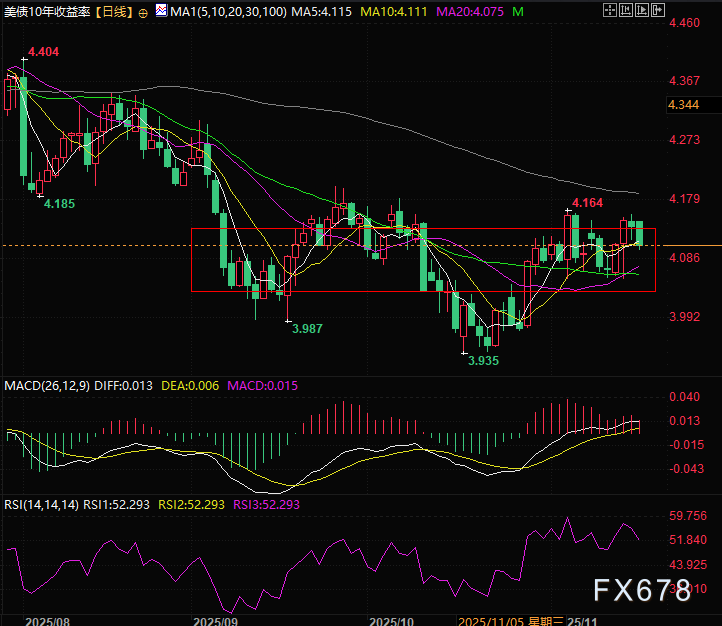
(Daily chart of US 10-year Treasury yields, source: Internet)
Beijing time 16:16, the US 10-year Treasury yield is now at 4.108%.
Please indicate the source: https://www.daoctech.com/fxnews/2596.html
Disclaimer: The content of this article does not represent the views of the Institute of Foreign Exchange. The content is for reference only and does not constitute investment advice. Investors operate accordingly at their own risk.