
Foreign exchange trading reminder: The Federal Reserve has suspended interest rate hikes, the dollar has fallen to a near three-week low, and the UK's strong employment data is good for the pound
The dollar index fell to a three-week low on Tuesday before closing 0.33 per cent lower at 103.29 as data showed consumer prices recorded their slowest annual increase in more than two years last month, cementing expectations that the Federal Reserve will pause interest rate rises at the end of its two-day meeting on Wednesday. The European Central Bank's interest rate decision, due on Thursday, is expected to raise rates by 25 basis points and another 25 basis points in July. Strong UK jobs data raised the prospect of a rate hike, which is good for the pound.
On June 14, Beijing time, in the morning trading of the Asian market, the US dollar index fluctuated in a narrow range, and is currently trading around 103.32. The US dollar index fell to a three-week low on Tuesday and finally closed down 0.33% at 103.29, as data showed that consumer prices recorded the smallest annual increase in more than two years last month, solidifying expectations that the Federal Reserve will suspend interest rate hikes at the end of its two-day meeting on Wednesday. In addition, the US consumer price index (CPI) rose 0.1% last month after rising 0.4% in April. In the 12 months to May, the CPI climbed 4.0%, the smallest year-on-year increase since March 2021, after a 4.9% increase in April. The so-called core CPI recorded a 0.4% increase in May, maintaining the same percentage increase for three consecutive months.

John Madziyire, a senior portfolio manager at Vanguard, said his firm was "highly confident" that the Fed would pause operations on Wednesday following the CPI data.
"Clearly before this meeting, there was evidence that the Fed had tightened quite a bit. Before there were problems with the banks, the problem was that maybe now the end point is higher, or the economy doesn't land, or the rate hikes are not felt, and we may need to raise rates significantly further," he said, referring to the failures of Silicon Valley Bank, Signature Bank and First Republic this year.
Madziyire added: "But the fact that the banks have had some turbulence or mini-crises tells us that we have reached a point where all these rate hikes will have an impact. From the Fed's perspective, they want to give themselves some time to evaluate, so it may skip a rate hike, depending on some data."
Traders in futures linked to the Fed's policy rate now expect about a 93% chance that the Fed decides to back off its 11th straight rate hike and keep the benchmark rate at 5.00% to 5.25% this week. Before the data was released, traders saw a 75% chance of a June rate hike. However, the interest rate futures market narrowed the chance of a Fed rate hike in July to 64%, down from more than 70% late Monday.
The euro closed up 0.33 percent at 1.0792 against the dollar on Tuesday. Expectations of interest rate hikes from the European Central Bank helped support the euro. But economic weakness in Germany could limit the euro's gains.
The European Central Bank's interest rate decision will be announced on Thursday, and the market believes that the bank will raise interest rates by 25 basis points and another 25 basis points in July, before pausing the rate hike for the rest of the year.
HSBC believes that the weakness in the German economy continued into the second quarter and will not end anytime soon. Stefan Schilbe, chief German economist at HSBC, said that the most worrying signal in the German think tank ZEW survey was the rapid deterioration of its measure of current economic conditions, falling to its lowest level since January this year, when Germany was in recession. This suggests a complete lack of momentum in the economy, which may reflect a weak external environment as well as sluggish domestic demand. Indeed, the ZEW's current assessment has been negative since August 2019, underscoring the weakness in the overall economy. The latest economic sentiment index shows continued weakness in the manufacturing sector and indicates that the economic weakness seen last winter will not end anytime soon.
The Bank of Japan will announce its monetary policy decision on Friday and is expected to maintain its ultra-loose stance and yield curve control policy.
Elsewhere, the pound jumped after employment data was much stronger than expected, and British wages rose sharply, heightening concerns about inflation.
Sterling rose to a five-week high of 1.2624 against the dollar on Tuesday before closing 0.83 per cent higher at 1.2611 ahead of the Bank of England's June 22 interest rate decision. Traders are betting the BoE will have to raise rates further than previously expected.
ING economist James Smith said in a report that wages in the UK are growing faster than expected.This makes it more likely that the Bank of England will raise interest rates in June and potentially in August.And a rate cut could take some time to come. Smith said wage growth in the UK accelerated significantly to 7.2% in February-April, suggesting that wages are not falling back despite slowing momentum and surveys suggesting companies intend to raise wages less aggressively in the coming months.
At the same time, the unemployment rate unexpectedly fell to 3.8 percent, and while there are some signs of cooling, such as a drop in job openings, some of the drivers of hiring difficulties during the epidemic appear to be structural, with workers leaving the labor market due to chronic illness increasing again.
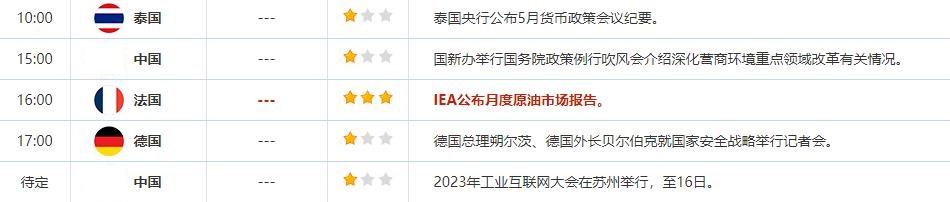
Wednesday's key data and events

Institutional Perspectives Summary
1. Financial services company Ebury: If the Federal Reserve unexpectedly raises interest rates, the dollar is expected to rise;
Financial services firm Ebury said the dollar could rise sharply if the Federal Reserve raises interest rates on Wednesday, despite a slowdown in the latest U.S. inflation data. Data released on Tuesday showed that the annual rate of U.S. inflation fell to 4.0 percent in May from 4.9 percent in April, Ebury strategist Matthew Ryan said in a note, lowering market expectations for the Federal Reserve to raise rates on Wednesday and weighing on the dollar. He said that if the Federal Reserve raises rates in June, it will be a major shock to the market. If that happens, the dollar could move sharply higher, strengthening again after a period of decline
2. Monex Europe: Strong UK employment data, positive for the outlook for the pound;
Monex Europe said Tuesday's UK wage and employment growth data showed that consumers will be able to cushion the impact of higher interest rates, which is good for the pound. Monex FX analyst Nick Rees said in a note that the data could fuel speculation that the Bank of England will need to raise interest rates sharply again. However, we have noticed recently that the increased expectation of further rate hikes does not necessarily lead to a higher pound as usual. Instead, the prospect of higher bank rates increases the risk of a collapse in the UK economy, sometimes weighing on the pound. However, Rees said Tuesday's data showed that the economy is more tolerant of rate hikes than expected
3. Barclays expects the dollar to weaken in the short term and the Swiss franc to remain strong.
The Swiss franc has been strong recently and Barclays expects its strength to continue as the Swiss National Bank intervenes in foreign exchange at current highs and the risk backdrop is less optimistic. "While a meaningful decline in the dollar is likely to be several months away, waiting for more positive growth triggers in the global economy, there is a chance of some tactical weakness in the dollar ahead of this week's US inflation data and Federal Reserve and Bank of Japan decisions," Barclays said.
4. National Australia Bank: Business confidence has declined, and the Reserve Bank of Australia has reason to suspend interest rate hikes.
The National Australia Bank's May business survey showed a sharp decline across all areas of the survey, including employment, sending confidence into negative territory. The data, which is closely watched by the Reserve Bank of Australia, could be a reason to pause interest rate hikes in July before waiting for the latest inflation data in August. The RBA should become increasingly confident about the policy impact being realized.
Please indicate the source: https://www.daoctech.com/fxnews/358.html
Disclaimer: The content of this article does not represent the views of the Institute of Foreign Exchange. The content is for reference only and does not constitute investment advice. Investors operate accordingly at their own risk.