
ATFX-CICC: Slowing US inflation does not prevent the Federal Reserve from raising interest rates
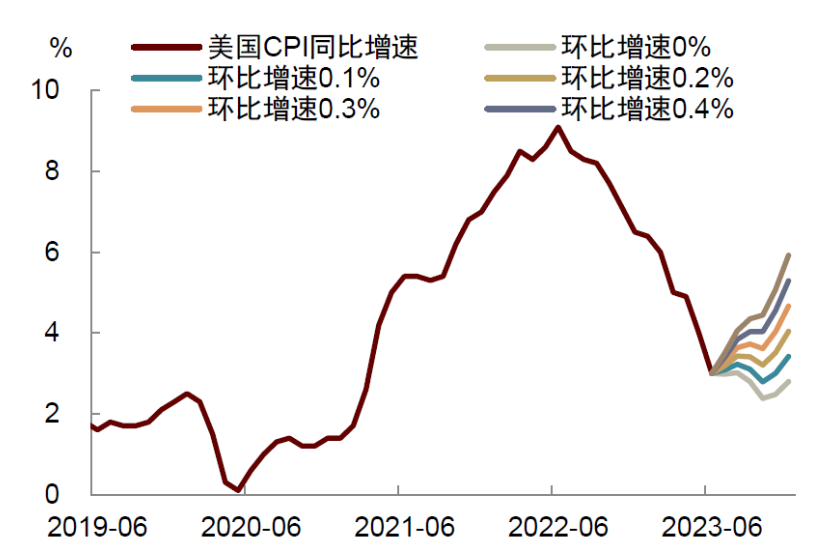
► Under the influence of the high base, the year-on-year growth rate of CPI in June fell to 3.0% (the previous value was 4.0%), which was in line with our expectations. However, with the weakening of the base effect, the year-on-year CPI may rebound in the second half of the year. We pointed out in the "Base Effect or Inflation Temporarily Reduced to 3%, Without Hindering the Federal Reserve's Interest Rate Raise" that due to the high base in the same period last year, the CPI will have a relatively obvious decline in June. From a month-on-month perspective, the CPI rose by 0.2% quarter-on-quarter in June, a slight rebound from the previous month, of which the rebound in gasoline prices Looking forward to the second half of the year, under the background of weakening the base effect, assuming that the future CPI increases by 0.2% month-on-month, then the year-on-year CPI growth rate at the end of the year will be 4.0%; assuming that the CPI increases by 0.1% month-on-month and the year-on-year CPI growth rate at the end of the year will be 3.4%; assuming that the CPI increases by 0% month-on-month, the year-on-year CPI growth rate at the end of the year will be higher than the current.
► Core CPI rose by 4.8% year-on-year, and the quarter-on-quarter growth rate fell to 0.2% from the previous 0.4%. This is a positive trend, but it should also be seen that there are some volatile sub-items that are dragging down inflation. Specifically, used car prices have declined after a two-month rebound. We found that used car prices in the CPI lagged behind the Mannheim Wholesale Price Index for used cars by three months, which means that used cars may still be a drag on inflation next month. In terms of rents, the seasonally adjusted main residence rent and owner's equivalent rent were 0.5% and 0.4% month-on-month, respectively, which were little changed from the previous month. Although there is a lag in CPI rents, we have yet to see signs of a sharp decline in rental inflation, and the more likely scenario is a slow decline in rental growth. In other services, hotel prices fell 2.3% quarter-on-quarter and air fares fell 8.1% quarter-on-quarter, which caused a large drag. However, hotel and air fares are volatile, and it is difficult to say that these prices will continue to decline in the coming months.
► Looking ahead, the second half of the year may present a combination of "core CPI slowdown + total CPI bottoming out". Despite the positive progress in the June CPI data, we have not yet seen conclusive evidence that inflation can return to 2% soon. In fact, the inflation trend in the last two months is not much different from what we predicted in our mid-year outlook report. According to previous predictions, the year-on-year growth rate of core CPI may slow to 3.8% by the end of the year, and the year-on-year growth rate of total CPI will fall back to 3% in the third quarter and rebound to 3.5% by the end of the year. That is, US inflation will still be above the Federal Reserve's long-term target of 2% by the end of the year.
► Slowing inflation helps ease concerns about interest rate hikes, but it is difficult to change the result of interest rates staying high for longer. We disagree with the view that the lower-than-expected inflation data in June will trigger the Federal Reserve to ease. The Fed is not just watching inflation in recent months, but also other indicators such as economic growth and employment. Given that the economy has grown better than expected since the beginning of the year, employment has remained strong, and real incomes have continued to grow and real estate sales have picked up, the Fed still has a lot of work to do to contain inflation. We expect the Fed to continue to raise interest rates at the upcoming FOMC meeting in July, and the possibility of interest rate cuts during the year is low.
► Finally, what do you think of the recent and future trend of US Treasury interest rates? Since the beginning of the year, the resilience of the US economy has exceeded expectations, which has led the market to continuously raise its expectations for the Federal Reserve's end point interest rate, which has led to the pricing of US Treasury interest rates in the direction of high for longer. Although total US inflation has fallen back to 3% in June, the ten-year US Treasury interest rate is still about 3.9% after the inflation data is released. We believe that it is supported by a combination of cyclical and structural factors: from a cyclical perspective, we believe that the return of total inflation to 3% is a symptom, or does not represent the disappearance of inflation stickiness. As we mentioned earlier, looking at the next half year, with the base effect fading and the overall resilience of the economy, there may be a risk of a rebound in total inflation in the fourth quarter, while the core CPI may remain at a high level of around 3.8% at the end of the year. This means that the current data may not be enough to let the Federal Reserve relax its vigilance, and until there is sufficient evidence to support the real end of the interest rate hike cycle, we expect that it will be difficult for interest rates to open a downward trend channel. In the short term, the ten-year US Treasury interest rate may still fluctuate around the central high of 3.5%. From the perspective of structural factors, we have released a series of reports on the new macro paradigm, emphasizing a series of structural shifts in the US and even the global economy after the epidemic. The core meaning is that the macro characteristics of low inflation and low volatility in the past few decades may come to an end, and the future may face a new macro paradigm with rising macro volatility and rising inflation centers and interest rate centers. Although the paradigm shift is a medium- and long-term factor, it will also be reflected in the fact that interest rates face higher centers in cyclical fluctuations.
► Looking further ahead, we believe that after there are certain signals that the Federal Reserve will end the interest rate hike cycle, the US Treasury interest rate may begin to decline in trend. At present, we expect that the Federal Reserve may still raise interest rates in July, and the possibility of interest rate cuts during the year is low. This means that the downward inflection point of the US Treasury interest rate may be approaching the fourth quarter. In addition, even if the US Treasury interest rate starts to decline in trend, we think its downward space may be limited, or above 3% at the end of the year. The downward inflection point of the US dollar index is also waiting for the end of the interest rate hike cycle. With the Federal Reserve officially ending the interest rate hike cycle and the US economy experiencing downward pressure for a period of time, the Federal Reserve may In addition, the Chinese economy is expected to continue to recover in the second half of the year and drive the market's risk appetite to recover, highlighting the weakening pressure on the US dollar.
Chart: Year-on-year growth of the US CPI under different month-on-month assumptions
Please indicate the source: https://www.daoctech.com/fxnews/416.html
Disclaimer: The content of this article does not represent the views of the Institute of Foreign Exchange. The content is for reference only and does not constitute investment advice. Investors operate accordingly at their own risk.