
Australian foreign exchange trading reminds: the dollar has rebounded from a 15-month low, and the European Bank may continue to raise interest rates to curb inflation
On July 17, Beijing time, the Asian market morning, the dollar index fluctuated narrowly, and is currently trading around 99.96. Last Friday, the dollar index rebounded as investors consolidated losses before the weekend, but the dollar trend is still inclined to the downside, because in the case of weak inflation, the Federal Reserve is considered to be nearing the end of the rate hike cycle. UBS said that the position of the new chairperson of the Reserve Bank of Australia is still unclear and may be dovish. The European Central Bank meeting notes show that the European Central Bank may need to continue to raise interest rates after July to bring inflation back to the target level.
Beijing time on July 17th Asian morning, the dollar index fluctuated narrowly, and is currently trading around 99.96. After several days of sharp losses last week, the dollar index rebounded last Friday as investors consolidated losses before the weekend, but the dollar trend is still tilted downward, as the Federal Reserve is considered to be nearing the end of the rate hike cycle amid weaker inflation.
The dollar index hit a 15-month low of 99.57 earlier on Friday before closing up 0.20 per cent at 99.95. The index closed down 2.27 per cent, its biggest weekly decline since November.
U.S. producer and consumer inflation data for June showed that price pressures eased, exacerbating the dollar's decline last weekLast Thursday's data showed that U.S. producer prices barely rose in June, the smallest annual increase in nearly three years. Wednesday's report showed that the consumer price index (CPI) rose only slightly in June.
Helen Given, a currency trader at Monex USA, said the dollar's rally on Friday appeared to be mainly a correction. Markets may have overreacted to Wednesday's CPI data. Fed governor Paul Waller's comments reinforced the view that the Fed is still seeking to raise interest rates twice, even if markets are not entirely convinced.
Federal Reserve Governor Paul Waller said he is not ready to lift the alarm on U.S. inflation, and he is leaning towards further rate hikes this year.
CME Group's FedWatch tool shows,Markets still see a 95% chance of the Fed raising rates by 25 basis points this month, but no more for the rest of the yearAccording to the Commodity Futures Trading Commission, investors have been betting on a dollar turnaround for months, with short positions more than doubling in the month to July 7 but still well below 2021 levels.
"In the short term, we may see a slight strengthening in the dollar, but it remains to be seen whether the Fed can convince traders on July 26 [the Fed meeting date] that it will raise rates twice more, not once," said Monex's Given.
The euro touched a six-month high of 1.1244 against the dollar on Friday before retreating to close up 0.03 per cent at 1.1228. The ECB may need to raise interest rates beyond July to bring inflation back to target, according to meeting notes. Expectations of rate rises have boosted the euro, but economic risks to the eurozone remain a potential negative for the euro.
Melanie Debono, senior economist at Panson Macroeconomics, said trade in goods was unlikely to boost eurozone GDP in the second quarter. Debono noted that the European Union's trade deficit narrowed sharply to €300 million in May, but the nominal deficit was still larger than in Quarter 1 and would remain so in the second quarter unless exports were strong in June. "Quarter 1 real net exports of goods boosted real GDP growth because of lower imports of goods and a small increase in exports," she said. "But we believe the improvement in real net exports of goods has faded."
Sterling retreated against the dollar on Friday, closing down 0.33% at 1.3091. Inflation in the UK is expected to remain high and the Bank of England is expected to continue to raise interest rates, which will help limit the decline of the pound.
UBS Research economist Anna Titareva said the UK's June CPI report, due on Wednesday (July 19), may not allay the Bank of England's concerns, especially after this week's strong UK wage growth report. Titareva pointed out that annual headline inflation is expected to fall to 8.1% in June from the previous 8.7% due to falls in food, energy and core inflation. Still, she said,The stronger-than-expected wage growth data could keep the Bank of England under pressure to raise interest rates by 50 basis points at its August 3 meeting。
In addition, the strike in the UK continues, which has dragged down the British economy and become a major factor limiting the rise of the pound.
London Underground workers will go on strike on July 26 and 28 in a bid for better pay at work, according to Sky News. The dollar rose 0.4 per cent to SFr0.8621 against the Swiss franc from an eight-year low of SFr0.8568. The dollar is on track for its biggest weekly percentage fall against the franc since December, Sky News reported.
Elsewhere, the Australian dollar closed down 0.75 per cent at 0.6836 against the US dollar on Friday after Michele Bullock, whose seven-year term begins on September 18, was appointed president of the Reserve Bank of Australia on Friday, becoming the first woman to chair the central bank after a full restructuring. UBS said the new Fed president's stance was unclear and could lean towards dovishness.
UBS economist George Tharenou said it was difficult to say whether the new chairperson was more hawkish or dovish than the incumbent because of the Reserve Bank of Australia's lack of public voting records. Tharenou believes Bullock's policy preferences will not become apparent for some time because it is impossible to know whether the RBA's interest rate decisions are unanimous or divergent.Bullock recently said that full employment remains part of the RBA's mandate, suggesting she may be leaning towards dovishnessUBS still expects the Reserve Bank of Australia to raise interest rates by another 25 basis points, most likely in August.
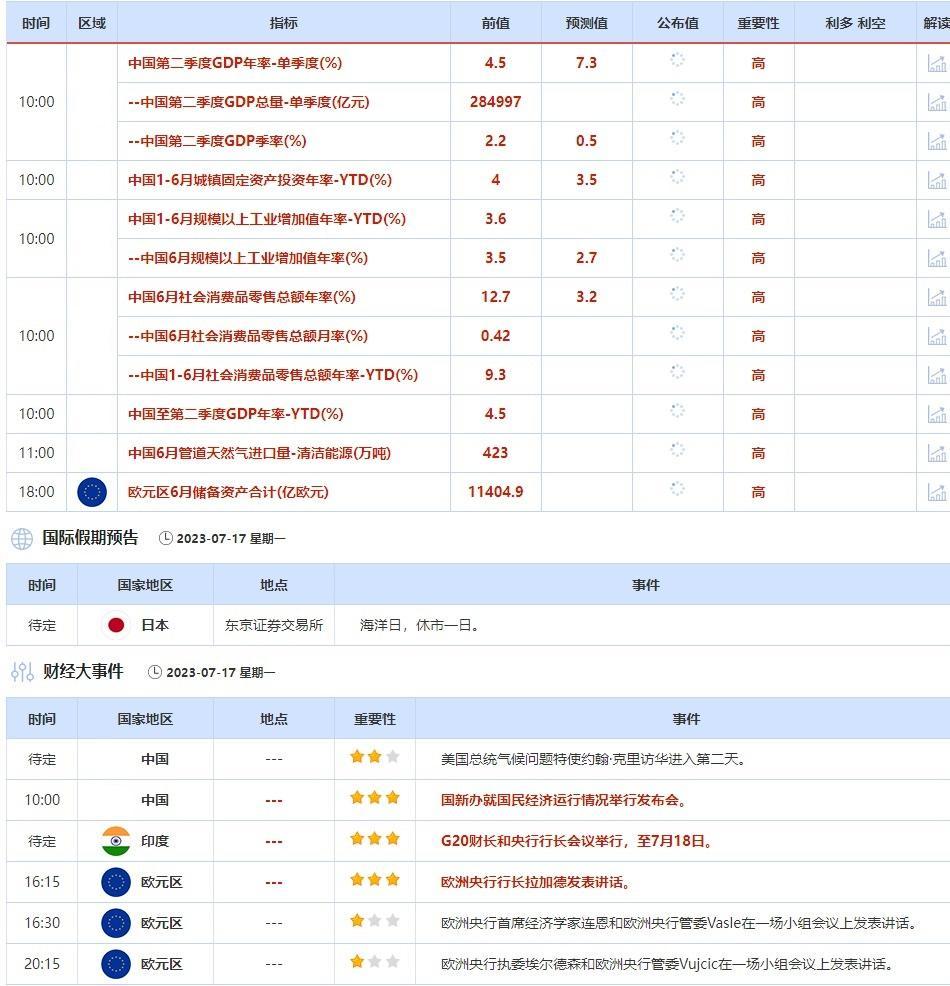
Key data and events on Monday
Institutional Perspectives Summary
1. Commerzbank: Last Wednesday's June inflation data may only be a precursor to further weakness in the dollar.
Antje Praefcke, FX analyst at Deutsche Bank, said the inflation data released last Wednesday may only be a precursor to further weakness in the dollar. If the next inflation data unexpectedly falls and economic data become increasingly clear that past rate hikes have had a depressing effect on the US economy, markets may become increasingly confident that key interest rates will not remain high for long, and the possibility of the Federal Reserve cutting rates before the end of the year is growing. This will lead to further weakness in the dollar;
2. Helaba Bank: The weakening of the US interest rate advantage over the euro area will boost the euro;
Analysts at Bank Helaba said expectations of further interest rate rises by the Federal Reserve were fading amid signs of weakening US inflation, narrowing the interest rate differential between the US and the eurozone and boosting the euro against the dollar. "The fading of US interest rate speculation and the weakening of the US interest rate advantage over the eurozone have supported the euro," they said. The euro earlier hit a 15-month high of $1.1248 against the dollar, according to FactSet data. The next hurdle for the pair is 1.1280, according to analysts at Deutsche Bank;
3. HSBC believes that the pound's rally has passed and remains cautious about its future trend.
Dominic Bunning, head of European FX research at HSBC, said his team did not intend to fight sterling's strength at this time, but were cautious that the main phase of sterling's rise might be over; HSBC believes that sterling's momentum may start to wane in the fourth quarter, leaving room for further strength in the summer; Bunning said: "We are by no means turning bearish on sterling. But in the absence of a significant improvement in the domestic situation, we would be cautious about a stronger rise in sterling;"
4. Allianz's chief economic adviser warns that the policy lag effect could lead to a recession in the US economy.
In an interview with reporters, Allianz chief economic advisor Mohamed Erian said that the inflation problem in the United States may continue for several months or even the whole year, but the tight labor market, the recovery of the dollar and the recovery of the economy will be the key factors for the recovery of the U.S. economy. The rate hike cycle has had a significant impact on commodities that are sensitive to changes in interest rates, which is what is driving the decline in inflation, coupled with the reversal of energy and food prices, especially for the United States. He believes that in the next 12 to 18 months, the lagged effect of Federal Reserve policy will continue to weigh on the economy, leading to a greater likelihood of recession. The economy itself is strong and robust, but if the policy is too tight, a recession may occur. Beware of the technical impact of the market, and a recession cannot be predicted solely by economic analysis. The lagging effect of Fed policy could lead to a downturn in the economy.
Please indicate the source: https://www.daoctech.com/fxnews/433.html
Disclaimer: The content of this article does not represent the views of the Institute of Foreign Exchange. The content is for reference only and does not constitute investment advice. Investors operate accordingly at their own risk.