
Retail investors are "happy to rush forward" again! Analysts warn: 2021-style disaster may be brewing
For many investors, the current situation is as if it never happened in 2022.
Technology stocks are rising like crazy and spreading to meme stocks, and bullish sentiment has reached fever pitch in the options market. In short, venture capital is the most popular investment since the end of 2021, and who would have thought that US stocks have only just left the longest bear market since the 1940s.
Speculative stocks skyrocketed
For now, the mania for meme stocks is "shining". MEME ETFs linked to the Solactive Roundhill MEME equity index are up 61% this year.
The ETF's most weighted holdings by weighting include bitcoin miner Riot Platforms (up 439% this year), artificial intelligence lending platform Upstart holdings (up 308%), Coinbase Global (up 196%), electric car maker Rivian Automotive (up 34%) and Carvana (up 740%). The frenzy has also pushed options trading related to these companies' shares to record highs.
In addition, despite the difficulties, Bitcoin also rose by 80% in 2023.
Retail investors are excited
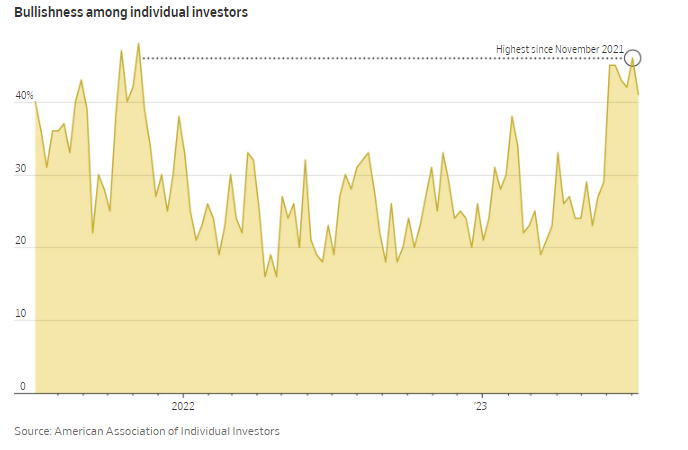
Retail investors are going all out. According to a survey by the American Association of Individual Investors,Bullish sentiment among retail investors, the expectation that the stock market will rise over the next six months, reached its highest level since 2021 this month。
The difference between the bull and the bear, that isThe spread between investors who think the stock market will rise and those who think the stock market will plunge has been positive for six consecutive weeksThe longest since November 2021。
Americans are also increasingly confident about the overall economy. According to a survey by the University of Michigan,Consumer confidence rose to 72.6 in July from 64.4 in June.This is the highest level since September 2021 and the largest increase since 2005
David Wagner, a portfolio manager at Aptus Capital Advisors, says investor concerns have lessened since the Federal Reserve bailed out the banking sector in March.
"The only thing that can stop this rally is the re-emergence of a major risk."
The fear fades.
In addition, compared to before,Investors are not snapping up options that protect portfolio returns when the stock market goes down, but choosing bets that can be profitable when the stock market continues to riseAccording to Cboe Global Markets,The put ratio, a measure of fear in the options market, has fallen to its lowest level since January 2022.
The Chicago Board Options Exchange Volatility Index (VIX) is currently around 13. The index is often referred to as Wall Street's fear gauge because it measures the price of options used to protect against market declines. Below 20 means there is little so-called "insurance demand" in the market.
In the eyes of many in the market, one reason for investor complacency is that the stock market is quietly moving higher and entering a bull market. According to an indicator from the Chicago Board Options Exchange,Since the end of 2021, the daily volatility of the S & P 500 has never been so small.
A "perfect storm" is brewing?
However, in the face of this situation, some investors have warned that,A perfect storm of collapse is brewing, and the current situation looks nothing like 2021.
At the end of 2021, retail investors were equally jubilant, and showed few signs of unease: put ratios were low, and so was the VIX. But by early January 2022, all three indices had peaked, and the S & P 500 was down 19 percent that year. Amanda Agati, chief investment officer at PNC Asset Management, said:
"FOMO [fear of missing out] has become so intense that retail investors have swarmed into the market in the last hurrah."
It is not just the booming markets that are worrying. Rising borrowing costs in the United States could slow the economy, impeding businesses' access to credit and making it harder for businesses and households to get loans. In the past year or so, interest rates on auto loans and mortgages have risen by about 3 percentage points. Credit card rates have risen from 16 percent to 22 percent, according to Federal Reserve data.
While inflation has eased, the latest data show US CPI growth slowed to 3 per cent year-on-year in June, but still above the Federal Reserve's 2 per cent target. Fed officials are likely to worry that Americans will get used to high inflation. Jason Bloom, head of fixed income and alternative ETF strategy at Invesco, said:
"If there is stagflation, interest rates will have to continue to rise, which is not a good situation for investors."
Please indicate the source: https://www.daoctech.com/fxnews/460.html
Disclaimer: The content of this article does not represent the views of the Institute of Foreign Exchange. The content is for reference only and does not constitute investment advice. Investors operate accordingly at their own risk.