
Nearly 90% of U.S. consumer debt is not affected by the base rate
While interest rates on some loans, such as credit cards, are rising as the Federal Reserve raises interest rates, interest rates on much of consumer debt remain at levels last seen a few years ago, allowing many households to keep spending and keeping the economy strong even as recession forecasts prevail.
According to data from Moody's Analytics,As of Quarter 1, interest rates on only 11% of outstanding household debt fluctuated with the base rate.
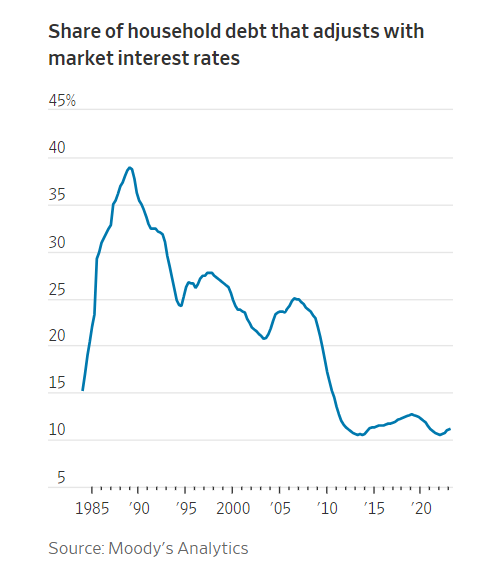
That's because Americans locked in ultra-low interest rates on debt like mortgages and auto loans for more than a decade after the 2008 financial crisis, when fixed-rate debt became more common and lenders abandoned products like adjustable-rate mortgages and home equity lines of credit that played a role in the recession. Households also owned a large number of auto and student loans, often at fixed rates, for more than a decade.
According to the Federal Reserve, households will have to put up 9.6 per cent of their disposable income to pay down debt in Quarter 1, higher than at the height of the epidemic but still below the post-crisis average.
The prevalence of fixed-rate debt could undermine the effectiveness of the Federal Reserve's interest rate hikes.The current U.S. economic growth and consumer spending remain largely solid. A popular indicator suggests that,The Federal Reserve's actions have had less impact on financial conditions than they did earlier this year.
Mark Zandi, chief economist at Moody's Analytics, said "this is one of the reasons why consumer spending continues to be strong and the Fed rate hikes have less impact on the economy".
Black Knight estimates that Americans who refinance their mortgages at higher rates have saved $42 billion a month since March 2020.
Some of those locked in low rates do feel trapped. Upgrading a home or car is now prohibitively expensive, and the national housing market has been paralyzed by homeowners' reluctance to move because they don't want to give up cheap mortgages.
Alex Durbin, 36, a private wealth manager, said his three-bedroom home in the Columbus, Ohio area could no longer accommodate his family of five. They bought a plot of land for their new home, but with mortgage rates around 7 percent, they couldn't afford the house they wanted. "We're in a strange state of uncertainty," he said.
Mr. Durbin said they also wanted to use a car with more space, but for the time being planned to stick with a paid-up Honda Odyssey minivan with a 135,000-mile range. "I don't even want to think about what the financing costs are," he said.
Still, cheap fixed-rate debt has generally put borrowers in better financial shape. Many have bought homes that have appreciated in value. Some have also taken advantage of rising interest rates on savings accounts and Treasuries, making them winners in the Fed's anti-inflation campaign.
Durbin refinanced their mortgage at 2.75% at the height of the epidemic. They accumulated savings by cutting back on spending, and then paid off car and student loans.
This means that when the Federal Reserve began to raise interest rates sharply last year to curb inflation, theHousehold balance sheets have not been hitThe Federal Reserve on Thursday raised interest rates to a 22-year high for the 11th time since March 2022. Even though the price of most things is up now, there is still room in Durbin's family budget to dine out with three young children and enjoy vacations several times a year.
"It gives us a lot of breathing room," Mr. Durbin said of his mortgage rates.
Please indicate the source: https://www.daoctech.com/fxnews/497.html
Disclaimer: The content of this article does not represent the views of the Institute of Foreign Exchange. The content is for reference only and does not constitute investment advice. Investors operate accordingly at their own risk.