
FX: Who will have the last laugh on both sides of the oil market?
As global markets continue to tighten,The upward trend in oil prices since the second half of the year appears to be recovering。
Brent crude oilFutures are trading near $87 a barrel after six weeks of gains, and since the start of the year traders have been betting on a rebound in the second half of 2023 at a time when US inventories have been falling sharply.
Oil prices fell earlier this week on the back of a weaker-than-expected recovery in Asia, but the setback did not last long.
Oil prices rose again yesterday as fears of a tightening in global markets continued,WTI crude oilAt one point, the 2023 high of $84 was tested. Europenatural gasPrices have also pushed up oil and coal prices, and a weaker dollar has also helped.
The supply side is tightening as OPEC + leader Saudi Arabia follows through on its pledge to cut output by 1 million barrels a day this month and next. The kingdom has given bullish traders renewed hope by suggesting it could even cut production further if the market needs it.
Even Russia, which has largely ignored OPEC + commitments for months, has belatedly come to the rescue. Forecasts from the International Energy Agency (IEA) show that,Oil inventories are expected to decrease sharply for the remainder of the year。
Naeem Aslam, chief investment officer at Zaye Capital Markets, said in a report:
"There's certainly enough upside momentum here that traders have really ignored all the bad news in Asia, even though many analysts are trying to highlight it as much as possible. In terms of oil prices, oil traders are very happy with their approach and the trend in the oil market appears to be skewed to the upside."
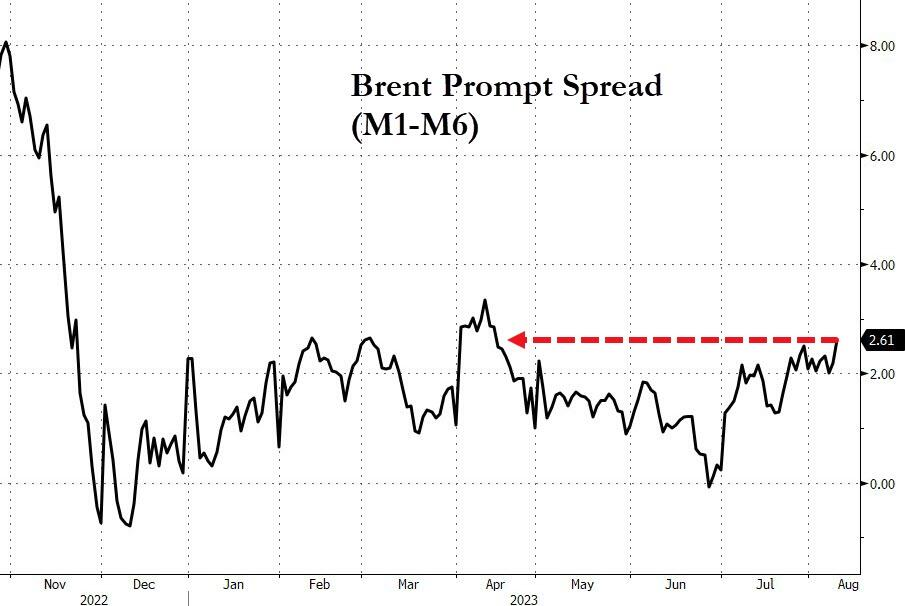
In addition, the time spread also indicates that,The rise in oil prices has a solid foundationThe premium for Brent's front-month contract over the six-month contract has surged to $2.50 a barrel from just over $1 at the start of the month. This apparent premium is known asSpot premiums usually mean that demand exceeds supply.
However, there are still many obstacles in the way of oil's rise:There are lingering concerns about a recession in the United States and a sluggish recovery in Asia, as well as the prospect of renewed supply from Iran, Venezuela or Iraq.
For example, the U.S. non-manufacturing Purchasing Managers Index (PMI) fell from 53.9 to 52.7 in June. Meanwhile, the manufacturing PMI continued a nine-month downward trajectory not seen since the 2008 financial crisis. The Conference Board's Leading Economy Index (LEI) also recently slipped from 106.9 in May to 106.1 in June, an unprecedented 15-month decline and marking the longest consecutive decline since 2009.
In addition, economic activity in the euro area is also facing a decline. The slower-than-expected recovery in Asia has been disappointing investors and analysts.
In light of these compelling indicators, analysts believe that...The production cuts should not be interpreted as a sign of a supply shortage. Instead, they underscore the concerns leading to an imminent decline in demand。
In addition, some formerly bullish oil analysts have also sharply downgraded their optimistic forecasts for 2023, but many, from Standard Chartered to UBS to Macquarie, still believe that oil prices will hit $90 a barrel or more by the end of the year.
FXTForeign exchange investment reminds that the next test for both long and short sides in the oil market is coming:Brent crude oil is approaching $87.49This is the highest point in the past six months, and it was close to that level but did not break through.If Brent crude can break through that threshold, it could pave the way for testing the peak set in January 2023 at just over $89 a barrel.
Please indicate the source: https://www.daoctech.com/fxnews/569.html
Disclaimer: The content of this article does not represent the views of the Institute of Foreign Exchange. The content is for reference only and does not constitute investment advice. Investors operate accordingly at their own risk.