
FX reports that US stocks lost more than $170 billion in the first 7 months
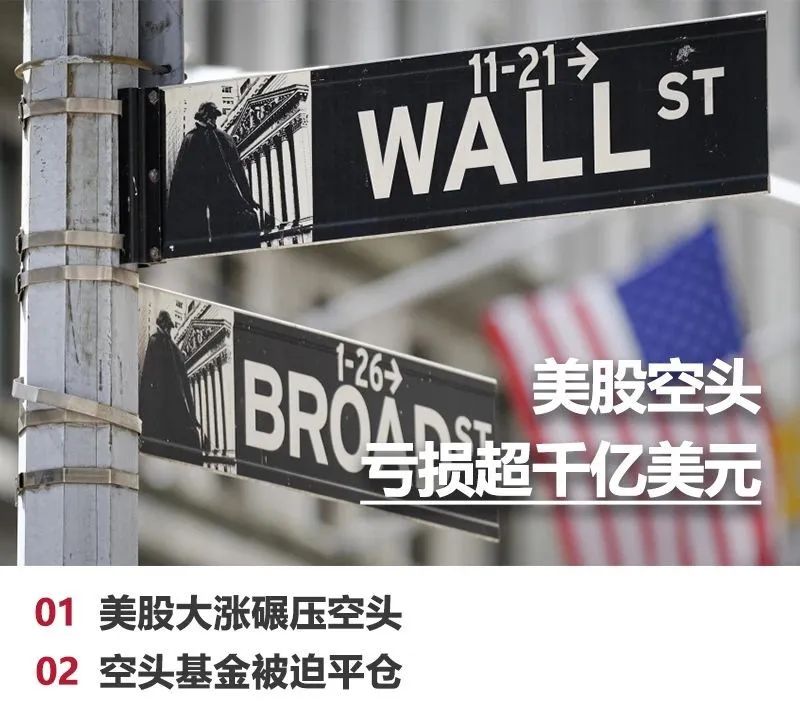
The unexpected rise in the US stock market in 2023 has left hedge funds shorting the stock market with big losses. Faced with the continued rise in the stock market and widening losses, these funds have been forced to position squaring their short positions. Over the past two months, short funds have been position squaring at a rate not seen in nearly a decade.
"US stocks rose sharply, with short losses exceeding $170 billion in the first seven months of 2023."
US stocks continued their rally this summer, helped by a recent slowdown in US inflation and strong economic data that boosted investor optimism. The S & P 500 rose about 3 per cent in July, taking the overall gain in the first seven months of the year to 20 per cent. The Nasdaq rose 4 per cent in July and is up 38 per cent in the first seven months of the year.
The strong rally in the stock market has helped equity hedge funds as a whole achieve better returns. The HFRI 500 Equity Hedge (Total) Index, an equity hedge fund index, rose 2.7 per cent in July, according to HFR, the hedge fund research group. The gains were driven largely by the technology and value sub-strategies - the HFRI 500 EH Technology Index and the HFRI 500 EH Fundamental Value Index rose 4.5 per cent and 3.2 per cent respectively. In the first seven months of the year, the HFRI Equity Hedge Index led other strategies with a 7.8 per cent gain.
According to S3 Partners, North American (US and Canadian) hedge funds racked up a $53.50 billion mark-to-market loss on their short trades in July, bringing their total losses in the first seven months of the year to $175.2 billion. Short trades in all 11 major sectors of the S & P 500 recorded losses in July, while only short trades in the utilities sector did not lose money in the January-July period.
The main source of losses for short funds is technology stocks. According to data from S3 Partners, the 20 stocks with the largest short losses in January-July this year were dominated by technology stocks. The top five stocks were Tesla, Nvidia, Apple, Meta and Microsoft. The five stocks with the largest short losses in July were Nvidia, Alibaba, electric car company Rivian, digital asset exchange Coinbase and Meta.
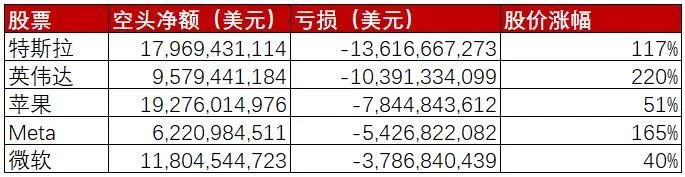
The five stocks with the largest short losses in January-July 2023, sources: S3 Partners; Yahoo Finance
"Wall Street makes optimistic forecasts, short funds are forced to position squaring"
Short funds have been cautious about the rally, given that most of this year's rally in the U.S. stock market has been contributed by seven large technology stocks. According to data from S3 Partners, short positions on the S & P 500 reached $487 billion as of June this year, and large technology stocks are the most popular targets for bears.
However, as stock prices continued to rise, many funds were forced to position squaring in order to stop losses in time, and short covering further contributed to the rise in stock prices. According to Goldman Sachs data, the rally in US stocks forced hedge funds to accelerate the reduction of short positions. The accumulated amount of short covering in June and July hit a record for two months since 2016.
Carl Icahn, a longtime Wall Street veteran and founder of Icahn Enterprises, said in early August that his overly pessimistic view of U.S. stocks had caused him huge investment losses and would gradually exit his short bets on U.S. stocks in the future. According to the Financial Times, Icahn lost $7 billion shorting U.S. stocks from 2018 to the first quarter of 2023.
Several major investment banks have also recently released more optimistic market forecasts. JPMorgan Chase does not expect a recession in 2023, Goldman Sachs has previously downgraded the probability of a US recession, and Mike Wilson, chief US equity strategist at Morgan Stanley, one of Wall Street's most bearish analysts, has also recently adjusted his view on the outlook for US stocks. He believes that this year's US stock market trend is more similar to that of 2019, which means that the S & P 500 index may still have further room to rise.
FXTFX Investments pointed out that while the losses of equity hedge funds were mainly concentrated in short portfolios, long portfolios showed signs of serious deterioration in July, with alpha-coefficient returns falling by about 1%. Short funds are likely to accelerate their shorting again in August.
reference
1. Wall Street Journal, Surprise Stock-Market Rally Bulldozes Bearish Hedge Funds
2. Wall Street Journal, Bearish Bets Against S&P 500 Are Surging, Despite Love for Big Tech
3. Reuters, Equity hedge funds get crushed by bearish bets in July
4. Hedgeweek, Technology and financials lead July hedge fund gains
5. S3 Partners, July U.S.\Canada Short Side P\L
6. Financial Times, Carl Icahn admits mistake with bearish bet that cost $9bn
Please indicate the source: https://www.daoctech.com/fxnews/651.html
Disclaimer: The content of this article does not represent the views of the Institute of Foreign Exchange. The content is for reference only and does not constitute investment advice. Investors operate accordingly at their own risk.