
Saudi oil prices have reached $100/barrel! Could the inflation outlook get worse?
Javier Blas, co-author of The Trading World: Money, Power, and Commodity Traders, wrote that,For Saudi Arabia, oil prices have reached $100 per barrel.Here's his take:
In the world of oil, there is no such thing as a price. Because there are dozens of different measures, each crude oil has a price. Financial marekt focuses on two types of crude oil: Brent and WTI, which are traded in London and New York respectively. Its quotation is currently hovering around $90 a barrel.But from the Saudi perspective, oil prices have reached $100 per barrel.
This differenceReflecting the pricing power Saudi Arabia has gained over the past year and a halfThat has allowed the country to charge record premiums for its oil, especially as it faces U.S. and European customers seeking alternatives to Russian crude.
The surcharge is important because Saudi Arabia plays a central role in the market, accounting for about a tenth of global production.Saudi Arabia's pricing strategy is exacerbating global inflationary pressures, potentially forcing central banks to maintain interest rates at higher levels for longerAt the same time, Saudi Arabia's geopolitical hand has also become stronger
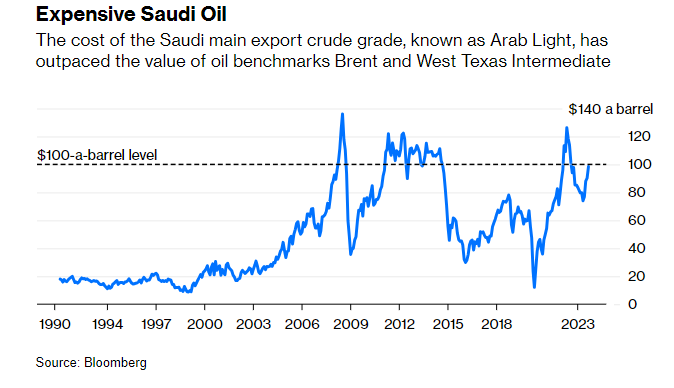
according toIndustrial foreign exchangeStatistics, Wednesday.The price of Saudi Arabia's flagship Arabian Light crude rose to nearly $98.47 a barrel in Europe.Over the past 40 years, Arab Light crude has traded above $100 only a few times, including in 2008, between 2012 and 2014, and in 2022.
The mechanics of global markets explain why Arab Light is trading at such a premium to closely watched benchmarks Brent and WTI. Oil prices have been set by the market since the collapse of the fixed oil price regime administered by Opec in the mid-1980s, and Opec's influence lies in adjusting output.
Since 1988,Saudi Arabia has been selling crude oil according to a formula that combines benchmark prices such as Brent crude with relatively small discounts or premiumsBenchmarks and spreads vary depending on whether the Americas, Europe or Asia are being sold to
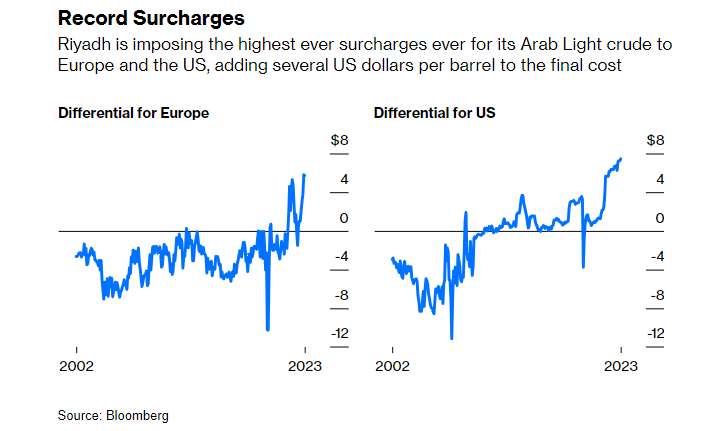
For most of the past 35 years, these spreads have been measured in cents rather than dollars. And, with the exception of Asia, they are mostly negative, meaning Saudi Arabia sells its crude at a lower price than European and American benchmarks. Asia tends to pay a relatively small premium. Between 2000 and 2020, Saudi Arabia sold crude to European buyers at an average price of about $3 a barrel less than Brent.
However,The premium it charges has been rising recentlyIn September, Saudi Arabia set the price of Arabian light crude at a record high, $5.80 a barrel higher than Brent.For U.S. consumers, the premium also reached a record high of nearly $7.25 per barrel.The premium in Asia is currently small, having surged to a record level of nearly $10 a barrel in the past year.
Saudi Arabia has regained pricing power for two reasons, one entirely intentional and the other accidental.
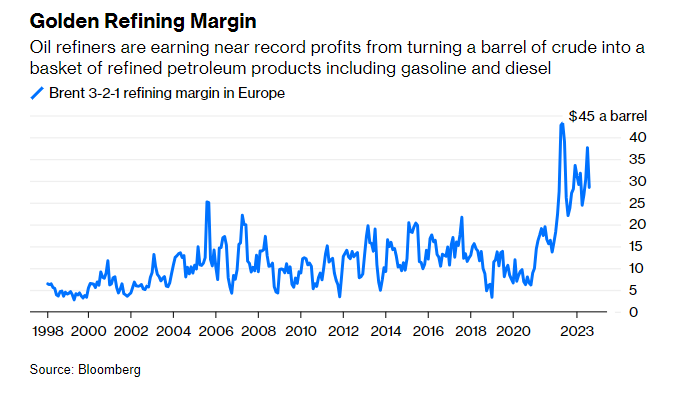
The first reason, and perhaps the most important, is that...Saudi Arabia is taking away some of the cake enjoyed by refinersGlobally, refining margins have soared to record levels due to soaring demand and a lack of refining capacity
Each month, Saudi Arabia calculates the value of what a typical refinery can produce by processing Saudi crude oil, known in industry jargon as gross output (GPW). The higher the GPW, the higher the seller can charge the refinery without the buyer complaining. Since mid-2022, the GPW of a barrel of Saudi crude has skyrocketed. As a result, Saudi Arabia is ensuring that refiners share some of the extra profits with it.
The second reason.The global oil market is particularly short of the kind of crude produced by Saudi Arabia.This is largely the result of the sharp production cuts Saudi Arabia has imposed this year. But it also reflects the fact that US shale, the biggest source of additional oil supply, is very different from Saudi crude. For many refineries with ultra-modern facilities capable of cracking the hardest-to-break hydrocarbon molecules, Saudi crude is their main feedstock, allowing them to run their plants better because they can produce more diesel. And relatively more petrochemicals are produced from US shale oil.
And here's the thing.Oil prices are not only high, but also rising, much higher than Brent and WTI would suggest.Just as during the first oil crisis in 1973-1974, Saudi crude grades were the main benchmark for the market.Central banks need to judge the inflation outlook by looking at the cost of Arab light crude oil. As things stand, the picture is not rosy and it is getting worse.
Please indicate the source: https://www.daoctech.com/fxnews/766.html
Disclaimer: The content of this article does not represent the views of the Institute of Foreign Exchange. The content is for reference only and does not constitute investment advice. Investors operate accordingly at their own risk.