
Beware of changes! The 10-year Treasury yield has reached a dangerous level
A bad week on Wall Street turned dismal on Thursday after a sustained surge in U.S. Treasury yields dented demand for risky assets. Finally,The U.S. stock market suffered its largest decline in six monthsInvestors are readjusting to a world where interest rates are at levels not seen in a generation.
The S & P 500 tumbled 1.6% and the Nasdaq 100 fell nearly 2%. Both indexes were on track for their worst quarters in a year. The 10-year Treasury yield rose to 4.5%, up more than 30 basis points in just three weeks.Leading the decline in the stock market are technology companiesAs investors turn to other asset classes for returns, the high valuations of such companies have become difficult to justify.
For months, US stocks have been able to withstand higher interest rates as investors put cash into big tech companies. But the Fed's signal that policy rates will remain high for much of next year triggered the latest move in Treasuries, forcing Wall Street in general - and fund managers in particular, who began chasing the big tech rally earlier in the quarter - to reconsider their case.
Adam Phillips, managing director of portfolio strategy at EP Wealth Advisors, which has moved away from so-called growth stocks in favour of value stocks, said: "After the tech rally this year, it's not a good time to step on the gas pedal and increase risk exposure given the high valuations." "Why expose clients to the additional risk of the stock market if you can make gains in other areas?"
Bank of America, citing data from EPFR Global,Investors pumped $26.40 billion into U.S. stocks in the week ending Sept. 13, the most since March 2022, with about $1.30 billion flowing into the tech sector.The Nasdaq 100, which had its best performance on record in the first half of the year, has fallen more than 5% this month.
With crude oil headed toward $100 a barrel and the dollar strengthening against major peers, equity bulls have more to contend with than rising interest rates. Still, they point to October, when a similar surge in yields sent the S & P 500 to bear market lows. The index then rallied in the first seven months of the year and remains 23 per cent above its 2022 lows.
The bulls' argument is that the initial rise in yields during the Fed's tightening cycle is always short-lived. Every time the 10-year Treasury yield has climbed above 4 per cent over the past year, it has briefly fallen back below 3.5 per cent.
The bears argue that this time is different. Fed officials are currently divided on whether to raise interest rates again this year, and agree that any rate cut will not come until 2024. That puts pressure on longer-dated Treasury bonds at a level not seen in 16 years. Higher yields could increase borrowing costs, slowing investment broadly, while also increasing the attractiveness of bonds as safe alternatives, threatening the recent stock market rally.
Yung-Yu Ma, chief investment officer at BMO Wealth Management, said that if the 10-year Treasury yield climbs to 4.5% or higher and stays there, traders will face the challenge of forcing overvalued stocks to readjust. Tech companies are particularly vulnerable to concerns about rising interest rates and yields, as many are valued based on projected profits in the coming years.
"It's enough to make investors cringe and make them worry that yields are changing significantly, with wide-ranging shocks to equities and other asset classes," Ma said. "If yields stay below this level [4.5 per cent], investors will still feel they are getting a reasonable return on fixed income, but not enough to start putting extra pressure on the desire to hold equities or take risks."
In addition, according toIndustrial foreign exchangeThe data.Speculators are again taking a large net short position in the 10-year TreasuryTodd Sohn, managing director of ETF and technology strategy at Strategas Securities LLC, said that means investors are shorting the bond market in anticipation of higher yields, although such extreme behavior could ultimately lead to lower yields due to tight positions
"There are concerns that yields could go up again, which would have a negative impact on the stock market," Sohn said. "But if it turns out to be just an illusion and yields go down again, that will ultimately support the stock market."
Friday morning in Asia-Pacific, 10-year US bond yields once again stood on the 4.5% mark, since the Federal Reserve announced in September interest rate decision two days up 24 basis points.
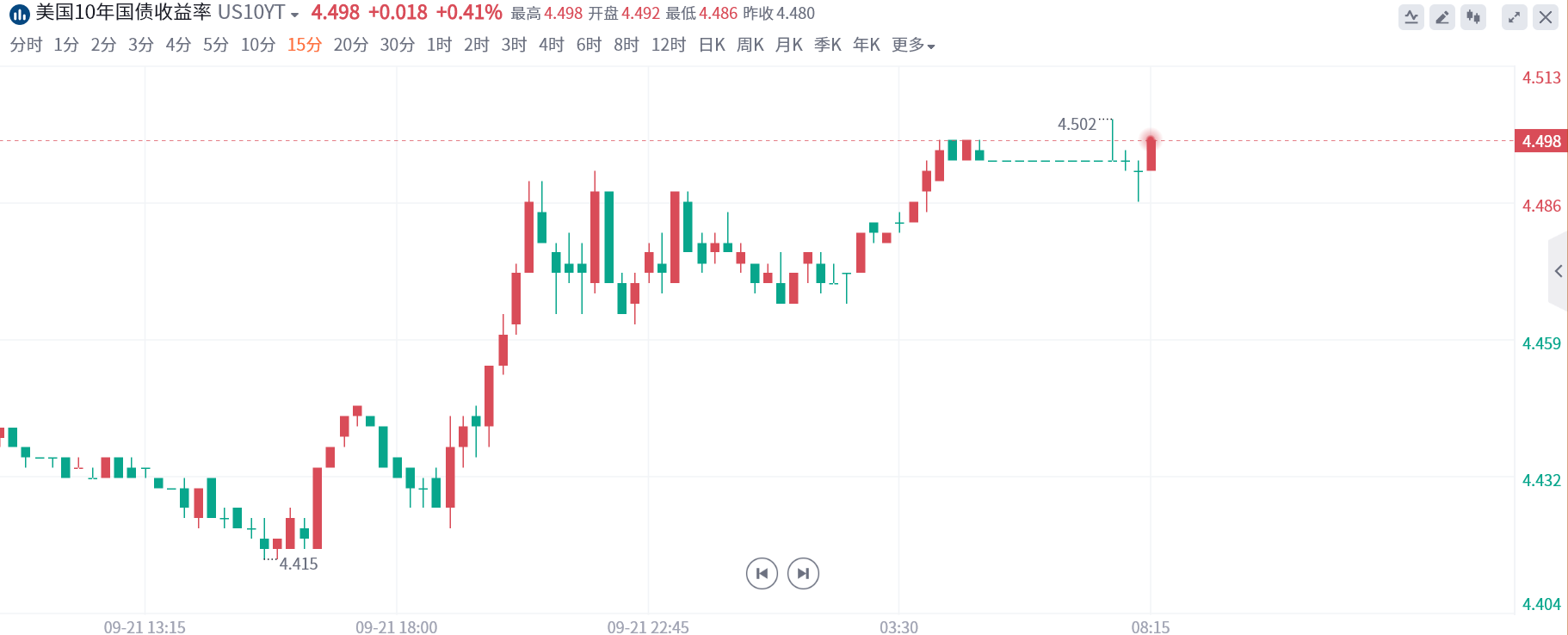
In a real-time market survey conducted after the Federal Reserve's decision was announced on Thursday,Nearly 60% (58%) of the 172 respondents said two-year Treasury yields had not yet peaked, while the majority expected 10-year yields to climb above 4.5%.More than half of the respondents to the survey (57%) said that the Federal Reserve will continue to raise interest rates despite its recent pause.Diane Swonk, chief economist at KPMG, said all the recent data had given the Fed the courage to keep interest rates higher for a longer period of time. "This is completely different from the world in 2019 and before."
Please indicate the source: https://www.daoctech.com/fxnews/814.html
Disclaimer: The content of this article does not represent the views of the Institute of Foreign Exchange. The content is for reference only and does not constitute investment advice. Investors operate accordingly at their own risk.