
Soaring US Treasury yields are a "double-edged sword"! Could the Federal Reserve benefit from it?
The recent surge in long-term interest rates to their highest level in 16 years has added to the mounting headwinds that threaten to derail the US economy from a soft landing.
Rising borrowing costs are putting the newly revived U.S. housing market at risk and increasing barriers for businesses seeking financingThat has also hit US equities, trimming some of the wealth gains investors have enjoyed so far this year.
The rise in interest rates - the yield on the 10-year Treasury note has risen more than a percentage point since mid-May - is one of a series of shocks to hit the American economy, which has been surprisingly resilient. Auto workers are on strike, the government is on the brink of a shutdown, student loan payments are resuming after the pandemic was suspended, and oil prices are rising.
"It's creating a headwind," said Diane Swonk, chief economist at KPMG. "Soft landings are under threat”。

While Swank expects the U.S. to avoid a recessionary hard landing, she sees a significant slowdown in annualized GDP growth in the fourth quarter, from around 4% in the current quarter to 1%, a forecast with downside risks.
For Fed policymakers, however, rising yields may not be such an issue, and may even prove beneficial, because the bond market's movements have not been accompanied by a rise in inflation expectations, which could lead to a sharp rise in prices.
This shows that,The move could cool an economy that Federal Reserve officials fear is overheatingThe latest rise in yields came after the Federal Reserve sent a more hawkish message than many investors had expected last week while keeping interest rates on hold.
Lou Crandall, chief economist at Wrightson ICAP LLC, said, "If bond yields rise, the need for the Federal Reserve to tighten monetary policy further decreases”。
The risk of economic contraction is growing
But not everyone is so optimistic.
Rising long-term interest rates will hurt demand for homes and cars, says Julia Coronado, founder of MacroPolicy Perspectives LLC. Moreover, it will cause the low-interest loans and bonds held by small and regional banks to depreciate further, squeezing their profits.
"It's a downside risk," said Coronado, a former Fed economist. "This will be a headwind that the economy will struggle to absorb”。
"We see that due to the lagging effects of monetary policy, coupled with the UAW strike and the upcoming government shutdown,The risk of economic contraction is growing", according to economist Anna Wong and her colleagues.
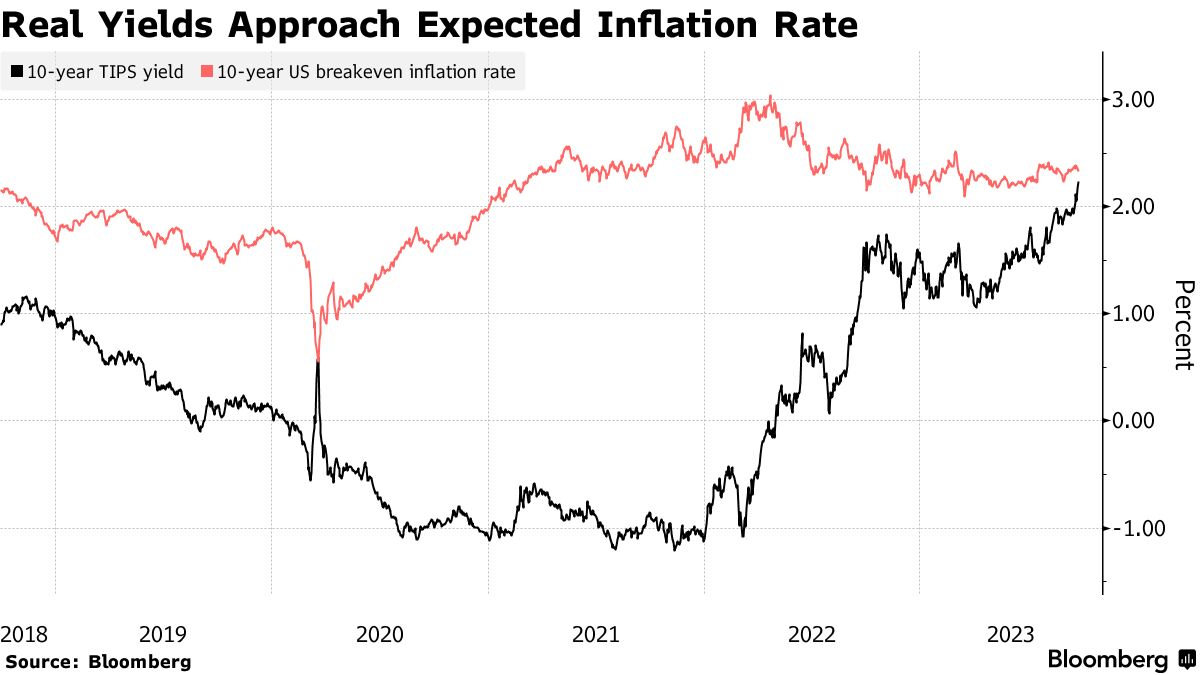
In the US on Tuesday, the yield on the 10-year Treasury hit 4.56 per cent, its highest level since October 2007. More relevant to the economy may be the yield on US inflation-protected bonds, which are now approaching the inflation rate.
When the actual yield in the bond market is higher than the expected inflation rate, it indicates that higher borrowing costs will have a greater impact。
Former Federal Reserve Governor Kevin Warsh said in a webinar last week that the rise in long-term Treasury yields is in part due to growing concerns about the large future budget deficits in the United States and fewer big buyers of Treasuries.
For its part, the Fed is steadily reducing its holdings of US Treasuries.All of this could push up the so-called term premium on long-term government bonds, signalling higher funding costs in the coming years.
The rise in interest rates has already had some impact.As higher mortgage rates continue to drive many potential buyers out of the market, U.S. homebuilder confidence has fallen to a five-month low this monthData from the Mortgage Bankers Association shows that the number of mortgage applications for home purchases is hovering near the lowest level in decades.
The US economy cannot withstand any more pressure
Consumer confidence has declined for the second consecutive month, with the world's largest companies andIndustrial foreign exchangeIn the federation's survey, some respondents expressed concerns about rate hikes.
Mark Zandi, chief economist at Moody's, said:Given all the headwinds facing the economy, it can't afford much more without risking a recession。
He said, "I think the U.S. economy can absorb 4.5% 10-year Treasury yields, butA yield of more than 5% for several months would be unbearable”。
Please indicate the source: https://www.daoctech.com/fxnews/854.html
Disclaimer: The content of this article does not represent the views of the Institute of Foreign Exchange. The content is for reference only and does not constitute investment advice. Investors operate accordingly at their own risk.