
Three consecutive yin forms build the top? Be wary of the increasing risk of the Australian dollar pullback
On Monday (July 28), the Australian dollar fell for a third consecutive day against the US dollar, and the market turned cautious in the short term. However, after the United States and the European Union reached a new trade agreement, the Australian dollar rebounded briefly.
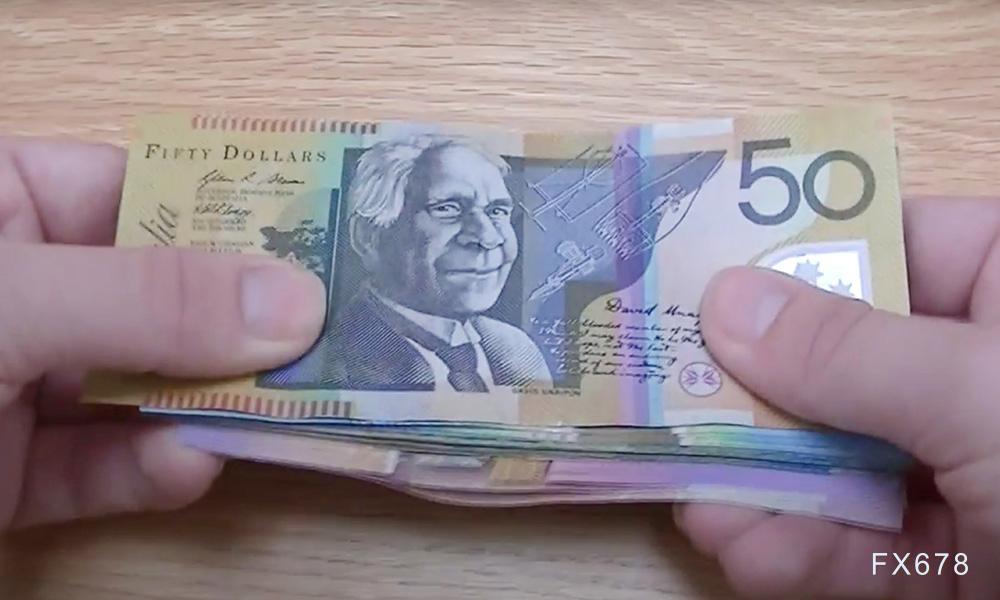
This week, the market will focus on Australia's second-quarter CPI data (to be released on Wednesday), which will become an important basis for judgment at the next interest rate meeting of the Reserve Bank of Australia (RBA). Previously, RBA Chairperson Michele Bullock reiterated his firm policy stance to curb inflation, emphasizing that the current global economy is still full of uncertainty. The market generally expects that if the inflation data shows strong, the RBA may further delay the pace of interest rate cuts.
San Francisco Fed President Mary Daly called expectations for two rate cuts this year "reasonable," but Governor Christopher Waller argued for a rate cut at the July meeting. Meanwhile, the labor market remained strong, and initial jobless claims fell for a sixth week in a row. The latest data showed 217,000, indicating economic resilience.
The preliminary Markit composite PMI in the United States rose to 54.6 in July, a seven-month high. The service sector PMI performed particularly well, reaching 55.2, higher than market expectations. However, the manufacturing PMI fell below the line of prosperity and decline to 49.5, reflecting that there are still hidden concerns in the manufacturing side. This pattern of "strong services and weak manufacturing" may put some pressure on the US dollar index, thus providing an opportunity for the Australian dollar to rebound.
Technical aspects:
From the current daily chart of the Australian dollar against the US dollar, the exchange rate has adjusted significantly after touching the stage high of 0.6624, forming a negative line arrangement for three consecutive days, and the momentum of the short-term pullback has increased. Bollinger Bands indicators show that the exchange rate has been blocked from falling on the upper track (0.6614), and is currently stepping back near the middle track (0.6540); the analysis believes that the lower support level is concerned with the 0.6466 line.
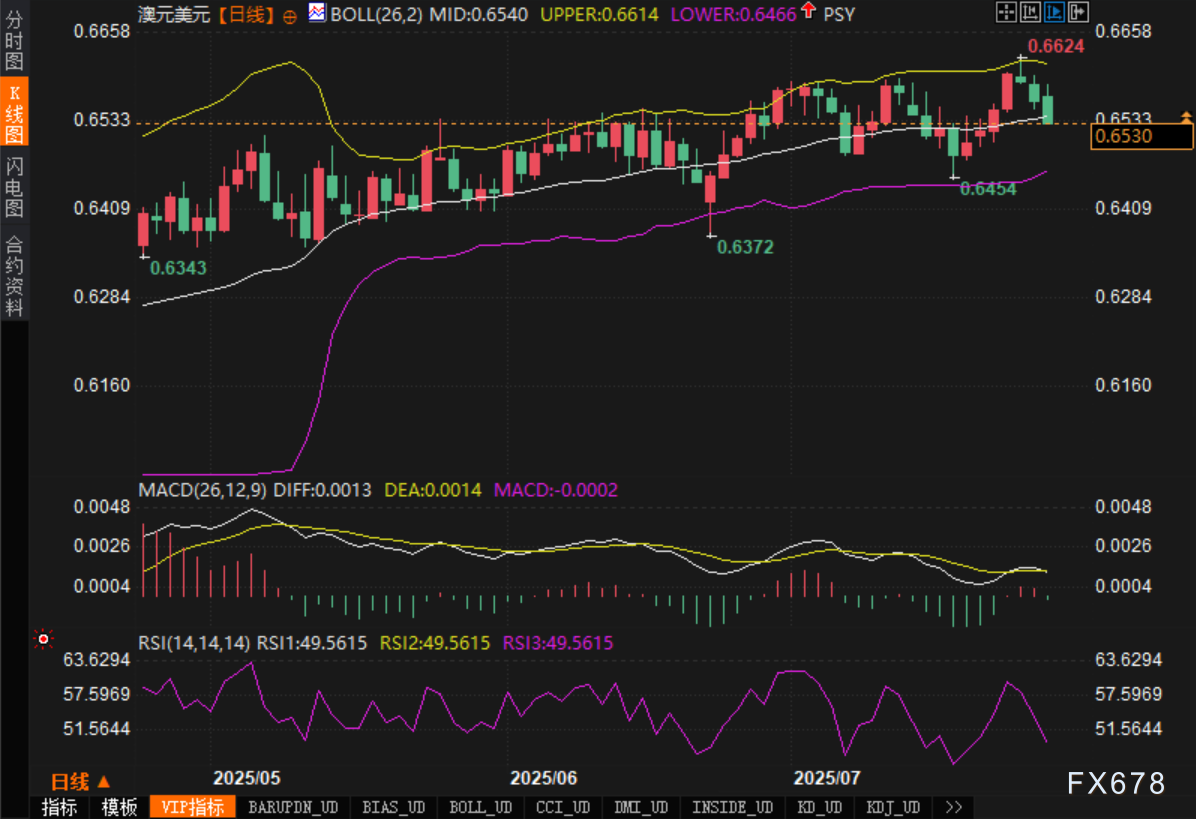
In terms of MACD indicators, the fast and slow lines (DIFF, DEA) are bonded and run horizontally, the red column is shortened, the MACD column value is slightly negative (-0.0002), and the short-term kinetic energy is weakened.
The RSI indicator is currently trading at 49.5615, close to the neutral zone, indicating that the exchange rate has not yet formed an overbought or oversold signal; if the RSI falls below 45 in the short term, it is necessary to be vigilant against further downside risks.
Overall, judging from a technical perspective, the analysis believes that the Australian dollar is currently in the correction stage of the upward trend. If it cannot hold the 0.6540 line in the future, it may further test the support of the 0.6454-0.6466 range below; conversely, if the exchange rate re-stands at 0.6600, the trend is expected to continue.
Market sentiment observation:
The current market sentiment is a typical "long-short game" pattern. On the one hand, the US and the European Union reached a trade agreement to warm up risk appetite; but on the other hand, the market's concerns about Australia's CPI data are still heating up, leading to increased financial divergence.
From the perspective of risk aversion, the US service sector performed strongly and employment data were solid, but the manufacturing sector weakened and the overall economy returned to "moderate and unstable". This left the market divided on the Fed's policy path, with short-term volatility amplified, and traders generally tended to wait for key data to provide further guidance.
In Australia, the RBA continues to convey a dovish tone, but whether to really cut interest rates still depends on the process of falling inflation. If the CPI remains high, or the easing schedule is delayed, the market will reprice the RBA policy path. Therefore, although the short-term market sentiment is slightly cautious, it has not completely turned short, and it is still in the "wait and see - game" stage.
Outlook for the future market:
The short-term outlook:
In the short term, the exchange rate is facing technical pullback pressure, especially after being blocked near the 0.6624 high point, the demand for stepping back is strengthened. The analysis believes that if the exchange rate cannot hold the 0.6540 line, it will further test the Bollinger lower rail support;
However, if there is an unexpected rise in the Australian CPI data, the exchange rate may usher in a technical rebound and re-challenge the 0.6600 mark; the short-term trend may maintain a high volatility structure, with a reference range between 6466-0.6624.
Medium- and long-term outlook:
From a trend perspective, the medium and long-term direction of the Australian dollar still needs to observe the trend of the US dollar index and the direction of the global economy. The analysis believes that if the follow-up US economy continues to slow down and the Federal Reserve clearly releases the path of interest rate cuts, the expected medium-term weakness of the US dollar will boost the Australian dollar. On the contrary, if the US dollar maintains a strong cycle, the upside of the Australian dollar will be limited;
In Australia, if inflation continues to ease and the RBA starts an easing cycle, the Australian dollar may face a medium-term adjustment risk; but if inflation persists and forces the RBA to maintain high interest rates, it will provide long-term support for the Australian dollar.
Please indicate the source: https://www.daoctech.com/fxoutrade/1666.html
Disclaimer: The content of this article does not represent the views of the Institute of Foreign Exchange. The content is for reference only and does not constitute investment advice. Investors operate accordingly at their own risk.