
Dollar Outlook: Ahead of the release of key CPI data, the bearish momentum of the dollar index has strengthened
On Monday (September 8), the dollar index (DXY) edged down 0.12% intraday to close at 97.6, continuing a sharp sell-off triggered by weak employment data last Friday. After the dollar index closed below its 50-day moving average late last week, the dollar continued to come under pressure as expectations of a sharp easing by the Federal Reserve later this month increased.
Last Friday's low of 97.430 is currently an immediate support level. If it falls below this level, the downside momentum could accelerate further towards the July 24 low of 97.109. On the upside, traders are focusing on the key resistance level - the pivot at 97.859, followed by the 50-day moving average at 98.100, and another pivot at 98.317.
After the weak non-farm payrolls data, the Federal Reserve became the focus of the market
The August non-farm payrolls report showed a marked slowdown in job growth, with the unemployment rate rising to 4.3 per cent - the highest level in almost four years - prompting markets to quickly adjust their expectations for interest rates. Fed funds futures now show the probability of a 50 basis point cut this month has risen to 10 per cent from 0 per cent last week, according to the CME Fed Watch tool.
Lee Hardman, FX strategist at MUFG, noted that while the dollar index fell below the key level of 98.000, the market reaction was less dramatic than the short-term yield movement would suggest. He added that the weak non-farm payrolls report strengthened market expectations for the Federal Reserve to resume rate cuts, and the first rate cut could be even larger.
Political pressure on the Fed is also intensifying. US Treasury Secretary Scott Bessent has called for greater scrutiny of the Fed's interest-rate-setting authority, while President Trump is still considering replacing Jerome Powell as Fed chair.
Traders focus on inflation data, U.S. Treasury yields fall
The Dow rose across the board on Monday, while US Treasury yields fell across the board. The 10-year yield fell to 4.053%, its lowest level since April; the 2-year yield slipped to 3.484%; and the 30-year yield fell more than 4 basis points to 4.716%. The decline reflected both weak jobs data and heightened investor expectations for this week's inflation data.
The August Core Consumer Price Index (Core CPI), due to be released on Thursday, is expected to rise 0.3% month-on-month. Analysts at Deutsche Bank pointed out that the data could have a significant impact on Federal Reserve policy expectations, especially in the context of the current period of media silence at the Federal Reserve. In addition, the producer price index (PPI) released on Wednesday and the revised benchmark employment data released on Tuesday are also on the radar of traders.
Market Outlook: The US Dollar Could Face Further Downside Risks
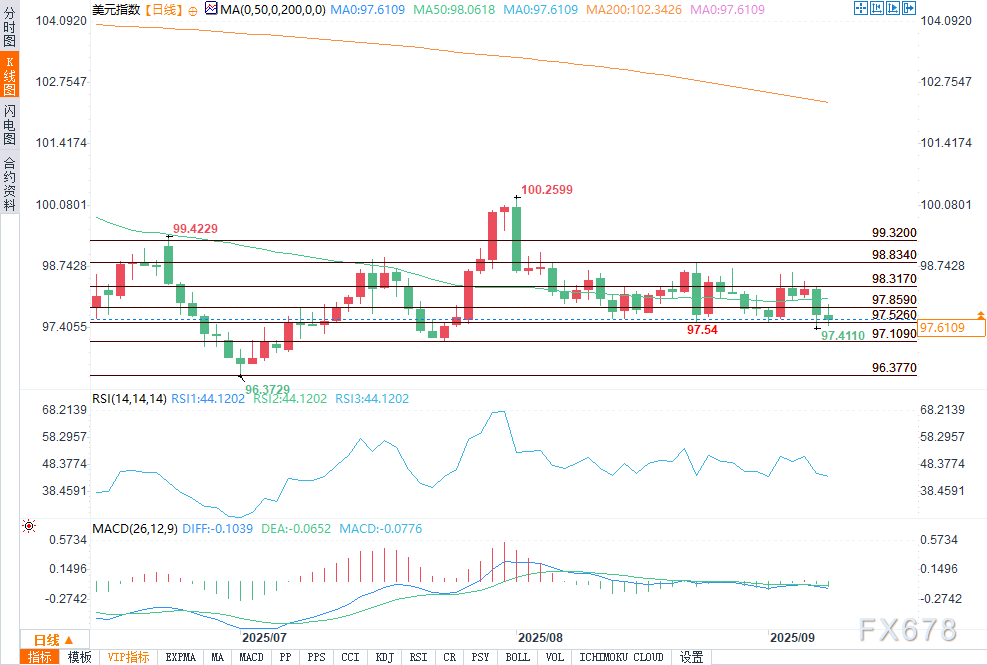
(Dollar index daily chart, source: Internet)
With the dollar index already below its 50-day moving average and the probability of the Federal Reserve cutting interest rates rising, market sentiment remains bearish in the short term. Unless the upcoming inflation data is unexpectedly higher than expected, the dollar index may continue to face downward pressure, especially if the support level of 97.430 falls. The resistance level in the range of 97.859 to 98.317 remains solid, which will limit the room for the dollar to rebound.
Please indicate the source: https://www.daoctech.com/fxoutrade/1754.html
Disclaimer: The content of this article does not represent the views of the Institute of Foreign Exchange. The content is for reference only and does not constitute investment advice. Investors operate accordingly at their own risk.