
The rebound in oil prices is limited: the dual suppression of oversupply and capital contraction
On Thursday (August 7), U.S. crude oil rallied 0.89% in Asian trading, and is now trading around 64.92. It has fallen for 5 consecutive days. Oil prices rebounded due to short covering and profit taking. At the same time, Saudi Arabia raised the price of crude oil to Asian customers for the second consecutive month to show confidence in oil demand. Although oil prices rebounded, the rebound may be highly suppressed by the dual suppression of oversupply and capital contraction.
The surge in Russian crude oil exports and the withdrawal of Wall Street capital are forming a double chain, restricting the rebound in international oil prices.
According to Reuters data on Thursday (August 7), affected by the shutdown of refineries caused by drone attacks in Ukraine five days ago, crude oil shipments in western Russian ports in August are expected to increase to 2 million barrels per day, 200,000 barrels per day more than originally planned.
The complete shutdown of the new Kuibishev refinery and the halving of production capacity at the Ryazan refinery have forced Russia to urgently divert Urals crude oil originally used for domestic processing to the export market, and spot traders have locked in an additional ten Aframax tankers to meet transportation demand.
This sudden supply shock directly exacerbated the pressure on global crude oil inventories, resonating with OPEC +'s recent decision to increase production by 548,000 barrels per day, which together suppressed the price of Brent crude oil below $70 per barrel.
At the same time, Wall Street's capital contraction in the fossil fuel industry is reshaping market expectations.
Bloomberg data shows that in the first half of 2025, the six major banks' oil and gas loans fell by 25% year-on-year to $73 billion, with Morgan Stanley's oil and gas loan business falling by as much as 54%.
This deterioration in the financing environment is directly reflected in the fundamentals of the industry: the scale of global upstream mergers and acquisitions has plummeted by 34% year-on-year, US shale transactions have stalled due to high valuations and declining reserve quality, and the number of active drilling rigs in the Permian Basin has fallen to the lowest level since 2021.
Despite the political signal from the Trump administration's withdrawal from the net-zero banking alliance, the decline in real investment in the industry is more due to market risks, with expectations of returns on capital persistently low due to increased oil price volatility and depletion of shale inventories.
This structural contradiction is particularly pronounced in the cash market: Russia is eager to sell Urals crude oil discount expanded to $7/barrel, while US shale producers insist that WTI oil prices stabilize above $65 before restarting production.
Goldman Sachs forecasts that the global crude oil surplus will 800,000 barrels per day in 2025 and further expand to 1.40 million barrels per day in 2026, which makes the geopolitical premium unsustainable.
Although tensions in the Middle East may temporarily push up oil prices, Russia's ability to evade sanctions through its shadow fleet, such as the average real export price exceeding $80/barrel in 2023, will eventually suppress the room for price recovery.
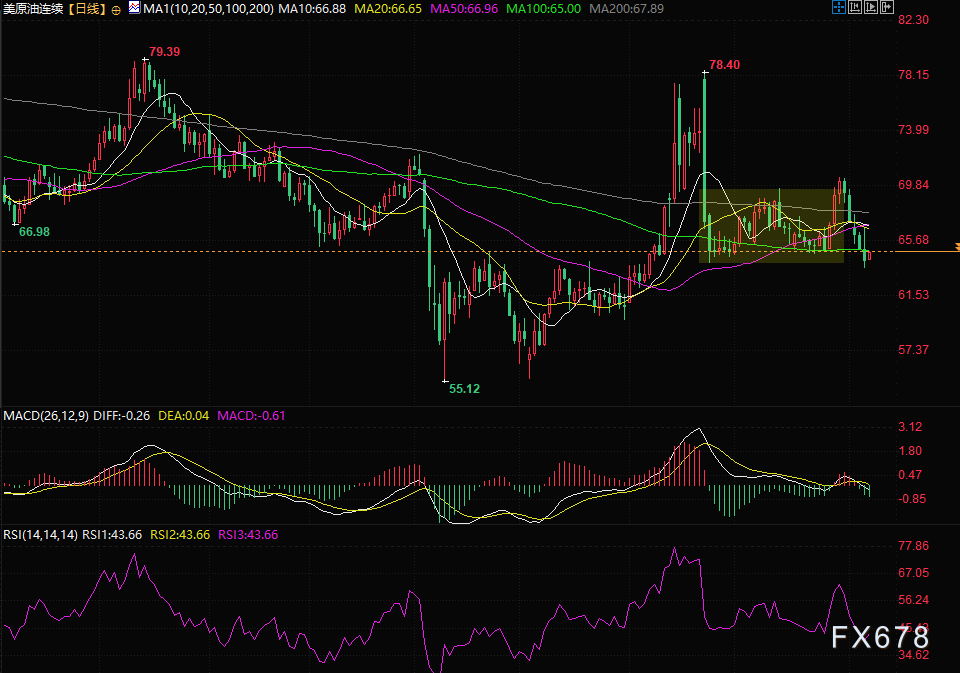
(U.S. crude oil daily chart, source: Internet)
At 10:23 Beijing time, the price of US crude oil is now trading at $64.98 per barrel.
Please indicate the source: https://www.daoctech.com/fxoutrade/1957.html
Disclaimer: The content of this article does not represent the views of the Institute of Foreign Exchange. The content is for reference only and does not constitute investment advice. Investors operate accordingly at their own risk.