
The moving average is not the most important indicator in technical trading
As a technical trader, many people will study technology tirelessly, from the K-line to the line, from the moving average to various self-made unique indicators, which is a never-ending path.
In fact, technology is not that important, and many metrics are not necessary.
Today we will try to remove a metric that everyone thinks is essential: the moving average.
Our research into technology can only solve two problems: direction and entry and exit location.
1. Direction:
Direction is the easiest to judge. You don't need any indicators, and you can tell with your naked eye. The difficulty of direction is to determine the point of reversal. On the contrary, many trend indicators are also misleading.
Take the moving average as an example:
A, in the initial stage of the market
The moving average is a trend indicator, and those who often use it will find it more misleading than effective.
When the market is about to turn long, the price has risen a lot on the chart, and you can perceive the direction to rise without the moving average. And the moving average will only turn up when the price is much higher than the moving average. Therefore, in the initial stage of the market, deleting the moving average indicator does not affect your judgment of the rising direction at all.
However, if there is a moving average on the chart, when the price hits the moving average, you think it is just a rebound, and considering the resistance of the moving average, you may go short. When the price breaks the moving average, you may even expect it to pull back and watch profits shrink or turn from profits to losses.
These two side effects affect your judgment of the market. If you can't keep up with the rhythm, it is easy to appear "wrong step by step".
That is, if the moving average does not exist, it will not affect the market judgment; if it exists, it will instead produce two side effects. Why should such an indicator be displayed in the chart?
B, in the middle of the trend
In a rising trend, the oscillation time is much longer than the rising time, that is, the oscillation time is very much. And the moving average is a killing tool in the oscillation, but anyone who does trading clearly knows that the moving average is used during the oscillation, always making small profits and losing big money. There is no need to keep it.
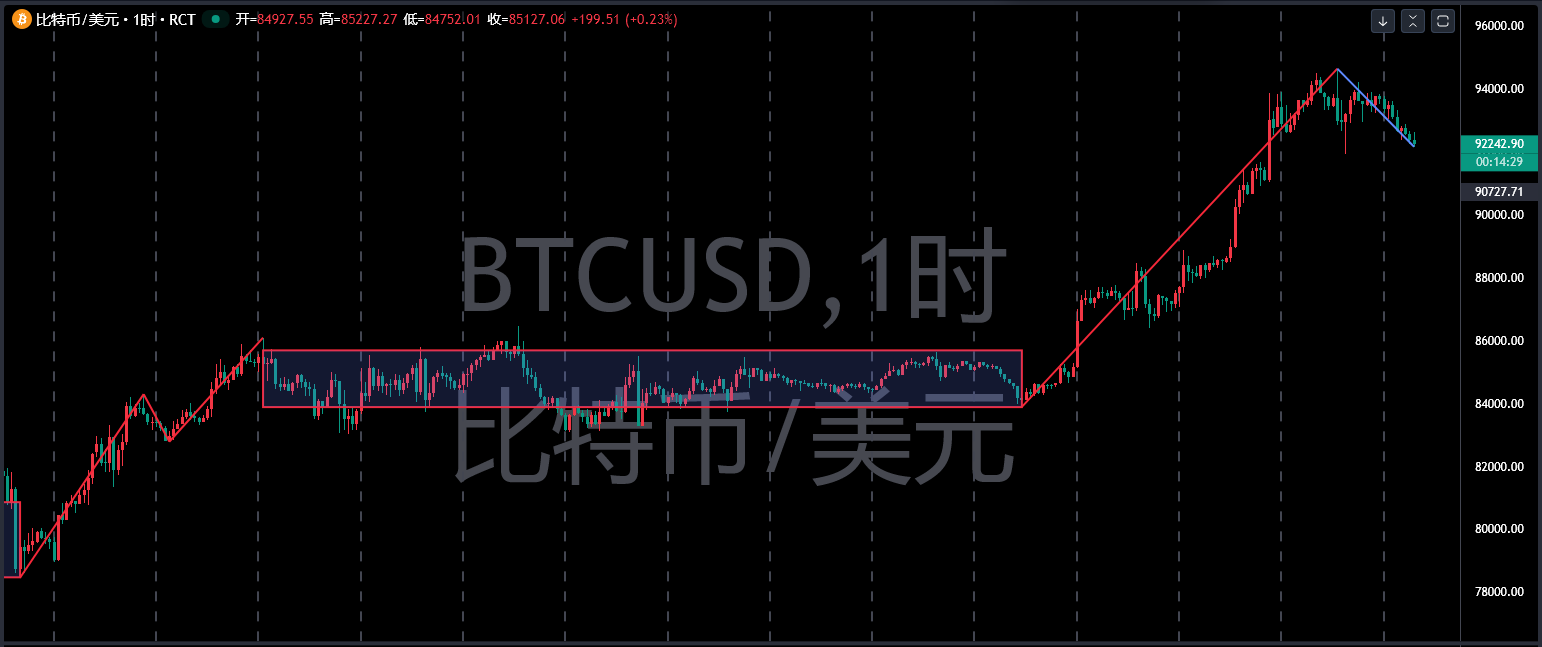
In a strong upward trend, without the moving average, you can also see that it is rising. The candlesticks of the positive lines clearly tell you that the rising and rising, even if there are occasional negative lines sandwiched in it, are quickly eliminated by the positive line. At this time, the moving average is often far below, and it hardly plays a role in guiding the direction.
In the trend is not obvious but slow rise, up 100 points, down 70 points in the zigzag rise, the moving average is easier to deceive, if you set the moving average parameter is not large enough, the price will often cross the moving average line. This will seriously affect your judgment of the direction, you will swing from side to side in the rise and fall, and even forget that this is in an uptrend. The moving average really should not exist at this time.
C, at the end of the trend
At the end of the trend, the price has reached its peak and is starting to reverse, building a downtrend. The moving average at this time, due to its lag, will make you mistakenly think that there will be another rise. Maybe there is another rise, but many times the decline is very fast, and in your hesitation, the profit of multiple orders has been greatly reduced. That is, the side effects of the moving average still exist.
2. Entry and exit positions:
If you determine the direction, or what level of direction, it is easier to enter and exit.
The first consideration is whether to enter or not. This mainly depends on the return/risk. You can enter the market if you are suitable, and you don't need to enter if you are not suitable. The moving average is not used at this time.
If the entry/exit is determined, the first consideration is the entry/exit position, whether the entry position is good or bad, mainly depending on the support and resistance areas, as well as the reversal and size of the K-line.
The places where the moving average may play a role at this time are: moving average support and moving average suppression. It is also possible that it may not play a role, such as the price breaking through the moving average, or the price turning around when it does not reach the moving average.
3. Quantify with fractions
Help: If you use 100 points to measure the effect of the moving average, its reference value to the direction is around 20 points, and the effect on the position is greater, but it should not exceed 40 points, which is almost 30 points.
Side effects: The side effects of the moving average on the direction must be more than 60 points, and the harm to the entry and exit positions should exceed 25 points.
This is very intuitive: the sum of help is < 60, while the harm of side effects is > 80.
The overall effect of an indicator on trading is less than 60 points. Why should we use it?
The harm of side effects is > 80 points, so why should we delete it?
4. Final statement:
In the past, I have written a lot of articles on the actual use of moving averages, and those articles have focused on the advantages of moving averages. And you have also read N articles on the use and benefits of moving averages elsewhere.
Indicators are like a double-edged sword, with advantages and disadvantages.
This reminds me of human nature. There are many opposites in human nature. If there is an A-side, we must think of his-A-side, that is, the more ruthless he is towards others, the more affectionate he is, the more enthusiastic he is towards others, and the more he ignores himself.
Then we can't just look on the bright side and ignore the downside.
This is all the articles that speak ill of the moving average, and even ask to delete it, in order to make us understand that the moving average is not that important, not that good, not that essential.
Please indicate the source: https://www.daoctech.com/fxschool/1591.html
Disclaimer: The content of this article does not represent the views of the Institute of Foreign Exchange. The content is for reference only and does not constitute investment advice. Investors operate accordingly at their own risk.