
Gann theory practical application science
An Overview of Gann Theory
William Delbert Gann (1878-1955) was a famous 20th-century financial trading guru who combined mathematics, geometry, astronomy, and ancient occultism (such as the Bible) to develop a unique method of market forecasting - Gann's theory. This theory emphasizes the balance between time and price, and holds that market fluctuations follow specific mathematical and geometric laws.
core theory
1. The relationship between time and price
Gann believes that time is the most important factor in the market, and price fluctuations are governed by time cycles. Key concepts include:
Time cycles: Markets have fixed time cycles (e.g. day, week, month, year), such as:
30-Year cycle (long economic cycle)
10-Year cycle (stock market bull-bear conversion)
Seasonal cycles (e.g. January effect, May selling)
Price and time square: When the price running time and price range reach equilibrium (e.g. 1 day = 1 point), the market may reverse.
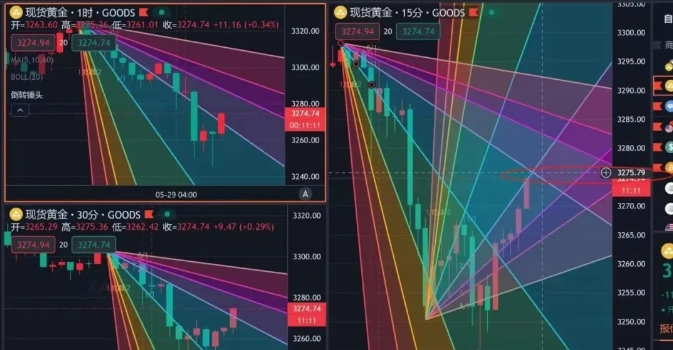
2. Gann Angles
Determine the strength of the trend by the slope (e.g. 1 × 1, 1 × 2, 2 × 1 lines):
1 x 1 line (45 ° angle): Price and time balance, the strongest trend line.
1 x 2 line (steeper): Prices rise twice as fast as time.
2 × 1 line (more gentle): Prices rise faster than half the time.
How to use: Draw angles from important highs or lows, with obvious support/resistance effects.
3. Gann Retracement
Unlike Fibonacci retracements, Gann believes that the key retracements are: 1/8 (12.5%), 1/4 (25%), 3/8 (37.5%), 1/2 (50%, most important), 5/8 (62.5%), 3/4 (75%), 7/8 (87.5%).
4. Gann Wheel/Square of 9
Predicting price and time turning points through a digital spiral (similar to a roulette wheel): used to calculate support/resistance levels and price targets.
For example, starting from a certain low point, each rotation of 90 degrees (or a specific number step) may correspond to a key price.
5. Gann's 24 Trading Laws
Gann summarized the classic trading principles, including:
Homeopathic trading: Don't go against the trend.
Stop Loss Discipline: Always set a stop loss.
Capital management: No more than 10% of the funds in a single transaction.
Time period combination: Trading during key time windows.
practical application
1. Trend judgment
Use Gann angles to determine trend strength:
The price is at the 1 × 1 line → upward trend;
Breaking the 1 × 1 line, the trend may reverse.
2. Point of sale
When the price is square with the time (e.g. 50 days + 50 points), a turning point may occur.
Key pullback levels (e.g. 50%) are combined with time windows (e.g. Day 30) to find entry opportunities.
5.29 Multicycle Gann Resonance
3. Cycle forecasting
For example, the 10-year cycle in the history of US stocks (such as the Internet bubble in 2000, the financial crisis in 2008, and the epidemic crash in 2020).
Seasonal laws: such as "Sell in May and Go Away".
Controversies and limitations
Complexity: Gann's method involves mathematics, geometry, astrology, etc., and is difficult to standardize.
Subjectivity: Different analysts may come to different conclusions.
Difficulty in verification: Some theories (such as astrology) lack scientific basis.
Comparison with Wave Theory
summary
Gann Theory is suitable for traders who enjoy mathematics, geometric analysis, and believe in time cycles.
It is recommended to combine: trend line, moving average, volume and other tools to improve accuracy.
Please indicate the source: https://www.daoctech.com/fxschool/1621.html
Disclaimer: The content of this article does not represent the views of the Institute of Foreign Exchange. The content is for reference only and does not constitute investment advice. Investors operate accordingly at their own risk.