
Non-farm outlook: July jobs report expected to show further slowdown in U.S. hiring, unemployment rate likely to rise
Economists predict that the July jobs report will show signs of further cooling in the labor market as uncertainty over U.S. government policies, particularly tariffs and immigration, continues to weigh on business decisions.
Nonfarm payrolls are expected to increase by 117,500 in July, down from 147,000 in June, according to FactSet's forecast consensus. The unemployment rate is expected to rise slightly to 4.2% in July from 4.1% in June.
"We think the economy will continue to weaken, especially in the private cyclical sectors of the economy," said Kathy Bostjancic, chief economist at Nationwide. "The private sector remains subdued and the knock-on effect is that overall income growth is not much."
While the impact of the tariffs did not appear to be as large as expected, Bostjancic said the impact was subtle. "I think the uncertainty around the tariffs is mostly affecting business concerns about overall demand for goods and services," she said. Instead of mass layoffs, companies are taking a cautious approach to job creation.
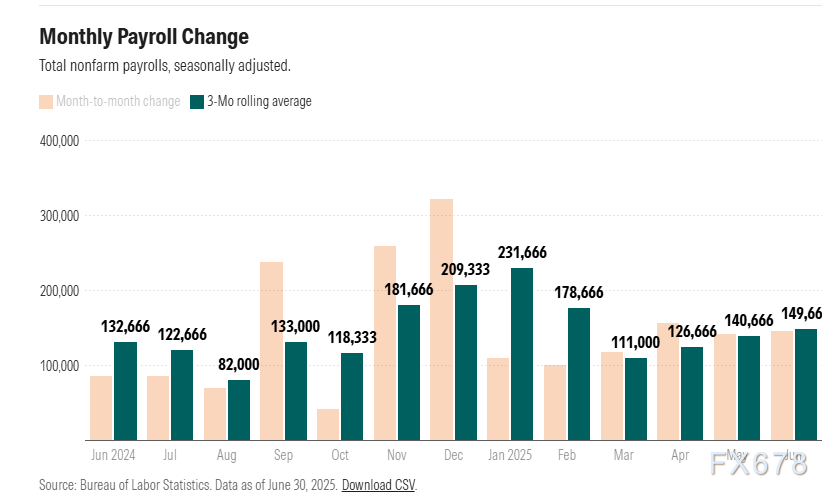
(The change in the number of non-farm payrolls in the United States, the yellow column shows the monthly change, and the green column shows the three-month rolling average.)
July employment report forecast highlights
Employment report release time: 21:30 on August 1 (Friday), Beijing time
Nonfarm payrolls are expected to increase by 117,500, down from 147,000 in June.
The unemployment rate is expected to rise to 4.2% from 4.1% in June.
Hourly wages are expected to increase by 0.3%, up from 0.2% in June.
Focusing on private sector job growth
While overall job growth was relatively healthy, Bostjancic highlighted concerns about employment in cyclical sectors that are sensitive to the economy. "We think this will continue to be weak," she said. "There are no net job additions in the sector."
At the same time, despite the increase in average hourly wages, Bostjancic observed that overall income growth was "basically flat" due to fewer hours worked. She said the weakness in the private cyclical sector was not just an isolated trend, but provided insight into the broader private economy. "This tells us that, at least in the private sector, the overall economy is somewhat sluggish. Overall employment growth remains weak, and the knock-on effect is that overall income growth is not much."
The expected June jobs report appears to be strong, but it is not
However, economists at Goldman Sachs believe that "private sector employment growth will rebound to a slightly firm (but still weak) pace", with growth expected to 100,000, down from 147,000 in June.
At UBS, economists expect a "weak" July jobs report, with non-farm payrolls rising 95,000 and the unemployment rate rebounding to 4.2%. "We expect July non-farm payroll growth to slow from the 147,000 in June, largely because government sector growth should slow, which was unexpectedly 73,000 in June," they wrote.
The unemployment rate is expected to rise slightly
Bostjancic expects the unemployment rate to rise slightly in July. "We expect the unemployment rate to rise by 0.1 percentage points," she said, noting that the drop in the unemployment rate last month was largely due to a decline in the labor force participation rate. "Last month we recorded a record monthly increase for so-called'frustrated workers. 'People who want to find jobs are having a hard time finding jobs." After adjusting for the impact of the decline in the labor force participation rate, Bostjancic believes the unemployment rate has risen to 4.7 percent.
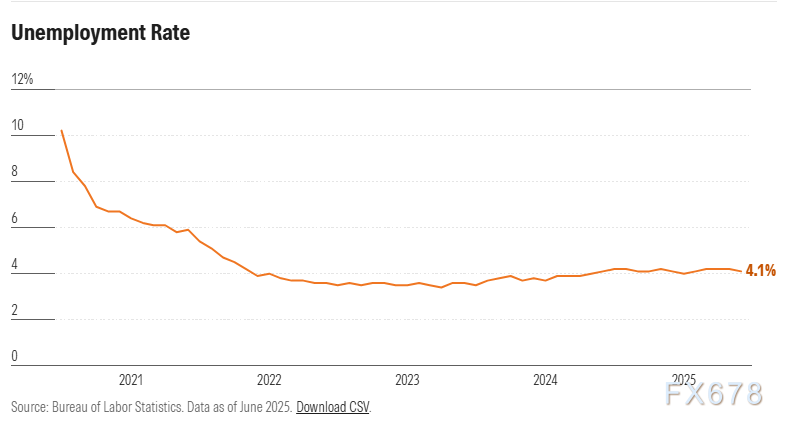
(Overview of changes in the US unemployment rate)
Analysis of the impact on gold prices
Weakness in the labor market favors gold prices.If slower job growth and higher unemployment suggest weaker economic activity, it could strengthen market expectations of a rate cut by the Federal Reserve. Interest rate cuts typically reduce the opportunity cost of holding gold, driving gold prices higher.
Policy uncertainty supports gold prices.Gold as a safe-haven asset could be buoyed if the report reflects uncertainty over tariff and immigration policies that could increase demand for safe havens.
Weak income growth limits inflationary pressures.Although hourly wages are expected to increase slightly, the reduction in working hours is expected to lead to flat overall income growth and limited inflationary pressures. This may further support the Federal Reserve to maintain accommodative policy, which is indirectly positive for gold prices.
Short-term fluctuations may include:If the actual data is lower than expected (e.g. non-farm payrolls are much lower than 117,500 or the unemployment rate is higher than 4.2%), gold prices may rise due to increased risk aversion and interest rate cuts. Conversely, if the data exceeds expectations, gold prices may be under short-term pressure.
At 09:07 Beijing time, spot gold was trading at $3290.16 per ounce.
Please indicate the source: https://www.daoctech.com/fxschool/1672.html
Disclaimer: The content of this article does not represent the views of the Institute of Foreign Exchange. The content is for reference only and does not constitute investment advice. Investors operate accordingly at their own risk.