
The central bank's decision is imminent: the pound is stagnant at 1.33, is a sudden market imminent?
On Wednesday (August 6), the pound/dollar fluctuated in a narrow range near the 1.3300 mark, and the exchange rate continued to trade sideways for several days. The market entered a typical waiting mode for news. Traders' attention focused on the two major events of the week: the Bank of England's interest rate decision and the potential change in policy direction caused by the personnel change of the Federal Reserve.
Fundamentals:
As for the Federal Reserve, following Kugler's resignation on Friday, US President Donald Trump said he would name his successor within this week. The appointment is widely expected to strengthen his influence over the FOMC or heighten concerns about the Fed's independence. Trump has publicly stated that the candidates include four people, including White House economic adviser Kevin Hassett and former Federal Reserve governor Kevin Warsh. This move has raised market expectations that the Federal Reserve policy will move towards more easing, which will put some pressure on the dollar.
In terms of US economic data, the July non-farm payroll (NFP) data was significantly lower than expected, while the data for May and June were revised down, and the unemployment rate also rose, strengthening expectations for a rate cut in September. According to the CME FedWatch tool, the market is almost certain that the Federal Reserve will cut the federal funds target rate by 25 basis points at its September meeting, to a range of 4.00% -4.25%.
In sterling, the Bank of England is due to announce its interest rate decision this Thursday. The market consensus expectation is that interest rates will be cut by 25 basis points to 4%, which has been fully priced in. The key variable is whether the central bank sends more dovish or hawkish signals, especially forward-looking judgments on inflation and the job market.
While the UK's CPI remains high on the back of rising energy and food prices, official data show a cooling labour market, rising corporate burdens on social security costs and slowing hiring. On the fiscal front, inflation expectations have also been boosted by a rise in welfare spending by Rachel Reeves, chancellor of the exchequer. Mr. Bailey, the central bank governor, has recently struck a conciliatory tone, saying the risk of inflation returning to its 2 per cent target over the medium term had "dissipated".
Technical aspects:
On the 4-hour chart, the GBP/USD shows a clear "sideways finishing after a downtrend" structure. Since the high of 1.3588, the exchange rate has quickly fallen back, and the exchange rate has formed a stage low near 1.3140 and rallied. It is currently running around the middle Bollinger Bands (1.3265).
Bollinger Bands show a slight closing trend, indicating that volatility has converged and the market is in a stage of consolidation and accumulation. The current price is located near the middle rail, trying to break through the upper Bollinger Band rail 1.3346, but it has not been able to achieve an effective breakthrough, indicating that there is obvious resistance at the 1.3346 line. The lower support is at 1.3185 (lower Bollinger Band rail) and the previous low is 1.3140.
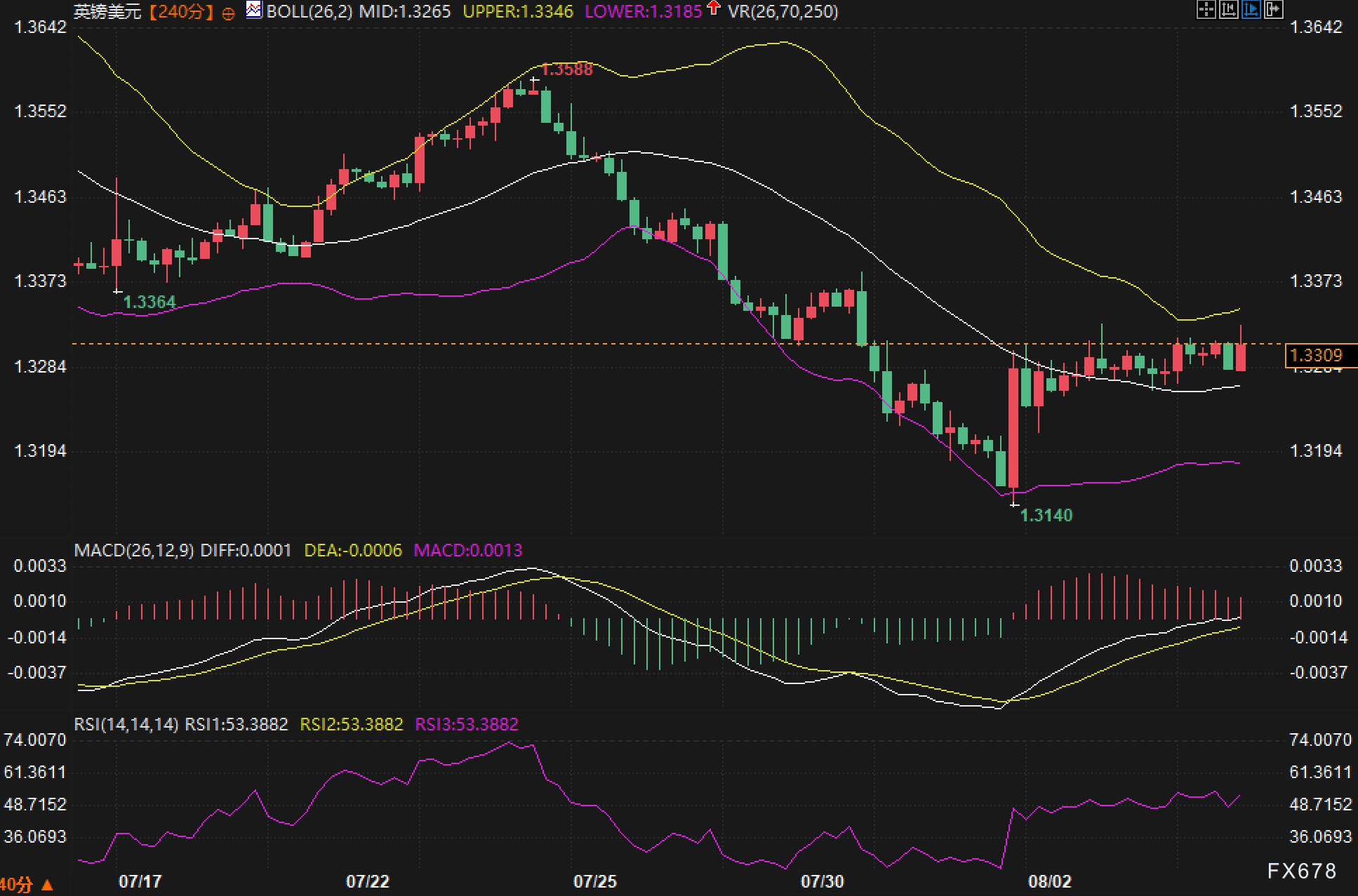
In terms of the MACD indicator, the MACD line is slightly higher than the signal line, and the red bar is enlarged, indicating that the short-term momentum is starting to strengthen, but the upward action is still relatively moderate. The RSI remains at 53.38, indicating that the market is in a neutral-to-multi range and has not entered an overbought or oversold state, suggesting that there is still room for two-way choices in prices.
Overall, the analysis shows that the technical side shows that the exchange rate is in a consolidation market, and the upper and lower tracks have not yet broken through, so it is necessary to be vigilant for the upcoming sudden market. Once 1.3346 breaks through and stands firm, it may trigger further rebound space; conversely, if it falls below 1.3185, it will become possible to dip to 1.3140 again.
Market sentiment observation:
The current market sentiment is cautious and wait-and-see, with the exchange rate repeatedly tugging around the psychological level of 1.3300, indicating that both the bulls and the bears lack enough confidence to take the initiative to attack. On the dollar side, due to Trump's upcoming important personnel appointments and high expectations for interest rate cuts in September, the dollar index continues to hover at a low level, providing indirect support for the pound.
On the other hand, the market remains cautious about the Bank of England's interest rate decision this week. Although interest rate cuts have basically become a consensus, the uncertainty of the future policy path still divides market expectations. Some traders are betting that this round of interest rate cuts is the end of the cycle, and the pound may usher in a stage of support; another view is that the central bank may continue to release dovish signals to suppress the pound's medium-term trend.
In terms of sentiment indicators, RSI, MACD, etc. did not form a clear deviation or extreme signal. Combined with the Bollinger Band closing pattern, it indicates that a directional breakthrough may be ushered in in the short term, and the market risk appetite needs to be triggered by an event stimulus.
Outlook for the future market:
Before the decision of the Bank of England and the Federal Reserve personnel, the exchange rate may still remain in the range of 1.3185 - 1.3346. The analysis believes that if the tone of the central bank is dovish, the pound will face some downward pressure in the short term, and the exchange rate may test the key support of 1.3140;
On the contrary, if the Bank of England releases a hawkish signal, inflation pressures are covered by strengthening expectations, or if the Federal Reserve orders the market to be unexpectedly neutral, the pound may experience a technical rebound, with the target looking above 1.3400.
Please indicate the source: https://www.daoctech.com/fxschool/1684.html
Disclaimer: The content of this article does not represent the views of the Institute of Foreign Exchange. The content is for reference only and does not constitute investment advice. Investors operate accordingly at their own risk.