
5:4 thrilling vote! The £1.34 defense line sounded the "air raid alarm", and the "hawkish mutiny" within the central bank "triggered a long and empty street battle"!
On Thursday (August 7), at 19:00 Beijing time, the Bank of England (BoE) announced its latest interest rate decision, lowering the base rate from 4.25% to 4% by a thrilling vote of 5 to 4. This is the fifth interest rate cut in a year since August 2024, in line with market expectations. The decision was highly concerned by a rare split vote within the Monetary Policy Committee (MPC), and for the first time, a majority opinion was reached in two rounds of voting. The pound rose more than 40 points against the dollar in the short term after the announcement of the resolution, reaching a maximum of 1.3427, but then quickly fell back, reflecting the market's divergent interpretation of the path of interest rate cuts and inflation prospects. This article will combine the details of the resolution, real-time quotes, and institutional and retail investors' feedback to deeply analyze the market reaction and future trends.

Market background and resolution overview
In the context of heightened global economic uncertainty, the Bank of England faces the dual challenges of inflation and the job market. Inflation in the UK rose to 3.6% in June, a further increase from 3.4% in May, and the central bank forecasts that inflation will peak at 4% in September, well above its 2% target. Meanwhile, the unemployment rate rose to 4.7% in the three months to May, a slight deterioration from the previous 4.6%, indicating a cooling job market. Geopolitical tensions and tariff rhetoric have exacerbated market risk aversion. Although the UK economy grew from 0.1% in the second quarter to 0.3% in the third quarter, overall growth remained sluggish. Against this backdrop, the Bank of England voted 5-4 to cut interest rates by 25 basis points. Governor Andrew Bailey reiterated that interest rates are still in a "downward channel," but stressed that future rate cuts will be carried out "gradually and cautiously." Notably, the central bank's statement deleted the expression "monetary policy needs to continue to tighten" and replaced it with "monetary policy constraints have decreased," suggesting that the rate cut cycle may be nearing an end.
Compared with the decision on June 19, when the MPC voted 6-3 to keep interest rates unchanged at 4.25%, the pound plunged 18 points against the dollar to 1.3404. In contrast, the decision to cut interest rates triggered more violent market volatility, highlighting market sensitivity to policy disagreements and the inflation outlook. Institutional and retail reactions also revealed different interpretations of the future policy path.
Real-time quotes and market sentiment
After the announcement of the resolution, the pound against the dollar (GBP/USD) rose rapidly, surging more than 40 points in the short term, reaching a high of 1.3427, and the latest reading was 1.3400, an increase of 0.34% in the day. This wave of gains was mainly driven by the decision to cut interest rates in line with expectations, but it quickly fell back after rising, indicating that the market was uneasy about the unexpected stance of the four members of the MPC against the rate cut. In contrast, the market had generally expected that seven committees would support the rate cut, but only five actually agreed, highlighting the policy differences than expected. The FTSE 250 index in the UK trimmed its gains after the resolution, rising only 0.07%, reflecting the cautious attitude of the stock market towards the boost effect of interest rate cuts. In the bond market, the yield on the two-year British government bond rose 6 basis points to 3.889%, and the yield on the 10-year government bond rose 5.5 basis points to 4.588%, indicating that the market is concerned about the upside risk of inflation.
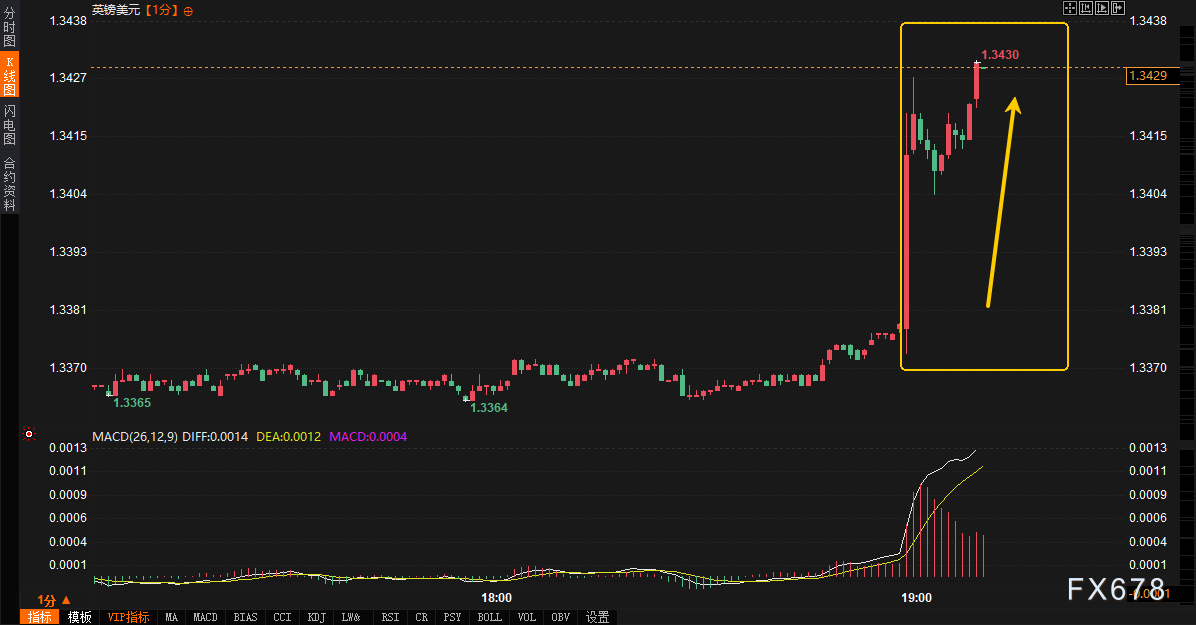
The real-time feedback further revealed the divergence of market sentiment. Institutional investors generally focused on the split vote in the MPC and the upward revision of inflation forecasts. One prominent institutional analyst pointed out: "The 5-4 vote and the first two rounds of voting indicate that concerns about inflation risks are growing within the Bank of England, especially food price inflation is expected to rise from 4.5% in June to 5.5% by the end of 2025." Retail investors paid more attention to the short-term volatility of the pound, with one user commenting: "The pound quickly fell back after rushing to 1.3427, and then rose to 1.3430. The market is clearly hesitant about whether the rate cut cycle will continue. The 1.34 mark is a key support." Compared with the expectations before the announcement, some institutions had predicted that interest rates could be cut again in November, but this expectation was significantly cooled after the resolution, and there was even discussion among retail investors that "interest rate cuts may be suspended during the year".
The change in market sentiment was also pulled by the central bank's forecasts. The Bank of England raised its forecast for peak inflation to 4% and predicted that inflation would not fall back to 2% until the second quarter of 2027, a quarter later than its May forecast. Rising food prices, minimum wage adjustments and global price pressures were cited as the main factors driving up inflation. In addition, the central bank expects the unemployment rate to rise to 4.9% in the fourth quarter of 2025, indicating further pressure on the job market. The data heightened concerns about monetary policy tightening, and the short-term rise of the pound against the dollar was not sustained, reflecting investors' trade-off between the benefits of interest rate cuts and the risk of inflation.
Interest rate cut expectations and market impact
The rate cut comes as the Bank of England tries to balance inflationary pressures with sluggish economic growth. Inflation rose to 3.6% in June and is expected to reach 4% in September, well above its 2% target, strengthening opposition to a rate cut within the MPC. The four members who opposed the rate cut, including deputy governor Claire Lombadelli and chief economist Hugh Peel, were concerned that upside risks to inflation could be transmitted further through wage agreements and food prices. The meeting notes that medium-term inflationary pressures have risen slightly since May, in contrast to the central bank's previous expectations of a "gradual downside". In contrast, the European Central Bank has cut interest rates eight times in a row and expects eurozone inflation to remain below 2%, highlighting the more severe inflation dilemma facing the UK.
The market's adjustment to interest rate cut expectations directly affected the trend of the pound. After the June 19 decision, the pound fell 18 points against the dollar due to the unchanged interest rate in the short-term. Although the interest rate cut was in line with expectations, the vote difference and the increase in inflation forecasts undermined the market's confidence in further easing. An institutional analyst said: "The suggestion that the'interest rate cut cycle may end 'in the central bank's statement has made the market start betting on the probability of a December interest rate cut." There are voices among retail investors that the pound may fluctuate in the 1.34-1 range in the short term, lacking a clear direction. In contrast, the market generally expected another interest rate cut in November before the announcement, but after the resolution, this expectation was postponed to 2026, and the number of interest rate cuts in the whole year may only be one or two.
The boosting effect of interest rate cuts on the UK economy has also been questioned. The central bank raised its forecast for economic growth in 2025 to 1.25%, but stressed that trade policy uncertainty and slowing global growth could weigh on the economy. Efforts by Rachel Reeves, the finance minister, and Keir Starmer, the prime minister, to boost economic growth may be hampered by a slowdown in the rate-cutting cycle. One retail investor commented: "The rate cut was supposed to stimulate the economy, but inflationary pressures and deteriorating employment made the market doubt the effect, as evidenced by the weak performance of the FTSE 250." Institutions are more concerned about the long-term impact. One well-known institution analyzed: "The dilemma facing the Bank of England is similar to that of the Federal Reserve. The game between inflation and employment may make the policy path more complicated."
Outlook on future trends
Looking ahead, the Bank of England's monetary policy path is fraught with uncertainty. The central bank reiterated its "gradual and prudent" approach to rate cuts, but the 5-4 vote and first two rounds of voting show growing internal concerns about inflation risks. Market rates suggest that bank rates could fall to 3.8% in the fourth quarter of 2025 and further to 3.5% and 3.6% in 2026 and 2027, but this path could be adjusted by inflation exceeding expectations. Food price inflation is expected to rise to 5.5% by the end of 2025, combined with pressure from minimum wage and National Insurance hikes, which could further push up prices and limit the scope for rate cuts.
The pound against the dollar may fluctuate in the 1.34-1 range in the short term, with the 1.34 mark as a key support. If it falls below the 1.33 level, it may further test the 1.33 level. In the long run, if inflation continues to be high and the labor market continues to deteriorate, the central bank may be forced to slow the pace of interest rate cuts, and even the possibility of suspending interest rate cuts is not ruled out. Institutional analysts generally believe that the probability of a rate cut in December has dropped significantly, and the market needs to pay close attention to the September inflation data and employment report to judge the policy direction. Retail investors are more inclined to short-term trading opportunities and pay attention to the performance of the pound near key technical levels.
Overall, although the Bank of England's interest rate decision on August 7 injected short-term positivity into the market, internal policy differences and upside inflation risks weighed on the pound. Market sentiment swings between interest rate cut expectations and inflation concerns. The pound may continue to be volatile in the short term, while the long-term trend depends on the further evolution of inflation and employment data. Investors need to remain vigilant and closely track the central bank's follow-up signals and global economic developments to cope with potential market volatility.
Please indicate the source: https://www.daoctech.com/fxschool/1685.html
Disclaimer: The content of this article does not represent the views of the Institute of Foreign Exchange. The content is for reference only and does not constitute investment advice. Investors operate accordingly at their own risk.