
USD/JPY Outlook: Japan's unexpected GDP performance intensifies the Bank of Japan's interest rate hike bet, and the trend of the currency pair still depends on the US economy
On Friday (August 15), during the European session, the price of the US dollar/yen showed a volatile downward trend. After the opening, it rose and fell back, and the overall center of gravity shifted downward. Short-term bears had a certain advantage. The US dollar/yen was quoted at 146.908/918, down 0.57%.
The better-than-expected performance of Japan's gross domestic product (GDP) has increased market bets on the Bank of Japan (BoJ) to raise interest rates, but the movement of the dollar/yen still depends on the state of the US economy, with retail sales data and import price data now in the spotlight.
The dominant driver of the USD/JPY exchange rate remains the US economic and policy backdrop, with the next set of key signals likely to come from retail sales and import price data later on Friday.
Frances Cheung and Christopher Wong, foreign exchange analysts at OCBC, said the dollar/yen rally was helped by US Treasury Secretary Vincent Bescent's clarification that he was not calling for Japan to raise interest rates. Better-than-expected second-quarter gross domestic product data in Japan this morning pushed the dollar/yen further down. Wage growth, a wider range of service sector inflation and upbeat economic activity should continue to support the normalisation of BoJ policy. The widening policy divergence between the Federal Reserve and the BoJ will be the core support factor for the downward trend of the dollar/yen exchange rate. "
Trade boosts Japan's GDP
Japan's economy performed better than expected in the second quarter, with real GDP growing 0.3 per cent month-on-month, three times faster than market expectations. The surprise upturn was largely driven by trade: exports surged 2 per cent in spite of US tariffs, bringing net exports' contribution to growth to 0.3 percentage points.
Private consumption, which accounts for more than 50 per cent of Japan's economic activity, is an important driver of inflationary pressures, rising 0.2 per cent in the quarter, double expectations. The BoJ will be encouraged by signs of consumer resilience, but may still need to see wage growth translate further into stronger consumer spending before it is convinced that inflation is self-sustaining.
The GDP deflator, a broad measure of economic inflation that measures changes in the prices of all domestically produced goods and services, rose 3% year-on-year, down 0.3 percentage points from Quarter 1.
Steady economic growth, resilient trade and high inflation have all combined to strengthen the case for the BoJ to resume raising interest rates before the end of the year. While that may please Mr. Bessant, who this week made a rare remark that the BoJ was lagging in its fight against inflation, the dominant driver of the long-term dollar/yen trajectory remains almost entirely in the hands of the US.
US retail sales and import price data are in focus
Against the backdrop of the release of the US Consumer Price Index (CPI) and Producer Price Index (PPI) reports, retail sales data and import price data released later on Friday are the next set of risk events that could affect the USD/JPY trend - data that will reveal the actual impact of higher tariffs on upstream price pressures and consumer behavior.
Thursday's strong PPI report, which showed higher prices for services, echoed details in the CPI report, which has triggered a dollar/yen reversal. If the retail sales and import price data again beat expectations, the bullish trend in the dollar/yen may continue further into the weekend.
The Alaska summit between Mr. Trump and Mr. Putin could complicate currency movements, but its impact on safe-haven hedging activity is likely to be limited as the summit is widely expected to make little progress.
The US economic uncertainty has triggered sharp fluctuations in the USD/JPY
The recent movement of the dollar/yen exchange rate has been slightly abnormal by conventional standards, which is likely to reflect market uncertainty about the actual state of the US economy. US job growth has slowed sharply, but wage and service inflation remain firm, and there are few signs of large-scale layoffs. While the market expects the Federal Reserve to cut interest rates for the first time this year in September, this expectation could change rapidly if the July non-farm payrolls report proves to be unusually volatile, rather than initiating a trend change as it did 12 months ago.
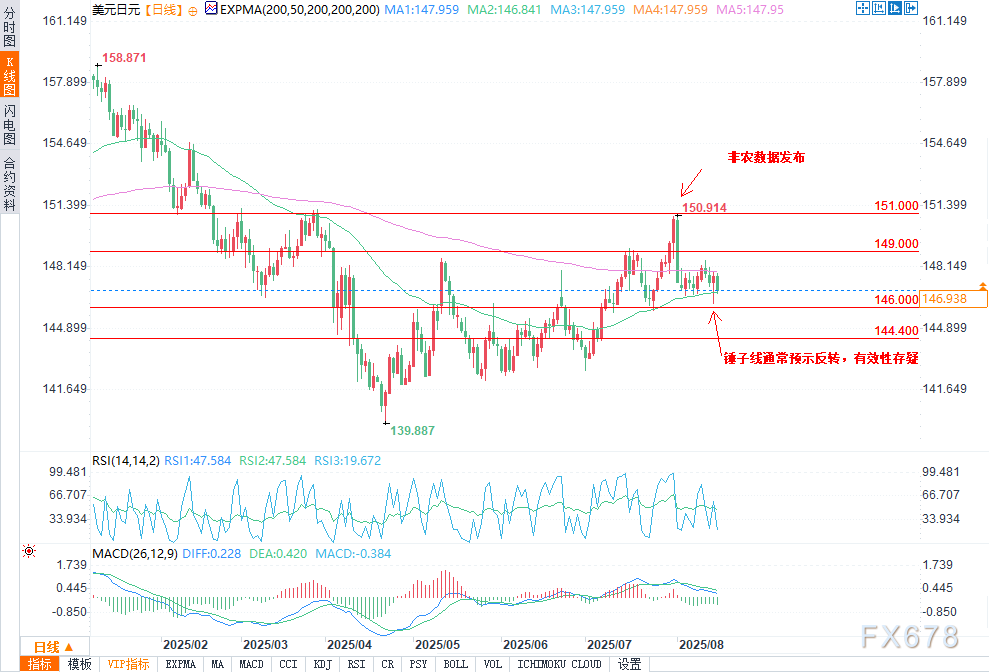
(USD/JPY daily chart, source: Internet)
As a result, since the non-farm payrolls report was released, the dollar/yen has been oscillating in a narrow range: when the exchange rate falls below 147.00, it will attract buyers to enter the market, and when it rises above 148.00, it will encounter selling suppression. The "hammer line" pattern that appeared on Thursday's daily chart suggested upside risks for the exchange rate ahead of Friday's data release, but considering the recent volatility, it is difficult to give this signal too much weight.
At the same time, the momentum indicator did not send a clear signal: the relative strength index (RSI, 14-day cycle) and the moving average convergence and divergence (MACD) both flattened around neutral levels, which means that the market should pay more attention to the actual movement of the exchange rate.
If the data push the exchange rate to break through the current oscillation range, support levels will be seen at 146.00 and 144.40, respectively, and resistance levels will be located at 149.00 and 151.00.
Please indicate the source: https://daoctech.com/fxschool/1705.html
Disclaimer: The content of this article does not represent the views of the Institute of Foreign Exchange. The content is for reference only and does not constitute investment advice. Investors operate accordingly at their own risk.