
The 4,500 ringgit mark has collapsed! Behind the three shades of palm oil, the bulls' defense line is facing the test of "match point"
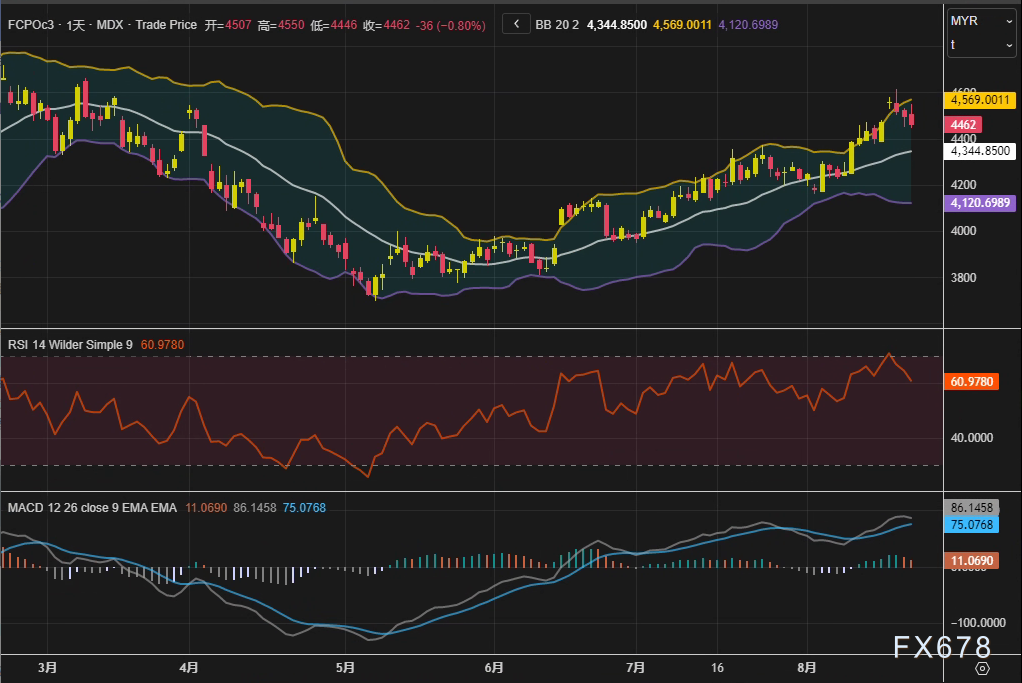
On Thursday (August 21), the main palm oil contract FCPOc3 of the Malaysian Derivatives Exchange (BMD) continued its decline, closing at 4462 ringgit/ton, down 36 ringgit, or 0.8%. Despite the strong export data from August 1 to 20, the market failed to hold the key psychological level of 4,500 ringgit, dragged down by the weakness of vegetable oil futures of China Dashang, and the selling pressure intensified in the afternoon.

Market background: outer disk oil and financial sentiment dominate
In intraday trading, the Dalian Commodity Exchange palm oil contract (DCPcv1) fell 0.19% and the soybean oil contract (DBYcv1) fell 0.17%, diverging from the Chicago Board of Trade (CBOT) soybean oil rose slightly by 0.47%. The regional spread movement reflects the market's short-term cautious sentiment on Asian demand. "The weakness in the Dalian market directly affected the confidence of the bull market, and technical selling accelerated after the loss of 4,500 ringgit," said a Kuala Lumpur trader.
Fundamental Dynamics: Inventory Contraction and Export Divergence
Despite the pressure on prices, there are still supporting factors in the fundamentals. According to data released by the Indonesian Palm Oil Association (GAPKI) today, Indonesia's palm oil inventories fell by 13% month-on-month to 2.53 million tons at the end of June. Despite the increase in production, the acceleration of exports has effectively relieved inventory pressure. Meanwhile, Malaysia's palm oil exports rose by 13.6% -17% month-on-month from August 1 to 20 (according to Intertek and AmSpec Agri data), reflecting the resilience of the demand side.
Linked Markets: Crude Oil Support and Biodiesel Logic
Palm oil was indirectly supported by a slight strengthening in the crude oil market. The larger-than-expected decline in US crude and refined oil inventories reinforced expectations of solid demand, driving crude oil prices upwards. Since palm oil is an important feedstock for biodiesel, stronger crude oil prices usually increase its energy attribute premium, but this logic today failed to fully offset the overall weakness in the vegetable oil sector.
Technical and institutional perspectives: short-term adjustment or continuation
From the technical indicators, the RSI (14) of the palm oil contract is currently at 60.98, which is in the neutral multi-range, but the difference between the MACD fast and slow line has narrowed, indicating that the momentum has weakened. "The correction from the high of 4614 ringgit has not yet ended, and the price may test the low of 4450 ringgit on August 20 again," noted technical analysts at well-known institutions. This view is in line with today's close to the support level.
Future Outlook: Focus on Spread Repair and Policy Trends
In the short term, palm oil prices are still subject to external oil market sentiment and capital flows, but two factors need to be paid attention to in the medium and long term: one is the dynamics of inventory changes and export policies in Indonesia and Malaysia, and the other is whether the oil price gap between crude oil and plants continues to narrow. If biodiesel demand accelerates with the strengthening of crude oil, palm oil is expected to regain upward momentum, but it needs to break through the current technical pressure range.
Please indicate the source: https://www.daoctech.com/fxschool/1716.html
Disclaimer: The content of this article does not represent the views of the Institute of Foreign Exchange. The content is for reference only and does not constitute investment advice. Investors operate accordingly at their own risk.