
The dollar/Canadian dollar has reached a new high. What is the market driving it?
On Friday, the dollar/Canadian dollar pair continued to rise, hitting a three-month high at 1.3918, showing strong upward momentum. Behind the dollar's rally was a strengthening of risk sentiment in the market, and traders were cautious about expectations that Federal Reserve Chairperson Jerome Powell will speak at the Jackson Hole conference.
While a 75 per cent chance of a rate cut in September is widely expected, traders' concerns that Mr. Powell might stick to a "patient" stance, warning of the risk of tariff-induced inflation, have also made the market reaction more cautious. Recent statements from Fed officials have also failed to provide a clear direction.
At the same time, the Canadian dollar is under pressure from low oil prices, and there are still latent risks to the trade relationship between Canada and the United States, which in turn affects the trend of the Canadian dollar.
Fundamentals
Dollar analysis:
The dollar's rally has been driven by a number of factors. First, expectations of a possible rate cut by the Federal Reserve remain unchanged, with the main focus on how the Fed will respond to the economic slowdown while maintaining its inflation target. In addition, Powell's speech is expected to be a key catalyst for market sentiment, with traders watching his specific remarks on the current economic situation and monetary policy.
Canadian Dollar Analysis:
The weakness of the Canadian dollar is closely related to the weakness of oil prices. The recent pressure on oil prices has exacerbated the pressure on the Canadian economy, especially in the context of heightened global trade uncertainty, which has increased the risk premium of the Canadian dollar. In addition, while the improvement of Canadian retail sales data has helped to boost market confidence in the short term, the upside of the Canadian dollar remains limited in the context of global economic instability.
Technical aspects:
According to the chart analysis, the USD/CAD pair is currently in an upward trend. The price touched 1.3918, a three-month high, indicating strong upward momentum.
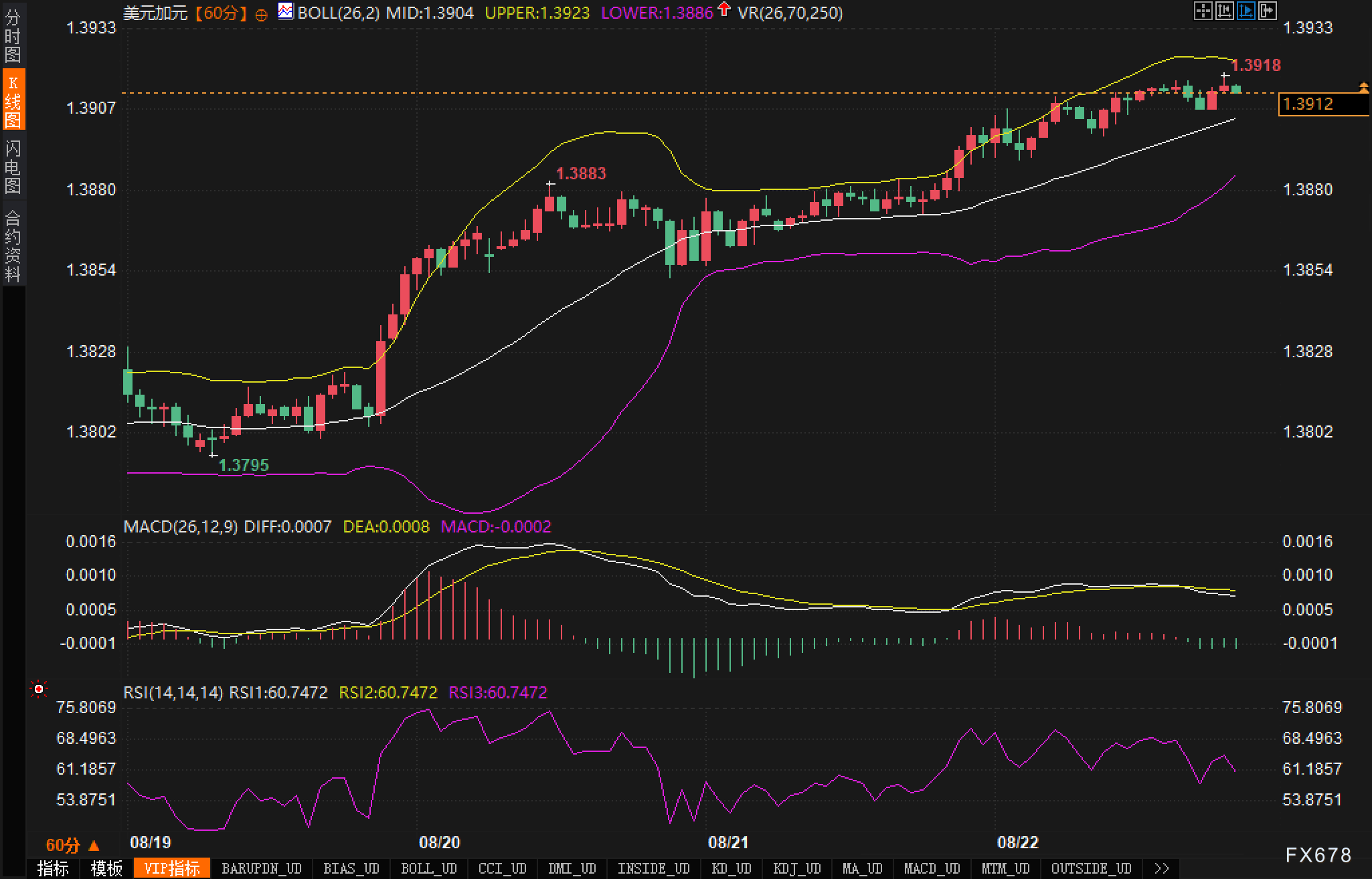
Bollinger Bands: The current exchange rate is stable near the upper Bollinger Bands, showing upward pressure. The width of the Bollinger Bands is expanding, indicating increased market volatility.
RSI: The RSI indicator is currently around 60, close to the overbought zone. Although there is a certain risk of a pullback, the overall market sentiment remains skewed.
Technical indications suggest that the USD/CAD pair may continue to rise in the short term, and if it breaks above 1.3920, it may challenge the next resistance level near 1.3950.
Market Sentiment Watch
The dollar continues to be favoured amid a pronounced risk aversion in the current market sentiment as traders fret about a global economic slowdown and heightened market uncertainty, particularly due to geopolitical factors.
Canadian dollar sentiment: Although the rebound in Canadian retail sales data has brought some hope to the market, downward pressure on oil prices remains the main reason for the weakness of the Canadian dollar, and trade risks between Canada and the United States may still exacerbate market unease.
Outlook
Long outlook:
From a technical perspective, USD/CAD has further upside in the short term after breaking through 1.3918. Market sentiment is skewed towards risk aversion, and the strength of the US dollar is likely to continue.
Short Outlook:
Although the US dollar is currently dominant, the Canadian dollar also faces potential room for a rebound, especially if oil prices recover and market sentiment stabilizes. If oil prices start to recover significantly, the support of the Canadian dollar may gradually emerge, leading to a correction in the US dollar/Canadian dollar.
Please indicate the source: https://www.daoctech.com/fxschool/1720.html
Disclaimer: The content of this article does not represent the views of the Institute of Foreign Exchange. The content is for reference only and does not constitute investment advice. Investors operate accordingly at their own risk.