
When the Dollar and the Japanese Yen Weak: The Price Game at the 147 Mark
On Monday (September 1), the European session of the US dollar/Japanese yen around 147.00 narrow consolidation. The intraday US dollar index DXY once fell back to around 97.55, but the exchange rate did not weaken, reflecting that the yen is also weak and the pattern of hedging at both ends is dominating short-term fluctuations.

Fundamentals
The main line of recent pressure on the dollar has come from the repricing of policy expectations: market expectations for the Federal Reserve's interest rate cut in September are "confirmed", and several officials - including Chairperson Powell - have made it clear that the downside risks posed by the cooling of employment have increased, and the policy rate is now ready to be reduced. At the same time, there is uncertainty about the continuation of US tariffs - last week a federal appeals court found that some of the Trump administration's tariff arrangements based on the emergency law were "illegal". Although the incident itself is a legal process, the policy sustainability doubts raised by it have further depressed the risk premium of the dollar. Looking ahead to this week, a basket of labour market indicators such as non-farm payrolls, job vacancies, unemployment benefits, and August ISM data will give more direct "hot and cold" readings; if employment continues to slow marginally, it will consolidate the consensus on interest rate cuts and curb the strength of the dollar's rebound.
On the yen side, there is little confidence in the Bank of Japan's second interest rate hike this year. Despite the finalization of the trade agreement between the United States and Japan, Bank of Japan members last week stressed that "there are still many uncertainties", noting that US tariff policy is suppressing "the sentiment of businesses and residents" in Japan. This means that unless the evidence of simultaneous wage and price increases is significantly strengthened, it is still a high probability scenario for the Bank of Japan to remain patient and gradual. Systemic strengthening of the yen still lacks catalysis until interest rate spreads have substantially converged.
Technical aspects:
From the daily chart, the dollar/yen is in the sideways convergence period after the "Bollinger Band squeeze". The current Bollinger middle rail is 147.748, the upper rail is 149.435, and the lower rail is 146.062; the K line has oscillated back and forth around the middle rail line in the past two weeks, indicating that the trend momentum is insufficient and the box is mainly fluctuating.
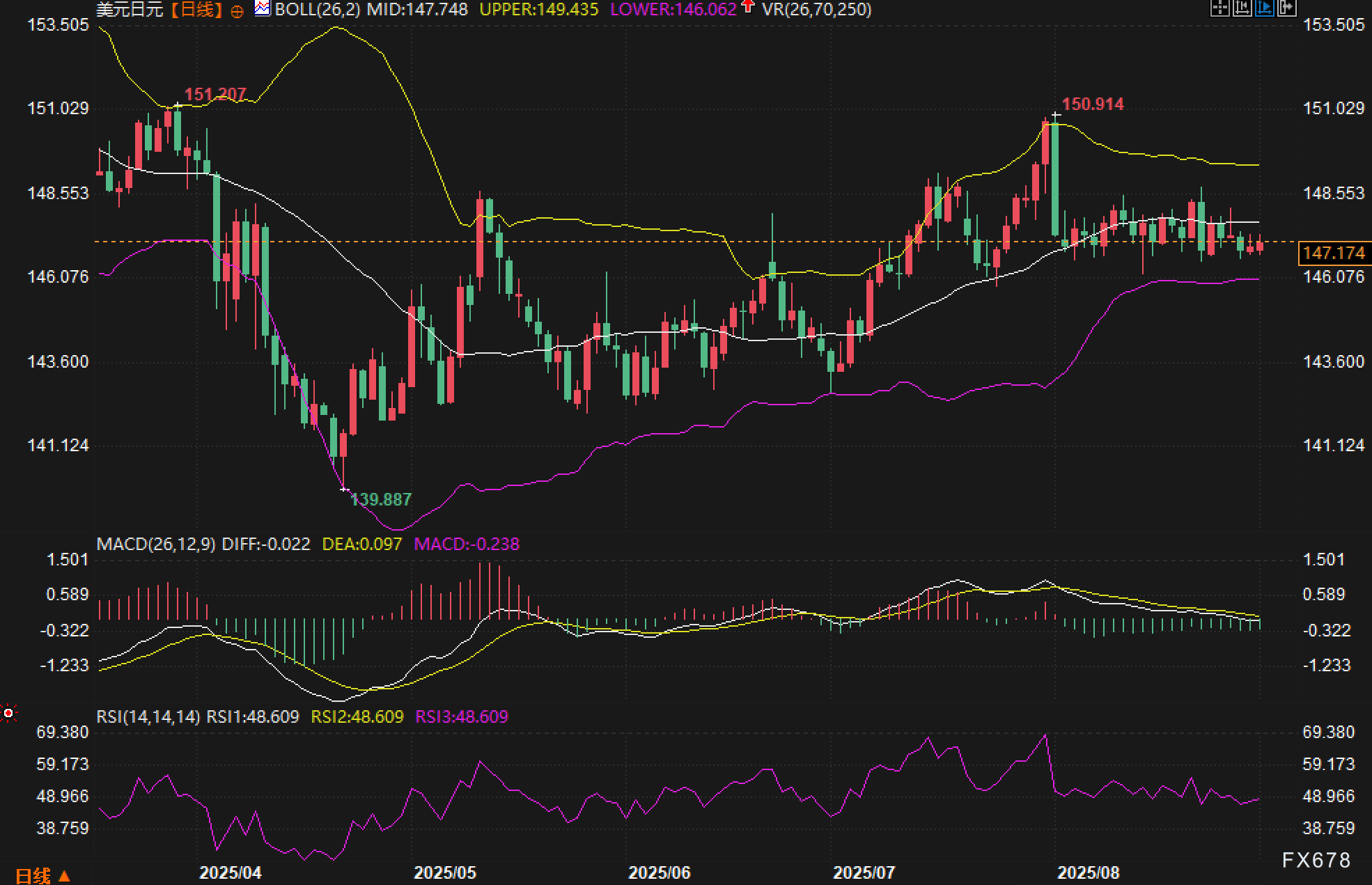
Structurally, the exchange rate once rose to 150.914, and then retreated and formed a narrower finishing area in August; the earlier low was at 139.887, establishing the framework of the "high and low point lift" of the medium-term upward trend. On the horizontal price level, the lower Bollinger rail 146.062 forms an important support; the upper rail 149.435 forms a resistance range, and the psychological level 150.00 is superimposed on the high point of 150.914, which is suppressed layer by layer.
In terms of index resonance, the MACD shows that the DIFF is -0.022, the DEA is 0.097, and the MACD column is -0.238. The DIFF is located below the DEA and the two lines are close to the zero axis. It is a "weak void but not diffused" structure, and the kinetic energy is hollow but lacks trend advancement. The RSI (14) is 48.609, and the neutral weak state is slightly lower than 50. With the narrowing of the Bollinger Band width, it indicates that the volatility is in the compression stage and the direction selection has not been completed.
Comprehensive judgment: 147.748 (Bollinger middle rail) is the current balance point; if the 146.062 support belt is effectively broken, the box will open down and point to the daily structure of 143.600 line; if it breaks through 148.50 and stabilizes above the middle rail, there is room for further testing 149.435/150.00/150. Since both RSI and MACD point to "weak oscillation", the first reaction is still the mean reversion and false breakthrough risk in the interval.
Outlook
Short-term (this week): The baseline scenario is a "data-driven range breakout". If US employment and the ISM continue to cool, and DXY's weakness around 97.55 continues, then USD/JPY needs to use the dual drive of "dollar weakness + technical breakout" to fall below 146.062; once the daily closing clearly falls below the lower rail, the price will point to 143.60. But if the data resilience is higher than expected, or the Bank of Japan continues to be cautious, the exchange rate may return to above 147.748 and challenge 148.50/149. 435, before deciding whether to form a backtest for the 150.00-150.914 area. Considering the current Bollinger Band extrusion and RSI neutrality, the first round of breakouts is more prone to false breakouts, and it is necessary to prevent the backtest confirmation of "breaking down" or "breaking down and pulling back".
Please indicate the source: https://www.daoctech.com/fxschool/1736.html
Disclaimer: The content of this article does not represent the views of the Institute of Foreign Exchange. The content is for reference only and does not constitute investment advice. Investors operate accordingly at their own risk.