
The Federal Reserve's hawkish interest rate cuts supported the dollar, traders reassessed the pace of easing, and the worsening UK fiscal deficit triggered double pressure
The dollar strengthened on Friday, extending a rally against most major currencies after the Federal Reserve cut interest rates this week but signalled a gradual easing ahead and traders were reassessing the short-term outlook.
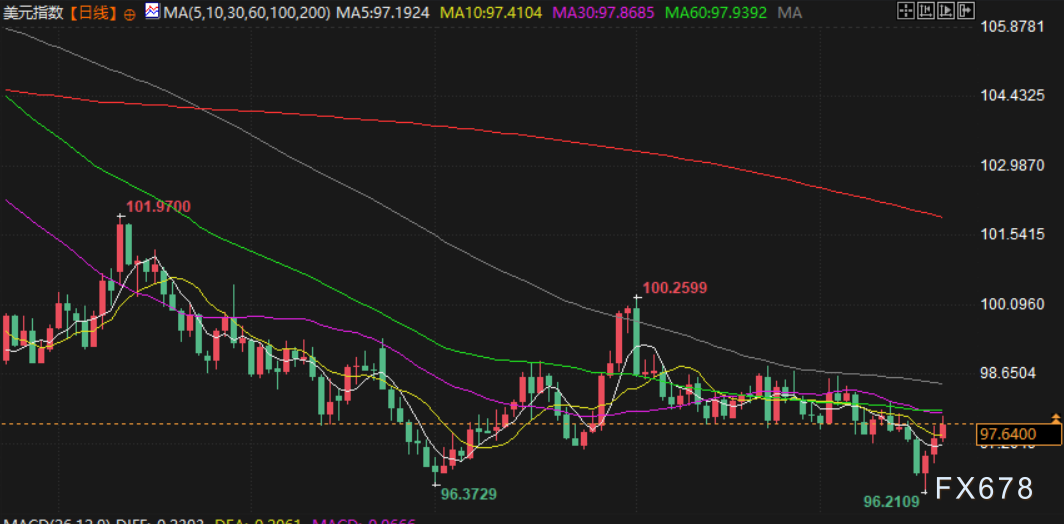
The dollar index rose 0.3% to 97.662. The index fell 1% on Monday and Tuesday on expectations that the Federal Reserve may initiate a rapid interest rate cut, but was flat this week.
The Federal Reserve cut interest rates as expected on Wednesday, but showed no urgency to cut borrowing costs quickly in the coming months. Its interest rate forecast chart, or "dot plot", shows that there may be two more rate cuts this year.
Marc Chandler, chief market strategist at Bannockburn Forex, said: "It's really been a two-in-two trading week. The voting results and the dot plot are not as dovish as the statements and concerns about the labour market." Mr. Chandler added: "We tell clients it's just a contrarian rally. If you have to sell dollars, there will be better prices soon."
In an interview, Mr. Bescent, the US Treasury secretary, encouraged the Fed to cut interest rates "aggressively". "President Trump has been very shrewd about economic governance and I think he's been right almost every time", he said. "The problem is that the Fed has been behind the curve. We hope they start to catch up in a drastic way."
Kevin Hassett, director of the White House National Economic Council and a leading candidate to be the next Fed chairperson, said on Thursday that a 25 basis point cut in interest rates was a good first step towards a big cut in interest rates, suggesting that the Fed's decision to cut interest rates appeared to be endorsed by the White House.
The analysis believes that the Federal Reserve's 25 basis points interest rate cut can be regarded as a buffer and expression to resolve the dissatisfaction generated by the White House through partial concessions.
"After Wednesday's rate cut sent mixed signals to the market, the market now sees a 92 per cent chance of a rate cut in October," ADM Investor Services said in a note.
Sterling fell on Friday as the UK's borrowing far exceeded official forecasts, adding to uncertainty over the fiscal outlook.
Sterling was one of the worst performers among the G10 currencies, reflecting investors' concerns about the ability of UK Chancellor of the Exchequer Reeves to control the budget. Sterling fell 0.6% to $1.3468, its biggest two-day drop since early April.
The Bank of England may not cut interest rates further this year, but sterling could weaken as markets digest that expectation and concerns about Britain's fiscal sustainability intensify, Rabobank's Jane Foley said in a note. She said markets remained closely watching Britain's difficult budget situation. She said Friday's release of worse-than-expected figures on UK public sector borrowing for August was a "timely reminder" of the UK's budgetary situation and the challenges facing Chancellor Rachel Reeves as she prepares for the November autumn budget.
The pound could come under further pressure in the short term as fiscal risks loom ahead of the autumn budget in November, strategists at Royal Capital Markets said in a note. The strategists said the UK economy faced considerable uncertainty ahead of the budget. "Based on our conversations with clients, we believe the majority of the market is prepared for a negative response to the budget."
Royal Bank of Canada forecasts that by the fourth quarter, the pound will fall to $1.3400 and the euro will rise to £0.8800.
The Bank of Japan announced after a two-day monetary policy meeting on Friday that it will maintain the current interest rate level unchanged, and will choose the opportunity to sell its financial assets in the future, reduce the scale of easing, and promote the normalization of monetary policy.
According to the announcement, the Bank of Japan continues to keep its policy interest rate at around 0.5%. In addition, the central bank will choose the opportunity to sell its holdings in the market in the future. Assets such as exchange-traded index funds (ETFs) and real estate investment trusts (REITs).
Bank of Japan Governor Ueda Kazuo said at a press conference that the Bank of Japan currently plans to sell ETFs with a carrying amount of about 330 billion yen and REITs with a carrying amount of about 5 billion yen every year, and the specific timing of the sale is to be determined.
According to the "Nihon Keizai Shimbun" website, the current market value of ETFs with a carrying amount of 330 billion yen is about 620 billion yen. As of the end of March this year, the ETF carrying value held by the Bank of Japan totaled 37 trillion yen, and the market price was about 70 trillion yen. During the COVID-19 pandemic, in response to the severe impact of the epidemic on the Japanese economy and market, the Bank of Japan continued to increase monetary policy easing by expanding asset purchase programs and other means. In March last year, the Bank of Japan announced the end of the negative interest rate policy, the first interest rate hike, and the suspension of ETF and REIT purchases. Since then, it has been looking for opportunities to sell its holdings.
The Bank of Japan kept interest rates on hold, but the committee disagreed and the yen strengthened. The unexpected opposition of two BoJ deliberators to keep rates on hold surprised investors and refocused on the timing of the next rate hike.
ING expects the Bank of Japan to raise interest rates in October, and analysts say the dissenting members' vote gives us more confidence in that view.
The market sees a 47 per cent chance of a rate rise in October, according to the London Stock Exchange Group, and analysts say the near-term fair value of the dollar against the yen has been overvalued, even without accounting for any realignment of the Bank of Japan's interest rate expectations.
ING expects the dollar to fall from its current level of Y147.95 to Y145.00 in a month and Y140.00 in three months.
Please indicate the source: https://www.daoctech.com/fxschool/1849.html
Disclaimer: The content of this article does not represent the views of the Institute of Foreign Exchange. The content is for reference only and does not constitute investment advice. Investors operate accordingly at their own risk.