
Sterling life and death battle! The 1.35 mark has become a watershed for long and short, and be wary of CPI detonating a rare market for 30 years
The pound has rallied above the 50-day moving average (1.3501) against the dollar since August, reaching a high of 1.3594 on Thursday, dampening the threat posed by the head and shoulders pattern in June-July, but if the exchange rate reverses the gains since last week's low (1.3399), it may follow the gradual flattening slope of the moving average.
On Tuesday (August 19) Asian session, the pound against the dollar narrowly oscillated, currently trading near the 1.3500 mark, the previous day's exchange rate closed down 0.4% to close at 1.3502. The dollar index (DXY) rose 0.24% on Monday to close near 98.15. On Tuesday in Asian markets, the dollar index held overnight gains and is currently trading around 98.20, promoting the general weakness of non-US currencies.
After hitting a new monthly high against the dollar last week (1.3595), the pound appears to be in a narrow range, and the consolidation trend is likely to continue as the exchange rate retreats before the July high (1.3789).
British economic calendar
The release of the UK Consumer Price Index (CPI) at 14:00 Beijing time on Tuesday could affect the direction of the pound against the dollar, with the market expecting headline inflation to rise to 3.7% in July from 3.6% in June. If the data show continued price increases, it may prompt the Bank of England to maintain a wait-and-see stance. In the previous August interest rate decision, the Bank of England narrowly passed the decision to cut interest rates by 25 basis points by a 5-4 margin.
As a result, sterling's range-bound moves against the dollar may be temporary - the Bank of England continues to fight inflation, but a weaker-than-expected CPI could weigh on sterling and force Governor Bailey and his colleagues to cut interest rates further.
The current situation suggests that the pound may struggle to hold on to the 1.3142 month-on-month low rebound against the dollar as the Bank of England emphasizes that "it remains appropriate to ease monetary policy in a gradual and prudent manner". However, as exchange rate movements are disrupting the potential head and shoulders pattern, the exchange rate may still try to recover further losses since the July high of 1.3789.
technical analysis
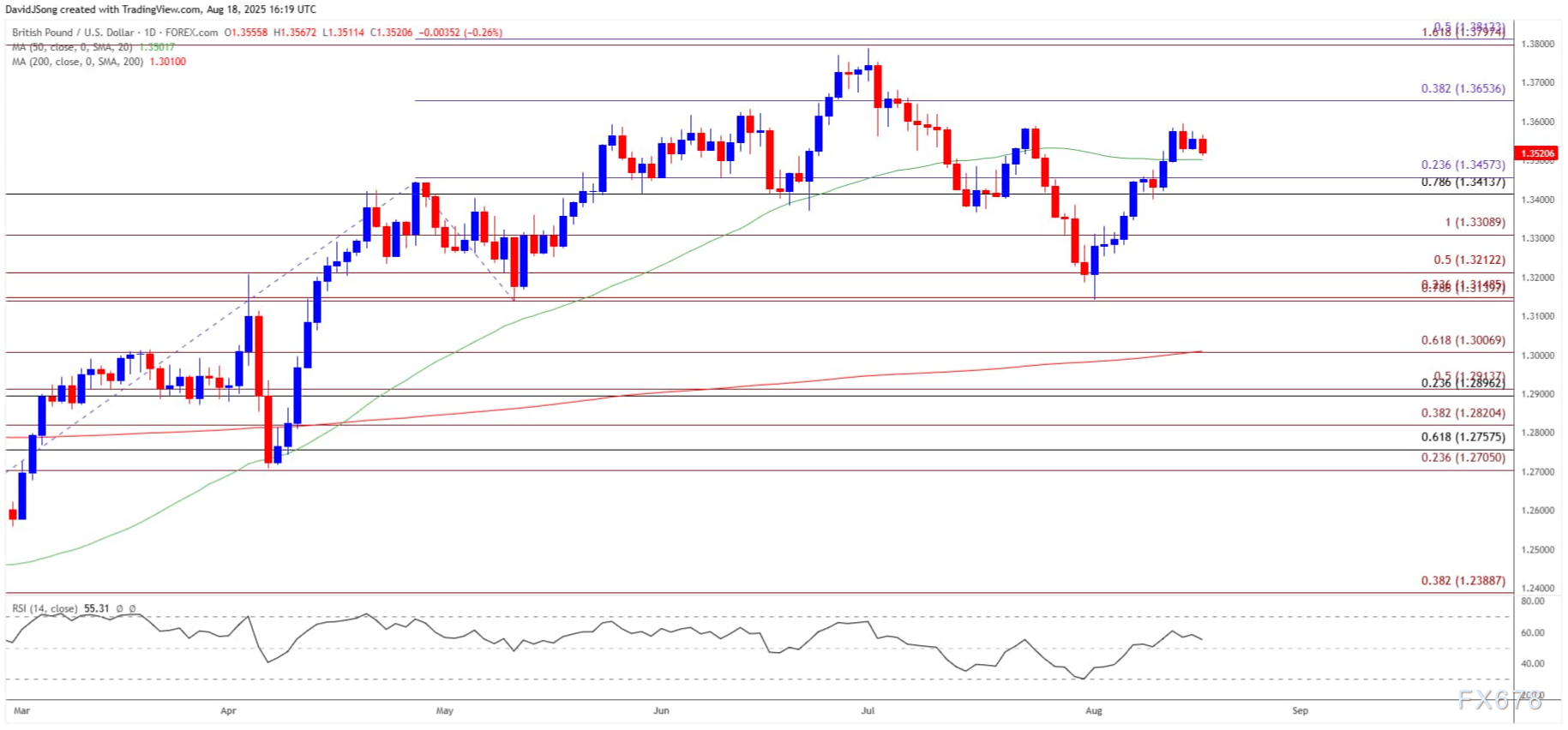
(Daily chart of GBP/USD)
If GBP/USD can hold above the 50-day moving average (1.3501), it is expected to continue last week's gains. If it breaks/closes above 1.3650 (38.2% Fibonacci extension), it may test the July high (1.3789).
If it breaks through/closes further in the range of 1.3800 (161.8% Fibonacci extension) to 1.3810 (50% Fibonacci extension), it may challenge the September 2021 high (1.3913). But if it fails to hold the support area of 1.3410 (78.6% Fibonacci retracement) to 1.3460 (23.6% Fibonacci extension), the pair may drop to 1.3310 (100% Fibonacci extension).
A loss of support at 1.3210 (50% Fibonacci Extension) could test the month's low (1.3142). A fall below the key area of 1.3140 (78.6% Fibonacci Extension) to 1.3150 (23.6% Fibonacci Extension) could further dip to 1.3010 (61.8% Fibonacci Extension).
At 10:43 Beijing time, the pound was trading at 1.3498/99 against the dollar.
Please indicate the source: https://www.daoctech.com/fxschool/2075.html
Disclaimer: The content of this article does not represent the views of the Institute of Foreign Exchange. The content is for reference only and does not constitute investment advice. Investors operate accordingly at their own risk.