
Sterling pulls back from a high level against the yen, policy expectations diverge to limit movement space
The pound against the yen (GBP/JPY) started the week under pressure, falling back from the psychological level of 200.00. Although it managed to stand at this level last Friday and hit a new high since 2008, the current pullback does not have obvious bearish momentum, more reflecting the market's cautious wait-and-see sentiment ahead of key central bank meetings.
In the UK, the Bank of England (BoE) is widely expected to leave its base rate unchanged at its policy meeting on Thursday and adopt a cautious wait-and-see stance. The recent rise in inflation expectations has supported the pound, but the lack of further policy tightening signals has also limited the pound's ability to move up.
An analyst at an international investment bank pointed out: "The Bank of England's inaction on interest rate policy will put pressure on the pound at a high level, but as long as inflation pressures do not ease significantly, monetary policy will still be difficult to shift to easing."

On the other hand, the Bank of Japan (BoJ) may delay the process of raising interest rates in the context of domestic political uncertainty, leaving the yen without buying support. However, Japan's second-quarter GDP was revised upwards, while the labor market was tight and real wages rose for the first time in seven months. These fundamentals provide the basis for another rate hike this year.
This policy divergence from the Bank of England's dovish stance has suppressed GBP/JPY to a certain extent.
"Market expectations for the Bank of Japan to raise interest rates are heating up, and despite political uncertainty, economic fundamentals are gradually improving, providing medium-term support for the yen," commented a Tokyo-based research firm.
At the same time, the recent agreement between the United States and Japan has removed some of the uncertainty, and the improvement in the external environment has made the market more focused on the Bank of Japan's policy meeting on Friday.
In addition, UK employment data (Tuesday) and inflation data (Wednesday) will also have an impact on the short-term trend of the pound. Overall, investors tend to remain cautious ahead of major risk events.
On a technical level, GBP/JPY is under pressure near the 200 mark, the short-term moving average maintains an upward trend, and the RSI falls back after being in the overbought area, indicating that the rally has cooled. If the price falls back to 198.50 support and stabilizes, it may restart the rebound trend, with the target pointing above 201.50.
If it falls below 197.80, it may trigger a deeper adjustment, backtesting the 196.50 line. Overall, the exchange rate is still in a high volatility pattern.
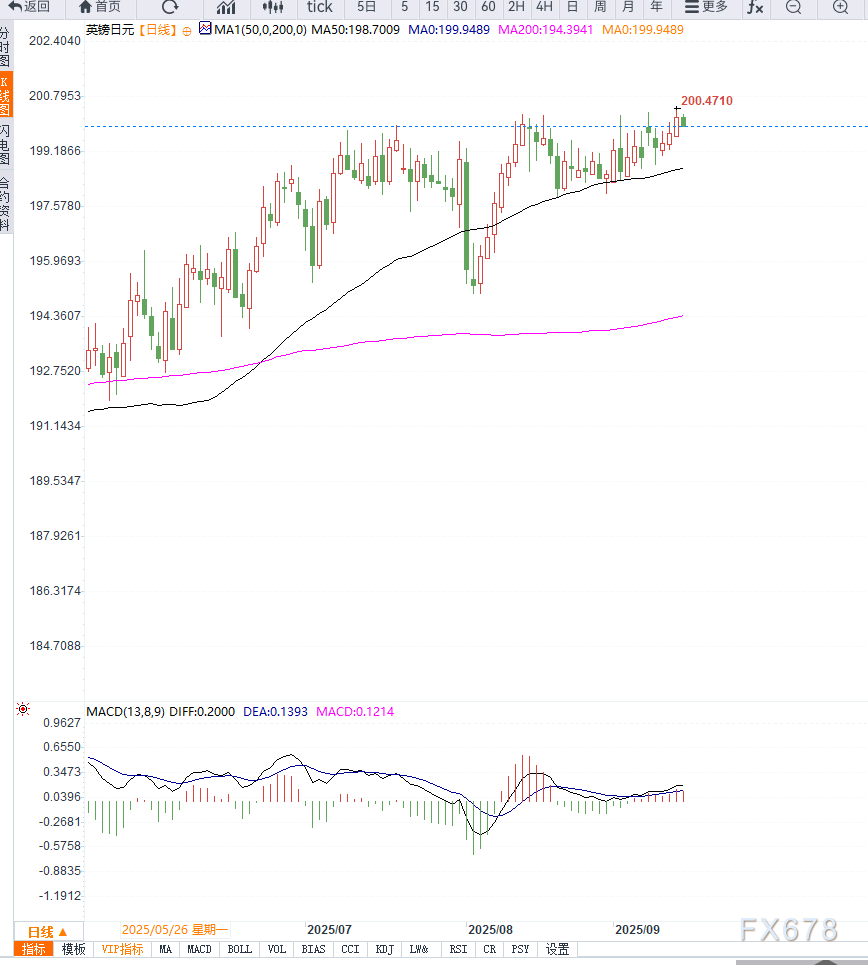
Editor's opinion: The current GBP/JPY is in high volatility, and policy differentiation is the core factor affecting the exchange rate. The Bank of England's wait-and-see attitude has limited the rise of the pound, while the Bank of Japan's interest rate hike expectation supports the yen, forming a short-term tug of war. Pay attention to the results of this week's two major central bank policy meetings.
If the BoE remains cautious and the BoJ confirms the path of interest rate hikes, GBP/JPY may fall back under pressure to support the 198.50-197 range. If the BoE unexpectedly releases a tightening signal, or the BoJ slows down the pace of interest rate hikes, the exchange rate may regain its upward mobility and test the resistance of the 201.50 and 200-day moving averages.
Overall, high volatility remains the main tone in the short term, and breaking through key support or resistance will determine the trend direction in the next stage.
Please indicate the source: https://www.daoctech.com/fxschool/2183.html
Disclaimer: The content of this article does not represent the views of the Institute of Foreign Exchange. The content is for reference only and does not constitute investment advice. Investors operate accordingly at their own risk.