
Euro long-short game: service industry inflation and employment data struggle
On Wednesday (June 3) in the European session, the euro was slightly under pressure against the dollar and was currently trading around 1.1610.
The Danske Bank research team pointed out that as short-term US and European interest rates remained stable, the euro maintained a narrow range of fluctuations against the dollar in the temporary balance of long and short forces.
Analysts emphasised that the combination of "strong macro data and solid earnings" was challenging the bearish view on US assets as the labour market no longer cooled following strong JOLTS data for April.hycmForeign exchange analysts are also concerned that the market's judgment on the trend of the dollar is diverging.

Market Review: The foreign exchange and fixed income markets are relatively calm
FX and fixed income markets were relatively calm yesterday, according to Danske Bank. This calm was reflected in several dimensions: eurozone inflation data was largely in line with expectations, energy prices were stable without sharp fluctuations, and short-term US and eurozone interest rates did not change significantly. The market lacked new macro catalysts, and traders remained on the sidelines until key data were released. HYCM Forex reminded investors that this calm may only be a brief lull before the storm.
From the actual trend, the euro/dollar rebounded after hitting a low of 1.1613 yesterday and a high of 1.1655, with extremely limited intraday volatility. This low volatility is no accident - it is estimated that about 90% of the current market volatility is pure sideways consolidation, and investors have developed "news fatigue" for real and fake news about the geopolitical situation.
The US labor market: no longer cooling, and may even tighten again
JOLTS job openings in the United States unexpectedly surged to 7.618 million in April, far exceeding market expectations of 6.87 million, the highest level since May 2024. The data attracted widespread attention in the market as it exceeded expectations by a statistically rare "9 Sigma level", setting a record for the largest upside surprise relative to consensus in the history of the survey.
Structurally, almost all of the surge in job openings came from professional and business services, which added 668,000 jobs, the largest monthly increase on record. At the same time, jobs in manufacturing and government also rose, while vacancies in finance and insurance fell. Notably, most of the new jobs came from small businesses with fewer than 10 employees, indicating that the recovery in demand from SMEs was an important driver of this data.
However, the other side of the data presented a "liquidity crisis" in the labour market - hiring plummeted 419,000 to 4.899 million, while voluntary resignations plunged 183,000 to 2.977 million, the lowest level since 2020. This shows that while business demand for labour is rising, employees' willingness to switch jobs is conservative, with the turnover rate falling to 1.9%, the lowest level since 2020.
Danske Bank pointed out that although the data reflect April rather than May, they reinforce the picture of a strong labour market that is no longer cooling and may even tighten again. After the data were released, market expectations for a 25 basis point rate cut by September have fallen to 35% from 48% the day before, and some Federal Reserve officials have even started to discuss the possibility of another rate hike to deal with persistent inflationary pressures. HYCM foreign exchange platform data show that investors are adjusting interest rate expectations more.
Inflation in the Eurozone: Overall in line with expectations, slightly higher than expected at the core
Eurozone HICP inflation rose to 3.2% year-on-year in May, in line with expectations, but slightly above preliminary national data and the highest level since September 2023. The core factor driving inflation higher was energy prices - which surged 10.9% year-on-year in May, the largest increase since February 2023. More worrying for policymakers, however, were signs of spreading inflationary pressures: core inflation rose to 2.5% year-on-year, higher than market expectations of 2.4% and 2.2% previously, the highest level in more than a year. Services sector inflation jumped unexpectedly from 3.0% to 3.5%, becoming the main driver of core inflation exceeding expectations.
Overall, this should limit the market's hawkish interpretation of the data, but the better-than-expected performance in services inflation still makes the data "moderately hawkish" for the ECB, in line with the bank's judgment that the ECB raised interest rates in June, according to Danske.
Overall, the euro is still in a range-based pattern against the dollar in the short term, and the relative stability of US and European interest rates provides a temporary balance for the exchange rate. However, strong signals from the US labor market are gradually weakening the market's bearish logic on US assets, limiting the downside of the dollar.
In the euro, core inflation exceeded expectations to provide the basis for the European Central Bank to raise interest rates in June, but the service sector-driven inflation upside also needs to be vigilant about its impact on the follow-up policy path. Short-term exchange rate fluctuations will still depend on Friday's non-farm data and the evolution of US and European central bank policy expectations. HYCMforeign exchange marketThe analysis points out that non-agricultural data will determine the short-term direction.
In terms of technology, the daily volatility of the euro against the dollar is weak. The exchange rate is currently running near 1.1610, under pressure below the MA20 and MA50 moving averages. The short-term pressure above is 1.1660, and the stage high of 1.1848 constitutes a medium-term strong resistance. Below, it is necessary to pay attention to the support of the previous low of 1.1575.
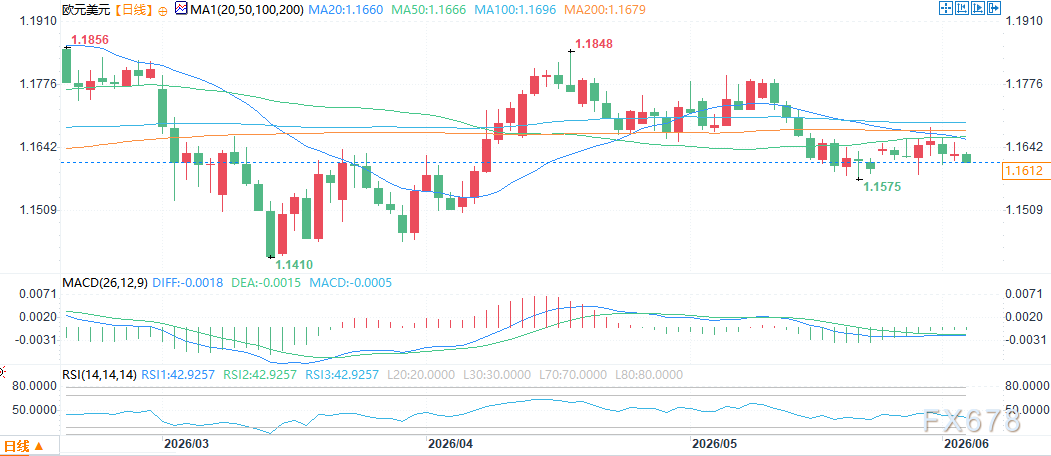
(EUR/USD daily chart, source: Internet)
The MACD runs below the zero axis, and the bearish kinetic energy continues slightly; the RSI falls back to 42.8, below the 50 pivot line, and the overall bearish. The price is continuously suppressed by the short-period moving average, and the rebound is weak. The short-term relies on the moving average to bear pressure and fluctuate weakly. The top focuses on the 1.166 resistance, and the bottom focuses on the 1.1575 support gain and loss. The break will further drop.
Please indicate the source: https://www.daoctech.com/fxschool/2621.html
Disclaimer: The content of this article does not represent the views of the Institute of Foreign Exchange. The content is for reference only and does not constitute investment advice. Investors operate accordingly at their own risk.