
How far does Europe have to go before monetary policy diverges from the United States?
Featured by Red Weekly | Jon O'Callaghan
(Eoin O'Callaghan)
The recent surge in financial stress in the US, compounded by signs that the Fed is nearing the end of its tightening cycle, could lead to further economic disparities between the US and the rest of the world. For Europe, the key question is whether and for how long the eurozone cycle and monetary policy will diverge from the US.
While near-term financial stress may pose downside risks to growth in Europe, we still expect supportive policies to be in place this year, while consumer and business fundamentals remain solid. There are growing signs of strong and increasingly entrenched inflation, and we believe this backdrop continues to mean that the European Central Bank (ECB) may need to raise interest rates for longer than market expectations. Here are the key considerations underpinning this view:
Financial stress in the US poses a new downside risk to eurozone growth. So far, the impact on European consumer and business confidence, and the funding costs of European banks, has been relatively limited, but these two risks still need to be kept in mind. The setback in consumer and business confidence could slow the expected growth rate of the recent economic growth survey, while the rise in financing costs could exacerbate the slowdown in private sector credit growth in Europe, which on an annualised basis fell from 6-7 per cent of GDP per month last summer to 1 per cent in Quarter 1 in 2023.
European banks are relatively more resilient. While we need to pay attention to the risks posed by rising financial stress, on the liability side of the balance sheet, European banks are relatively robust compared to the US, where there is less structural competition for deposits from money market funds. On the asset side, the European Central Bank has been a major buyer of government bonds, absorbing all net government bond issuance over the past decade.
Eurozone growth is underpinned by relatively supportive policies and fundamentals for consumers and businesses. While monetary policy is tightening in Europe, to a lesser extent, fiscal policy remains accommodative. Fundamentals for both consumers and businesses are very strong. Nominal income growth is at a record high and we expect real income growth to accelerate this year as headline inflation falls back to 3% at the end of the year. Unemployment is also at an all-time low, while corporate profitability is growing at an alarming rate and profit margins are at their highest levels before the global financial crisis. In short, without factoring in downside risks, fundamentals point to stronger growth momentum than the ECB's growth forecasts.
There are growing signs that inflation is strong and increasingly entrenched. Although core inflation in the Eurozone peaked at 5.7% in March, our forecasts suggest that our core forecasts for inflation in 2023 and 2024 are about 0.5-0 percentage points higher than those of the ECB due to continued strong increases in core service prices and record wage growth. Despite recent weakness in energy prices, consumer inflation expectations rebounded to nearly 3% in March, also suggesting that inflation has become more stubborn. Data in the Eurozone remains striking compared to the US, with both core inflation and wage growth moving higher. We continue to expect inflation in the Eurozone to exceed the US and G7 averages in the coming years.
Markets are pricing in upside risks to the ECB's likely extension of interest rate hikes. The ECB's decision at its May meeting to slow the pace of rate hikes to 25 basis points suggests some sensitivity to the recent slowdown in credit growth and the risks associated with recent financial stress. However, its own forecasts are consistent with final rates as high as 4.0 per cent, and for us the risks to these forecasts are skewed to the upside.
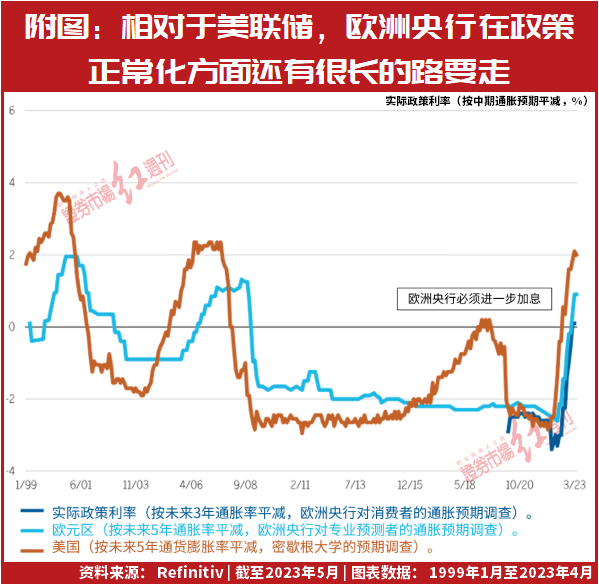
If financial stress intensifies, there will be some non-policy tightening. However, in the absence of such headwinds, the ECB is likely to continue to normalise interest rates in the autumn. Real interest rates also point to upside risks to the tightening measures the ECB needs to take. As Chart 1 shows, after the deflation of consumers' medium-term inflation expectations, the real interest rate is only 0.35%, well below the US equivalent of 2%.
Therefore, in general, investors should be prepared for continued discrepancies that will have different effects on asset prices in the euro area and elsewhere.
(The author is a macro strategist at Wellington Investment Management. The views expressed in this article are solely those of the author and do not represent the position of Red Weekly.)
Please indicate the source: https://www.daoctech.com/fxschool/392.html
Disclaimer: The content of this article does not represent the views of the Institute of Foreign Exchange. The content is for reference only and does not constitute investment advice. Investors operate accordingly at their own risk.