
Stop Loss Operation Tips: 8 Ways to Stop Loss
Stop loss is an essential part of foreign exchange trading, it can protect the safety of traders' funds and avoid further losses. The method of setting stop loss can be selected according to different trading strategies and market conditions. The following is8 Ways to Stop Loss
Method 1: Pressure level support level stop loss
After the order enters the market, look for the pressure and support position above or below this level to set a stop loss.
For empty orders, the stop loss is set above the pressure position, and for multiple orders, the stop loss is set below the support position.
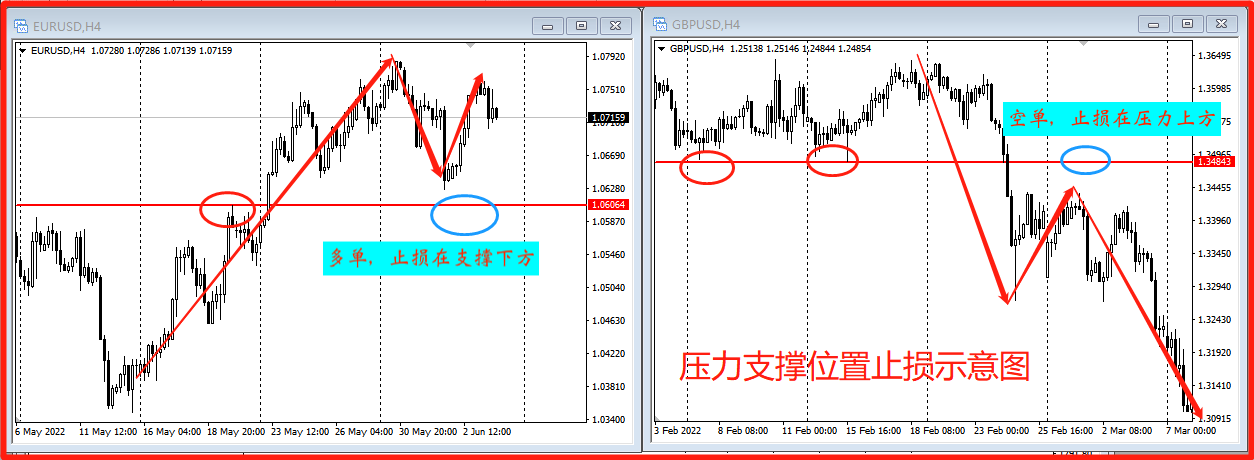
The left side of the chart is the EUR/USD 4-hour level k-line chart. After the bullish trend is established, the market will step back to form an entry pattern. After the order enters, the stop loss will be set below the front support position.
On the right side of the chart is the 4-hour k-line chart of GBP/USD. After the short trend is established, the market will step back to form an entry pattern. After the order enters the market, the stop loss will be set above the forward pressure position.
Note:
(1) The space for each stop loss is not the same, so pay attention to the use of positions. You can use the fund management method of fixed amount of each stop loss, stop loss amount/stop loss space = position.
(2) You can use this level or a higher level of support pressure than this level as a stop loss, but you cannot use a smaller level of support pressure as a stop loss.
Method 2: Stop loss at the front high and front low of the market start wave
This is the most common way to set a stop loss, and it is also the most commonly used stop loss method in right-hand trades.
After the start of the first wave of the market, the direction is established, and look for opportunities to enter the market. After entering the market, set the stop loss at the front high or front low of the starting wave.
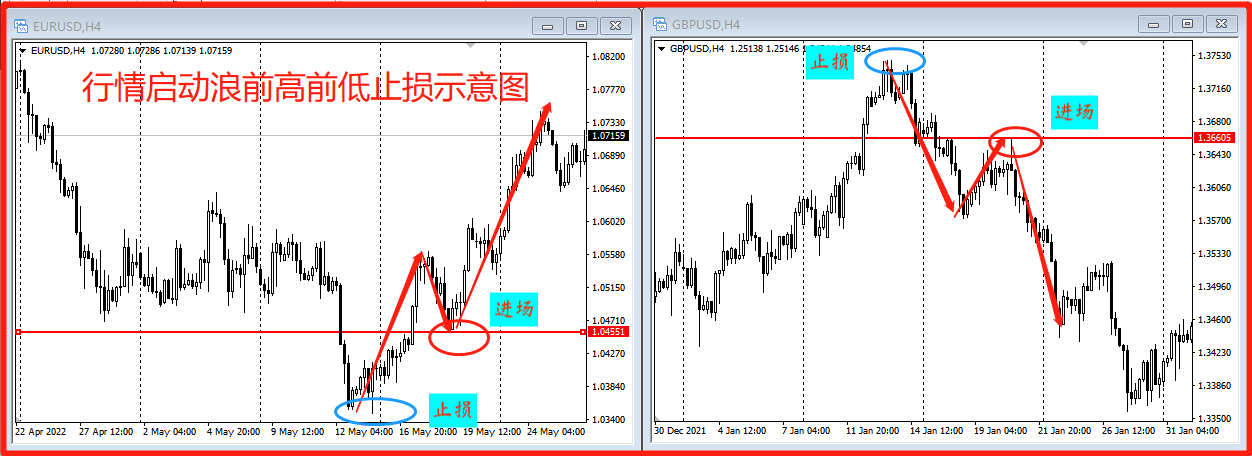
The left side of the chart is the k-line chart of the euro against the dollar. After the market starts the first wave of the bull, the step back establishes the entry. After the entry, the stop loss is set at the low ahead.
The right side of the chart is the k-line chart of the pound against the dollar. After the market starts the first wave of the bears, the step back establishes the entry. After the entry, the stop loss is set at the high point ahead.
Note:
The space for each stop loss is not fixed. When the pullback is not sufficient, for example, when the pullback is less than 38.2%, the stop loss space will be relatively large. Pay attention to position control.
Method 3: Market correction wave high or low stop loss
After the market start wave is completed, enter the market after the market correction wave is established, and set the stop loss at the high or low point of the correction wave.

The left side of the chart is the EUR/USD k-line chart. After the market is stepped back, a reversal k-line pattern is formed to enter the market, and the stop loss is directly set at the low point of the reversal pattern, that is, the low point of the correction wave.
On the right side of the chart is the k-line chart of the pound against the dollar. After the market is stepped back, the k-line pattern of the reversal is used to enter the market, and the stop loss is set at the high point of the reversal pattern (that is, the high point of the correction wave).
After the first evening star pattern entered the market, the market broke high again, and the order was stopped. The second entry of the inverted hammer line appeared again on the right, and the stop loss was still set above the inverted hammer line (the high point of the correction wave), and the market began to decline.
Note:
(1) Compared with the high and low points of the market start wave, the stop loss space is smaller, and the profit-loss ratio is more reasonable.
(2) The correction wave can sometimes go more complicated, and the order may be falsely broken through the continuous stop loss, so be prepared. In the picture above, the first time the pound enters the market, it is stopped.
Method 4: Moving Average Stop Loss
After the order enters the market, the price breaks through the moving average in reverse, and the order stops. This stop-loss method is generally used in the moving average trading system.

The chart shows the k-line chart of GBP/USD. After the price crosses on the left side of the chart, the order enters the market. In the blue circle on the left, the price breaks through the 30-day moving average in reverse. After the golden cross on the right, the multi-order enters the market. In the blue circle on the right, the price breaks through the 30-day moving average in reverse.
Due to the aggressive stop-loss method of price reverse breakdown of the moving average, two moving averages can be used at the same time, or three moving averages can be used to stop losses in batches, such as the 90-day moving average added in the figure, and all orders will be divided into two stops (in the two green circles in the figure).
Note:
(1) If you use a batch stop-loss method, you can allocate the proportion of each stop-loss position flexibly.
(2) The stop loss space is not fixed, and the use of positions should be reasonable, rather than heavy.
(3) In actual combat, multiple moving averages are more feasible to stop losses in batches.
Method 5: Organize the high and low points of the form to stop loss
This kind of stop loss method is mostly used in the trading system of break entry. After the break entry of the finishing pattern, the stop loss is set at the high and low points of the finishing pattern.

On the left side of the figure is a schematic diagram of the triangular relay finishing pattern in EUR/USD.
During the decline, the market went through a downward triangle. After sorting out the broken position, the order entered the market, and the stop loss was set at the high point of the consolidation pattern.
On the right side of the figure is a schematic diagram of the GBP/USD, head and shoulders inversion pattern. After the head and shoulders are broken, the order enters the market and sets the stop loss below the right shoulder.
Note:
Both the reversed shape and the relay shape can be used. For example, rectangular finishing, triangular finishing, flag finishing, double top and double bottom, head and shoulder bottom shape, head and shoulder top shape.
Method 6: Left-hand transactions are stopped by a fixed amount
Left-hand trading belongs to the trading logic of guessing the top and the bottom, buying in the falling process and selling in the rising process. Sometimes it is difficult to find a reasonable technical level to set a stop loss. You can use a fixed amount to stop the loss.
For example, in a top-bottom trade, stop loss 3% of the principal. The position can be determined according to the volatility of the product. After the order enters the market, the loss reaches 3% of the principal, and the position squaring out, waiting for the next opportunity.

The chart shows the k-line chart of EUR/USD. Assuming that the principal of the account is 10,000 USD, 3% of the stop loss principal is 300 USD. According to the 4-hour fluctuation of EUR/USD, the opening position is 0.3 lots, 300 USD/0.3 = 1000, and the stop loss is set at 1000 points.
(The points mentioned here refer to the small points of the 5-digit quotation system in foreign exchange trading software.)
Note:
(1) The use of positions should be rather conservative than aggressive.
(2) You can open the position in batches. After all orders reach the limit of the stop loss amount, all positions will be squaring at one time.
(3) The principle of using positions is that the positions of varieties with large volatility are light, and the positions of varieties with small volatility are heavy.
Method 7: Left-hand trade fixed space stop loss
The trading logic of guessing the top and bottom of the left trade. After the order enters the market, it is impossible to find a reasonable technical level for stop loss, and a fixed stop loss space is selected for stop loss.
For example, in a multi-order transaction, the order enters the market with a fixed stop loss of 500 points, and the market moves down by 500 points to stop the order.

The chart shows the k-line chart of EUR/USD. After the market tests up to the pressure, enter the market short, but there is no reasonable technical level above, and a stop loss can be set. Here, a fixed stop loss space of 500 points can be set.
Note:
The operation is relatively difficult, and different varieties, different time periods, and different stop-loss spaces should be adjusted flexibly.
Method 8: Trailing Stop Loss
After the order enters the market, set an original stop loss first. After the order generates a certain floating profit, adjust the stop loss along with the profit.
For example, if you hold a multi-order order, after a floating profit of 300 points, adjust the stop loss upward. Just like walking steps, every 300 points of profit is adjusted upward, only upward, not downward.

The chart shows the k-line chart of EUR/USD. After entering the market with a short order in the reversal pattern, the original stop loss is set at the high point of the reversal pattern. As the market develops, every 300 points down, the stop loss is moved until the market corrects and the order is out. The order in the chart moves a total of 3 times.
Note:
(1) Different varieties or transactions have different time periods, and the space for setting moving stops is different.
(2) There are many ways to move the stop loss, such as inflection points, high and low points of the k-line, and support pressure positions.
Please indicate the source: https://www.daoctech.com/fxschool/926.html
Disclaimer: The content of this article does not represent the views of the Institute of Foreign Exchange. The content is for reference only and does not constitute investment advice. Investors operate accordingly at their own risk.