
TD Bank: Federal Reserve may remain hawkish, Bank of Canada will end rate hikes this week
With inflation gradually easing towards target, the Federal Reserve's rate hikes are working as expected, but the Fed cannot let its guard down prematurely and may maintain a hawkish tone. Developments last week support our forecast that the Bank of Canada will end its rate hikes.
The United States: The Federal Reserve cannot let its guard down prematurely, and may maintain a hawkish tone
The U.S. economy is growing at a faster pace than initially reported in the third quarter. But a slowdown in consumer spending in October combined with some progress on inflation has strengthened market expectations that the Federal Reserve may have ended its tightening cycle. That said, there was some confusion in the Fed's rhetoric last week, with some arguing that today's policy rate is sufficiently restrictive, while others still believe it's too early to pull back. In his speech last Friday, Chairperson Powell called a rate cut premature.
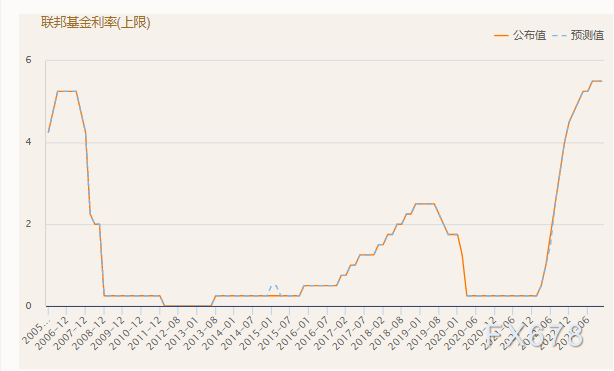
(Historical trends in U.S. interest rates, source: Central Bank Dynamics).
The revised value of U.S. GDP shows that the economy grew by 5.2% (annualized) in the last quarter, 0.3 percentage points higher than the initial value. The upward revision reflects improvements in government spending and fixed investment. A major category in contrast to this was consumer spending, which edged down to 3.6% from 4% previously. Heading into the fourth quarter, the personal income and spending report added another layer of restraint for consumers. Nominal spending rose 0.2% month-on-month in October, decelerating from 0.7% in September. Adjusted for inflation, the slowdown in spending was less pronounced, with growth slowing to 0.2% from 0.3% last month.
Given the dwindling supply of credit and the decline of "excess saving" in the epidemic era, U.S. consumers will have to rely more on income growth to fund spending. So any weakness in the labor market will affect the weakness in consumption. Looking at the labor market, continuing jobless claims rose to 1.93 million in mid-November. This is the highest level since late 2021 and another sign that the labor market is gradually cooling. Overall, we expect consumer spending to remain buoyant during the holiday season, but this momentum is likely to wane and consumption growth is likely to slow to around 2% this quarter.
(Figure 1)
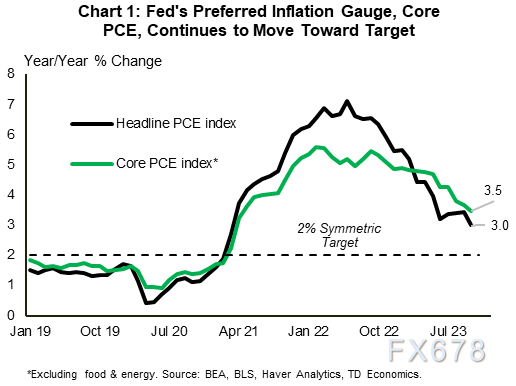
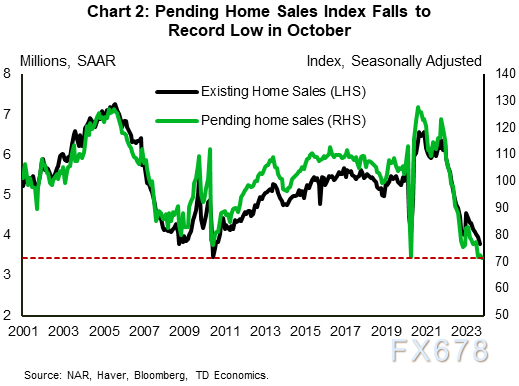
The monthly Personal Income and Expenditure report also brought some good news on the inflation front. The bright spot was the continued deceleration of the core PCE (the Fed's preferred measure of inflation), with year-over-year growth slowing to 3.5% in October from 3.7% the previous month (Figure 1). As the Fed continues to advance toward its 2% target, interest rates have declined, as have mortgage rates. The 30-year mortgage rate is currently hovering around 7.2%, about 80 basis points below its mid-October peak of 8%. This pullback appears to have provided some relief to the housing market, with mortgage purchase applications rising for the fourth straight week last week. But, the impact of interest rates tends to be lagging, so it will take a while for this to show through in sales activity. Therefore, sales of homes for sale fell to an all-time low in October, indicating that the situation could get worse before it gets better (Figure 2).
(Figure 2)
Overall, with inflation gradually easing towards the target, rate hikes are working as expected, but the Federal Reserve cannot let its guard down prematurely and may maintain a hawkish tone until it is confident that inflation will return decisively to 2%.
Canada: Avoid falling into a technical recession, the central bank will end interest rate hikes
Last week's data showed that Canada is not in a technical recession, a scenario that is increasingly likely until updated real GDP figures eliminate that possibility. Gross domestic product actually fell unexpectedly in the third quarter, contracting 1.1 per cent from a year earlier. But a strong upward revision to the second quarter brought output back into positive territory, lifting Canada out of a technical recession.
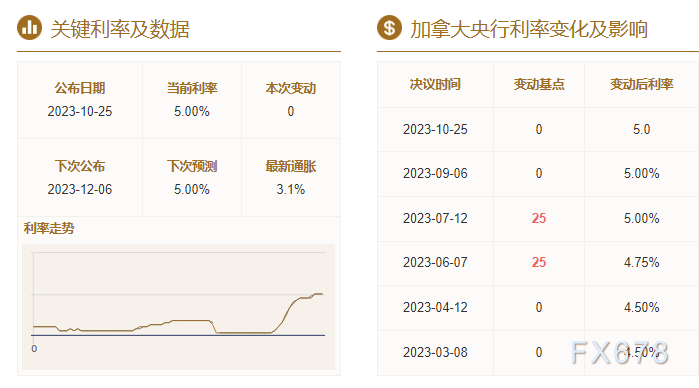
(Bank of Canada interest rate dynamics, source: Bank of Canada dynamics)
Although Canada is not in recession, it is showing weakness, and the risks to growth next year cannot be ignored. The decline in real GDP growth in the third quarter was largely driven by external factors, as net exports and slow inventory accumulation were the main drags. Final domestic demand, a better indicator of the health of the domestic economy, continues to grow at a strong pace.
The industry-based monthly gross domestic product provides first-hand data showing how things are going in the fourth quarter. October guidance noted that output grew at a moderate pace, helped by a modest but above-consensus-expected increase in September. This made growth trend positive early in the fourth quarter, but still below trend. The next few months are expected to provide clearer GDP data as the one-off shocks that caused volatility over the past six months have dissipated. For now, the rumours surrounding Canada already in recession should subside, but we expect GDP growth to be below trend for most of 2024 (Figure 3).
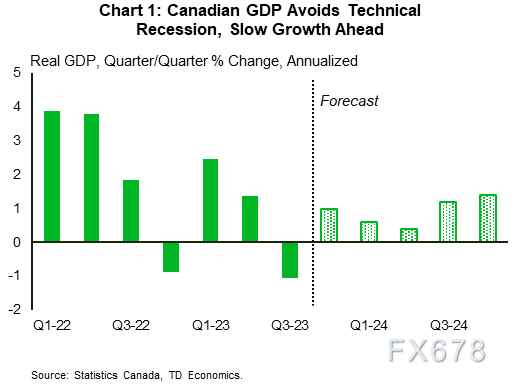
(Figure 3)
Canada's labour market is also slowing, but has not yet completely lost its edge. Canada added 25,000 jobs in November, pulling the three-month trend of job growth slightly lower. However, the unemployment rate has risen by 80 per cent since April (Figure 4) as labour force growth continues to outpace job growth. The labour market has held up relatively well at this point in the cycle, but the Bank of Canada (BoC) may want to see the market move further towards balance. Notably, wage growth remains strong, which could fuel future inflation concerns, while job vacancies, while down, remain high.
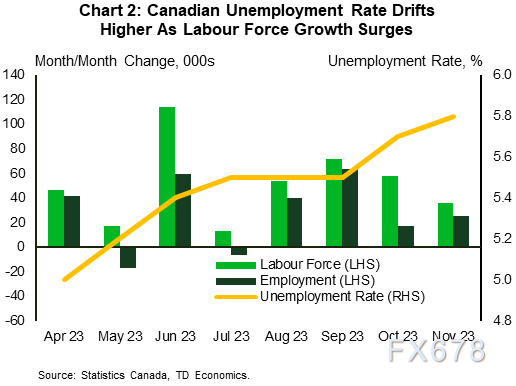
(Figure 4)
Developments over the last week have supported our prediction that the Bank of Canada (BoC) will end its interest rate hikes. However, it is too early for the Bank of Canada to be too dovish at this week's meeting and say anything about a rate cut or timing. The Bank of Canada may need to see inflation (especially in its core indicators) persistently lower before it abandons its inclination to raise rates. Markets have priced in the likelihood of a first rate cut around April, which is consistent with our view. The Bank of Canada (BoC) 's most aggressive rate hike in more than 40 years is working. Consumer spending is down, the labour market is rebalancing, and economic growth is in line with inflation gradually approaching the central bank's 2% target.
Note: The Bank of Canada will announce its interest rate decision this Wednesday (December 6) at 23:00 Beijing time.
Please indicate the source: https://www.daoctech.com/fxnews/1014.html
Disclaimer: The content of this article does not represent the views of the Institute of Foreign Exchange. The content is for reference only and does not constitute investment advice. Investors operate accordingly at their own risk.