
Goldman Sachs raised its gold price forecast, which turned out to be the reason!
Monday (March 18), the beginning of the Asian market,Spot goldNarrow range oscillation, currently trading in 2156.86dollar/Ounce. Although the price of gold began to recover last week after setting a new all-time high on March 8, the famous investment bank Goldman Sachs released a report on Friday (March 15) to raise its price forecast. The bank believes that the price of gold will rise to $2,300 before the end of the year.
The year 2023,Federal ReserveFiscal tightening to combat inflation has undoubtedly affected investment activity and helped to help certain safe-haven assets, including gold, which reached a new milestone value at the end of last year.
However, markets anxiously awaited a rate cut this year, leading to a lull in early 2024. That didn't last long, with gold prices rising to record highs in March. Now that performance has weighed on Goldman Sachs' forecasts, which now expect gold to hit $2,300 this year.
"We have raised our average gold price forecast for 2024 from $2,090 to $2,180, with a target of $2,300 by the end of the year," the bank said in the report.
Goldman SachscommodityNicholas Snowdon, head of metals at Research, and Lavinia Forcellese, an analyst, have noted in previous reports that downside risks to gold prices are expected to be limited by several key factors. First and foremost, central bank buying is strong and geopolitical tensions are high. Central bank buying, particularly from China and India, has helped offset outflows from gold ETFs, in part due to geopolitical tensions.
Central banks bought an average of 1,060 tonnes of gold between 2022 and 2023, compared with 509 tonnes between 2016 and 2019. The increase in gold reserves comes as China is shifting its reserves away from the US dollar, while countries such as Poland have also increased their gold reserves.
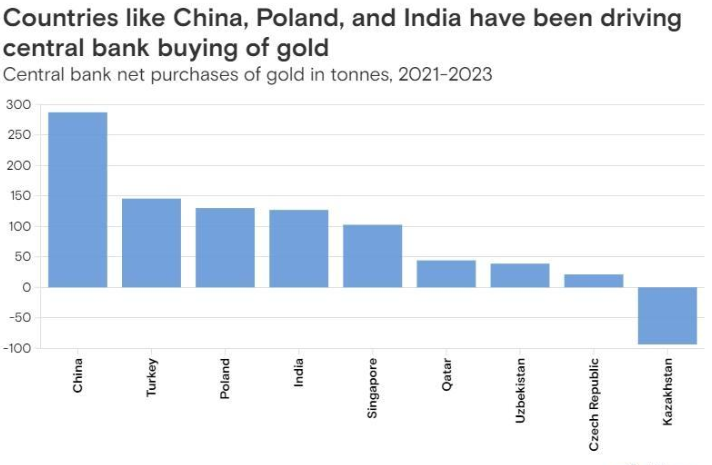
Depu Capitaldooprime"We expect central bank purchases to remain strong against a backdrop of reserve diversification in emerging markets and heightened geopolitical tensions," the analysts wrote.
It is worth noting that investment demand for gold has not yet rebounded. The recent decrease in ETF purchases may be due to the fact that gold ETF holdings are already high, especially when compared to actual inflation-adjusted interest rates. In recent years, Russia-Ukraine conflicts andUnited StatesMajor upheavals such as the Silicon Valley banking crisis have triggered buying of gold, which has remained high despite rising long-term U.S. yields.
Recent speculative positions in gold by institutions such as hedge funds have tracked changes in long-term yields, according to Goldman Sachs research, suggesting that people are more sensitive to changes in macroeconomic policy than to ETF holdings, which continue to experience outflows.
Goldman Sachs said: "Historically, changes in gold ETF holdings have tended to be triggered by major risk-off events and easy monetary policy cycles. Our analysts expect ETF holdings to climb once the Federal Reserve starts cutting interest rates. Strong retail demand for gold is likely to drive prices higher, while the" wealth effect "of rising income in emerging markets is driving consumer demand for gold, especially jewellery."
"The growth in jewellery consumption will be driven by the rapid growth of India's affluent consumer base," Goldman Sachs analysts wrote. "Gold consumption is also supported by a lack of alternative investment in some countries that have seen significant policy shifts over the past few years, including Turkey and large Asian countries."
Please indicate the source: https://www.daoctech.com/fxnews/1080.html
Disclaimer: The content of this article does not represent the views of the Institute of Foreign Exchange. The content is for reference only and does not constitute investment advice. Investors operate accordingly at their own risk.