
The market focuses on the Federal Reserve's decision, and the euro is expected to benefit from the European Central Bank's interest rate hike
On January 31, Beijing time (Tuesday), the Asian market morning, the dollar index rose slightly, and is currently trading around 102.25. The dollar index rose on Monday, closing up 0.28% at 102.22. The market expects the Federal Reserve to raise interest rates by 25 basis points this week, and TD Securities strategists hinted that if the dollar wants to rebound, it needs to see stronger economic data. The market expects the European Central Bank to raise interest rates by 50 basis points, and the euro is expected to be boosted, but the outlook for the euro zone economy is cloudy and may limit the rebound space. The market expects the Bank of England to raise interest rates by 50 basis points this week, but the UK economic and political risks continue, and the pound's rise may be short-lived, and it will continue to be under pressure in the future.
On February 2nd at 03:00 Beijing time, the Federal Reserve is about to start a two-day policy meeting. The Federal Reserve is widely expected to raise interest rates by 25 basis points, and investors will watch for any new signs of how many more rate hikes may be possible.
BannockburnGlobalForex chief market strategist Marc Chandler said Fed chairperson Jerome Powell was in a "difficult position" because "the Fed is going to raise rates by 25 basis points, but he has to fight against easing financial conditions".
Fed funds rate futures traders are expecting the Fed rate to peak at 4.94% in June and then cut to 4.53% by December. That contrasts sharply with comments from Fed policymakers who have said they need to keep rates in restrictive territory for some time in order to reduce inflation. The current federal funds rate is 4.33%.
The disparity is in part due to traders' speculation that a weakening U.S. economy and a possible recession will push the Federal Reserve towards a more dovish policy.
The dollar index has retreated from a 20-year high of 114.78 touched on Sept. 28 to around 102.2 as investors digested the possibility that the Federal Reserve is nearing the end of its tightening cycle. But the greenback has been largely in range swing over the past few weeks as it hit technical support levels against major currencies, including the euro.
The question now, Chandler said, is "whether the dollar will rebound, or whether this is a pattern of recuperation before further declines."
Stronger economic momentum may be needed to boost the dollar, strategists at TD Securities said in a note, adding that the catalyst for a reversal would need to come from stronger data.
The euro rallied and retreated against the dollar on Monday, closing 0.17% lower at 1.0848. Data on the day showed that Spanish consumer prices rose 5.8% year-on-year in January, up from a 5.7% year-on-year increase in December and the first year-on-year increase since July last year. Niels Christensen, chief analyst at Nordea, said: "These data will underline expectations for a 50 basis point hike by the European Central Bank on Thursday, while also indicating that interest rates will rise further."
The European Central Bank will hold an interest rate decision on Thursday, and the market expects it to raise interest rates by 50 basis points for the first time since December 28, which is expected to boost the euro. However, Oxford Economics said that despite the improved market sentiment, the economic outlook for the euro zone remains uncertain. This could weigh on the euro.
Paolo Grignani, senior economist at Oxford Economics, said the euro zone economic sentiment index rebounded for a third month in a row, indicating that the worst of the energy crisis is over. Nonetheless, the outlook for the euro zone economy remains uncertain. Similarly, the sharp deterioration in economic confidence in the euro zone over the past few months has not led to a sudden collapse in economic activity, and this improvement is not expected to translate into growth momentum for the euro zone economy in the first half of 2023 now. The data are also likely to reassure the European Central Bank of further interest rate hikes, as they suggest that economic activity in the euro zone's services sector is staying buoyant and that price pressures will persist even if they ease overall.
Sterling fell against the dollar on Monday, closing 0.39% lower at 1.2350. The Bank of England will hold an interest rate decision on February 2 and release meeting notes and monetary policy reports.
Gilles Moec, chief economist at AXA Investment Management, said in a note that the BoE faced a difficult decision on Thursday as policymakers worried about both the potential harm of excessive tightening and still very high inflation. The UK labour market remained tight and core inflation was higher than expected, requiring the BoE to raise interest rates by 50 basis points, but the MPC was clearly concerned about the risk of "excessive rate hikes".
In addition to the epidemic, the British economy is still suffering from the impact of large-scale strikes, which are the risk factors that weigh on the pound. The British "Guardian" said that the inflation rate and cost of living in the British economy have been at historical highs for several months, and various industries have called for higher wages. The wave of strikes has been continuous since December last year. The Guardian also said that the UK is facing a serious economic crisis due to the policy mistakes of the previous prime minister, the epidemic and the conflict between Russia and Ukraine.
In addition, British Prime Minister Sunak announced on the 29th that he would dismiss Nazim Zahavi from the cabinet, on the grounds that the latter seriously violated the ministerial code. Zahavi's position as chairperson of the Conservative Party was also dismissed. Political and economic risks continue, and the pound may continue to be under pressure.
The Australian dollar retreated from a high against the dollar on Monday, closing down 0.69% at 0.7059. Australia's inflation rate soared to a 33-year high in the fourth quarter of 2022, a surprise result that raises the possibility that the Reserve Bank of Australia will further raise interest rates, which is expected to limit the downside of the Australian dollar.
Tuesday's key data and events
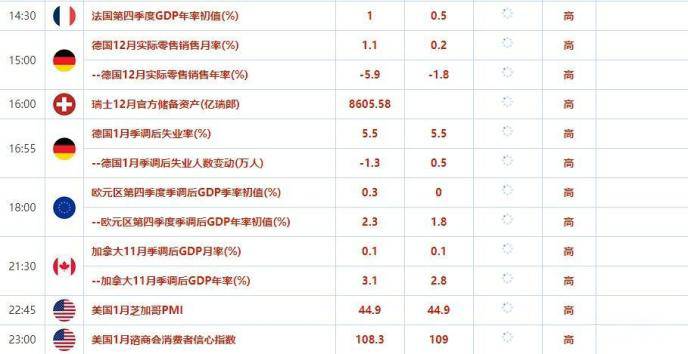
Investors need to pay attention to the major events: on February 1st (Wednesday) at 01:30 Beijing time, US President Biden delivered a speech on infrastructure; on February 2nd (Thursday), the Federal Reserve, the Bank of England and the European Central Bank announced interest rate decisions.
institutional perspective
1. Institutional analysis: The European Central Bank is raising interest rates faster than the Federal Reserve, and the euro will rise.
① The euro's four-month rally still has room to rise. Although the euro is still falling against the dollar, the euro is the best performing currency among the G10 currencies today. Spain's unexpected surge in inflation in January led traders to increase their bets on how much the European Central Bank would raise interest rates;
② Economists expect a 50 basis point rate hike on Thursday, and traders expect an 81% chance of a rate hike in March. The Federal Reserve is expected to raise rates by 25 basis points on Wednesday. Whatever Powell says, it will be difficult for him to reverse market bets on a rate cut later this year;
2. HSBC Investment Management: The US economic downturn will prompt the Federal Reserve to cut interest rates earlier, and it may be reduced by 100 basis points during the year;
HSBC Investment Management believes that with the US economy showing signs of recession, the Federal Reserve will change its stance and cut interest rates earlier and more aggressively than the money market expected this year.
② Joe Little, the firm's global chief strategist, said the Fed could cut rates by 100 basis points before the end of this year, double the 50 basis points currently absorbed by US interest rate swaps. He also sees the possibility of another 200 basis points in 2024. US 2-year Treasuries are the most sensitive to policy changes, with yields having fallen sharply from the 15-year highs they hit in November, but Little believes the market is not yet fully pricing in easing
3. Commonwealth Bank of Australia: Bank of Japan's actions in the coming months may put pressure on the United States and Japan.
① Kristina Clifton, senior economist and currency strategist at the Commonwealth Bank of Australia, said: "The strong rise in CPI in Tokyo in January adds to the case for starting to ease ultra-loose monetary policy;"
② She added: "In our view, speculation that the Bank of Japan will start normalising monetary policy in the coming months will put pressure on the dollar against the yen;"
4. Mitsubishi UFJ: The Canadian dollar is expected to perform poorly in 2023;
① Lee Hardman, senior foreign exchange analyst at MUFG, said: "It is necessary for the Bank of Canada to take a breather and assess economic performance for at least the first half of the year before adjusting its policy rate, especially given the lagged nature of monetary policy shocks to the economy and the full impact of tightening is yet to be felt."
② He said that in the current tightening cycle, the Bank of Canada has been ahead of other G10 central banks and has once again become the first central bank to officially announce a pause in tightening. This decision has strengthened market expectations that other major central banks, including the Federal Reserve, will soon follow the Bank of Canada's lead; "
③ He added: "The dollar remains vulnerable to further dovishness in Fed expectations. Overall, developments support our outlook for the underperformance of the dollar and the Canadian dollar in 2023."
Please indicate the source: https://www.daoctech.com/fxnews/112.html
Disclaimer: The content of this article does not represent the views of the Institute of Foreign Exchange. The content is for reference only and does not constitute investment advice. Investors operate accordingly at their own risk.