
The Reserve Bank of Australia takes off its "forward guidance" mask, and this week's resolution may become a bursting night for Australian dollar bulls?
The Reserve Bank of Australia has had communication problems, which has injected unpredictability into interest rate policy at a time when global uncertainty is already high, which has proved costly for investors.
This all stems from an April reshuffle at the Reserve Bank of Australia, which fully transferred interest rate-setting power to a new nine-member Monetary Policy Board.
At its second meeting in May, the committee decided to cut the cash rate by 25 basis points to 3.85 percent, sounding more dovish than analysts had expected, even considering the uncertainty caused by U.S. tariffs.
Due to some weak economic data, investors are betting heavily on another rate cut in July, while a Reuters poll of 37 analysts showed that 31 expected a rate cut.
It is crucial that investors are encouraged to hold large amounts of these positions because the RBA has not depressed expectations as it has in the past.
Imagine their surprise when the Reserve Bank of Australia's policy committee decided in a rare 6-3 split to leave interest rates unchanged, leaving many investors with painful losses.
After the decision, Reserve Bank of Australia President Michele Bullock told the media that the central bank could no longer provide guidance because interest rates were determined entirely by the policy committee and could not be pre-empted.
In essence, the RBA changed the way it communicated with markets without telling them that it had changed.
Luci Ellis, chief economist at Westpac and former assistant governor of the Reserve Bank of Australia, said: "With no MPB member leading the board, future inter-meeting communications are unlikely to be for or against market pricing."
This means that market surprises will occur more frequently here than in countries such as the US, which are more focused on avoiding market surprises.
A muted inflation report has since led investors to widely expect the Monetary Policy Committee to cut interest rates to 3.60 per cent at its next meeting on August 12 - partly on the assumption that central banks will not create two policy shocks in a row.
However, policy uncertainty is exacerbated by the committee's unique composition: it consists of only two RBA officials, a senior Treasury official and six part-time external members from economic, business and banking backgrounds, appointed by the current Treasury minister on the advice of the RBA.
The market knows almost nothing about the policy preferences of the six members, and this situation is difficult to change in the short term - at present, each member is only vaguely required to appear in public once a year.
It is now likely that members of the Reserve Bank of Australia's board will be in the minority in interest rate decisions, but the president will still have to face the media to defend decisions he opposes.
What's more, because the voting results are not public, it is sometimes impossible for investors to even judge whether the central bank's position has been overturned.
"It's easier for the current Fed president to lose the vote because the outside committee has a clear advantage," said Jonathan Kearns, chief economist at Challenger Bank and a former senior official at the Reserve Bank of Australia. "I think the current committee is more willing to challenge the president."
Jonathan Kearns pointed out that "this does pose additional risks, but the RBA needs to convince external members by providing rigorous analysis and rigorous advice."
This new governance model has made the Reserve Bank of Australia an "outlier" among global central banks. The decision-making committees of the Federal Reserve and the European Central Bank are composed entirely of central bankers, while the Bank of England consists of five central bankers and four professional economists. A nine-member committee.
Both the Federal Reserve and the Bank of England make public the voting positions of each member - both central banks have been increasingly divided in recent months. Andrew Hauser, deputy chairperson of the Reserve Bank of Australia, admitted at an economic forum this week that the July interest rate decision was indeed more unpredictable than it should have been, and admitted that the committee was still "groping its way" in the policymaking process.
He insisted that such unpredictability would not become the norm, but warned that markets "still occasionally experience shocks", as investors betting on rate cuts are eagerly hoping this week will not be such a "surprise moment".
As of August 11, 2025, the current official cash rate of the Reserve Bank of Australia (RBA) is 3.85%.
With the Reserve Bank of Australia no longer providing clear forward guidance, market bets on interest rate policy are more prone to miscalculation (such as the short-term jump in the Australian dollar caused by the unexpected maintenance of interest rates in July). If the RBA unexpectedly stands still again, the Australian dollar may rebound in the short term; conversely, if it is more loose than expected, the Australian dollar may depreciate rapidly. Policy uncertainty at the RBA has gradually evolved from a short-term volatility factor to a systemic risk to the Australian dollar. In the absence of clear guidance, the Australian dollar has become more sensitive to market sentiment, and traders may rely more on data-driven strategies.
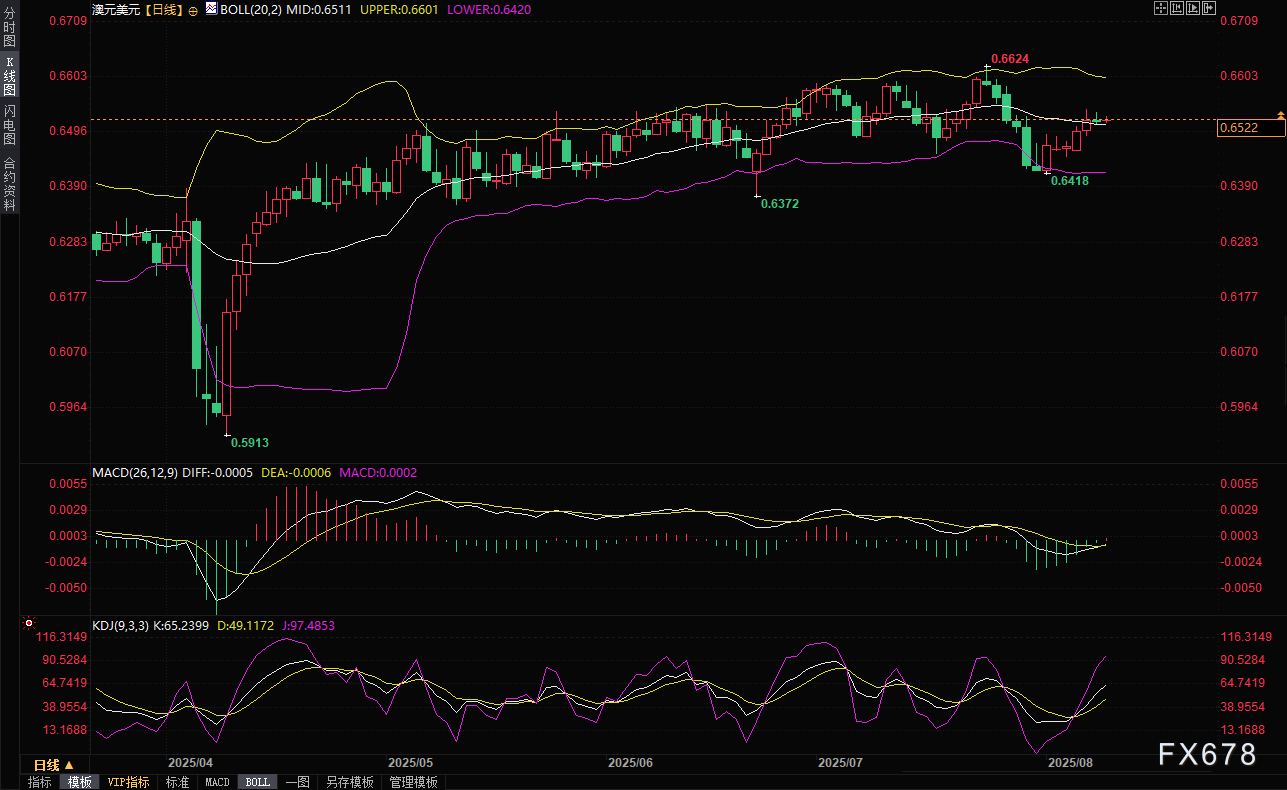
(Australian dollar/US dollar daily chart, source: Internet)
At 13:304 Beijing time, the Australian dollar was trading at 0.6521/22 against the US dollar.
Please indicate the source: https://www.daoctech.com/fxnews/1692.html
Disclaimer: The content of this article does not represent the views of the Institute of Foreign Exchange. The content is for reference only and does not constitute investment advice. Investors operate accordingly at their own risk.