
Gold prices are blocked below $3,400, with risk appetite limiting gains
On Friday (August 8), spot gold fell slightly after hitting a two-week high of $3,409 during the session, and the market sentiment was cautious. Gold prices were trading around $3,396 during the session, up 0.02%.

Gold has been underpinned by concerns about the economic impact of US tariffs, persistent inflationary pressures and rising expectations of a September rate cut by the Federal Reserve. However, a modest rebound in the dollar, relatively stable Treasury yields and broad risk appetite in global equities have limited further gains in gold prices, with bulls struggling to break through the key psychological barrier of $3,400.
Gold futures surged to record highs after the US imposed new tariffs on 1kg and 100oz gold bars, according to the Financial Times, despite a modest rise in spot gold prices and holding steady. The December gold contract on the New York Mercantile Exchange rose to an all-time high of $3,534.10 before easing slightly, driven by concerns about potential supply chain disruptions and rising import costs. The rally also spread to the Indian market, where multi-commodity exchange October gold futures hit a new high above the Indian rupee per 10 grams due to a weakening rupee, supply risks from tariffs and strong investment demand. 102,000.
First reported by the Financial Times, a ruling issued by US Customs and Border Protection (CBP) on July 31 classified 1kg and 100oz gold bars as 7108.13.5500 tariff code, meaning they would face higher import tariffs. The standard bars are mainly refined in Switzerland. The move is expected to increase pressure on Switzerland, one of the world's largest centres for trading precious metals, which exports about $61.50 billion a year to the US. It is another blow for Switzerland, which already faces a 39 per cent tariff on a wide range of exports under the Trump administration's reciprocal trade measures.
Market drivers: a stabilizing dollar, a rebound in yields, and risk appetite boost stocks
The dollar index (DXY) stood above 98.00 on Friday, but remains close to a two-week low.
US Treasury yields rallied, with 10-year yields holding steady at around 4.25% and 30-year yields at 4.82%, rebounding from multi-week lows and dampening gold's upward momentum.
Speaking on Friday, Mousalem, a Federal Reserve official, laid out the challenges facing the US economy but gave no direct view on interest rate policy. He said the labour market remained balanced but warned that weak economic activity could endanger jobs.
Mr. Musalem also noted that while the tariffs could temporarily push up inflation, the impact could fade as companies adapt by cutting costs and negotiating suppliers. He said there was some persistence in inflation and acknowledged that the Fed was currently missing its inflation target but was still fulfilling its jobs mandate. He also warned that if labour market conditions deteriorated, the central bank could miss both inflation and employment targets.
Global stock markets are on track for strong weekly gains, strengthening the risk-appetite tone and weighing on gold. The Stoxx 50 and Stoxx 600 are expected to gain 3.3% and 1.9% respectively for the week, their best performances since April. In Asia, the MSCI Asia Pacific index rose 0.4% to achieve a five-day streak of gains, while Japan's Nikkei 225 surged 2.2%. Britain's FTSE 100 is also expected to end the week in positive numbers. Meanwhile, U.S. stocks edged higher on Friday, capping a week of trading that has been awash in tariff news. The Dow Jones Industries Average Index rose more than 1% on the day, after hitting a record high on Thursday
Technical analysis: Hold the key moving average, but face strong resistance near $3,400
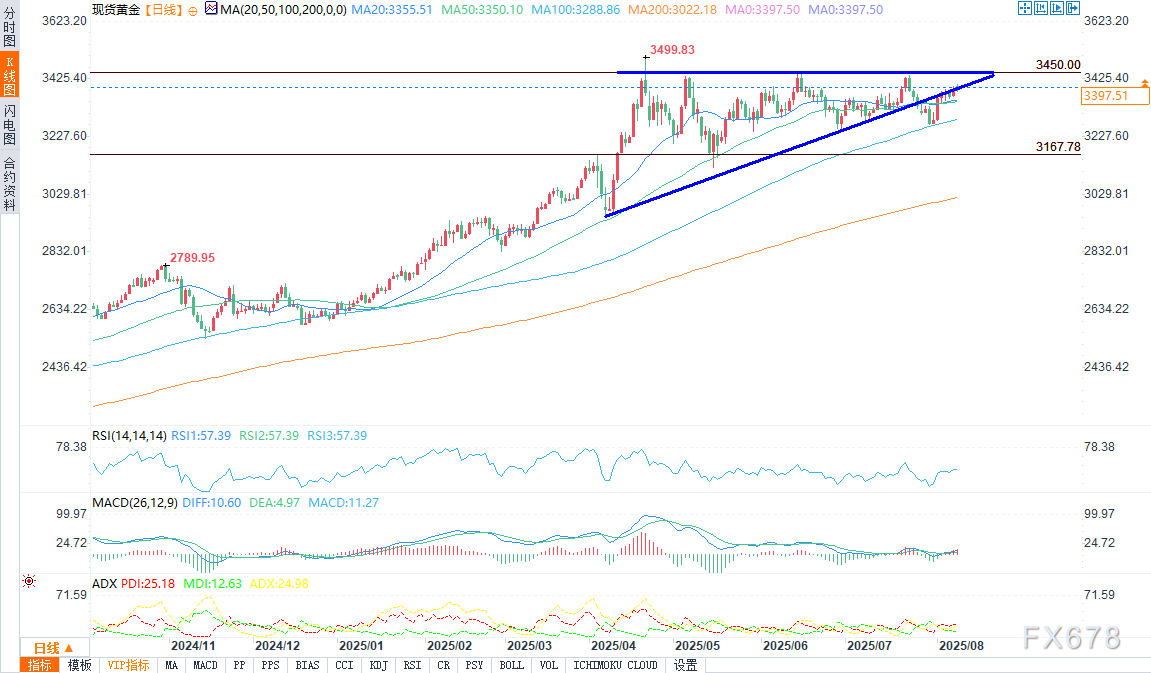
(Daily chart of spot gold, source: Internet)
Spot gold remains at the mercy of below the key resistance level of $3,400, with bears continuing to defend this psychological level. After touching a two-week high of $3,409 earlier on Friday, gold is struggling to maintain its upward momentum. Price action remains in line with the broader ascending triangle pattern, although last week gold briefly fell below the uptrend line, causing the pattern to weaken slightly. However, the decline received strong buying support above the 100-day simple moving average (SMA) of $3,289, helping bulls regain their footing and maintain the overall bullish structure.
The Relative Strength Index (RSI) on the daily chart is at 57, in the neutral range, indicating neutral to moderately bullish momentum. Meanwhile, the Moving Average Convergence Divergence (MACD) indicator remains positive, with the MACD line above the signal line, suggesting that momentum is improving. However, the Average Directional Index (ADX) remains low, indicating that the current trend is not strong enough.
For the bulls, it is crucial for the daily close to settle in the $3,400-3,410 area, which could open space for a move towards $3,450, while all-time highs around $3,500 are also back in view. On the downside, key support is at $3,349 near the 50-day moving average, followed by the 100-day moving average at $3,289 - a level below which could disrupt the current bullish structure and tilt the market towards bears.
Please indicate the source: https://www.daoctech.com/fxnews/1693.html
Disclaimer: The content of this article does not represent the views of the Institute of Foreign Exchange. The content is for reference only and does not constitute investment advice. Investors operate accordingly at their own risk.