
Foreign exchange trading reminder: the dollar rallied on safe-haven buying, and the UK's economic recession expectations increased pressure on the pound
The dollar index rose to a high of 103.17 on Friday before closing up 0.45 per cent at 102.86 after weak global corporate activity data fuelled risk aversion and hawkish comments from central banks added pressure on riskier currencies. Growing expectations that the UK economy could fall into recession weighed on sterling.
In early Asian trading on June 26, Beijing time, the dollar index fluctuated narrowly and is currently trading around 102.77. The dollar index rose to a high of 103.17 on Friday before closing up 0.45% at 102.86 after weak global corporate activity data led to risk aversion and hawkish remarks from central banks added pressure on riskier currencies.
US business activity fell to a three-month low in June as service sector growth slowed for the first time this year and manufacturing contracted more sharply, closely watched survey data showed on Friday. But the overall picture showed the economy picked up slightly in the second quarter, even as fears persisted that the Federal Reserve's aggressive rate hikes over the past year would trigger a recession
Earlier in the session, data showed business activity in the eurozone almost stalled in June as the downturn in manufacturing deepened while activity in the region's dominant services sector barely grew as overall demand fell for the first time since January.
Bipan Rai, head of North American FX strategy at CIBC capital markets, said: "We are starting to see signals from companies that demand is starting to slow slightly, which has led to a readjustment of expectations for future output." Mr. Rai said: "I do think that concerns about the future outlook are now suppressing risk appetite, and the dollar is being bought in part because of that concern."
Rai said that as the end of the month and quarter approaches, traders clear their books, which could also support the dollar.
Friday's data followed a larger-than-expected rate hike and hawkish comments from global central banks, which reignited fears that policymakers still have some way to go in tightening policy to rein in inflation and could even tip the economy into recession.
Kit Juckes, chief FX strategist at Socie ́ te ́ Ge ́ ne ́ rale (601166), said in a note: "The market was nervous about the surprise of a larger-than-expected rate hike following larger-than-expected rate hikes in the UK and Norway, which helped the dollar even before we saw the European PMI data."
Federal Reserve Chairperson Jerome Powell said on Thursday that the central bank would start to adjust interest rates at a "cautious pace" from now on, but ruled out the possibility of a rate cut "happening soon".
Last Friday, the euro fell to a three-day low of 1.0844 against the dollar, and finally closed down 0.56% at 1.0894.
Luis de Guindos, ECB vice-president, said the central bank was "entering the final phase of the tightening cycle" and that the timing of a pause in a series of rate rises "will depend on the data", he said in an interview. "The picture of core inflation is very important."
He added that the monetary policy and base period effects implemented by the ECB would "help" to slow core inflation and that it was important to "look at the second-round effects: everything related to wage growth and the evolution of unit labour costs". If the second-round effects scenario becomes complex, "monetary policy will have to do more" and fiscal policy must also play a role in reducing inflation.
In addition, weaker-than-expected PMI data from France and Germany raised fears of a recession in the euro zone and also weighed on the euro. Chris Hare, economist at HSBC, said the decline in the PMI for services in the euro zone was particularly severe, indicating that persistently high growth in labour costs and tighter monetary conditions had begun to take effect. If these headwinds do have an impact, they will raise questions about the extent of the euro zone's recovery from the winter recession in the second quarter.
The dollar rose to its highest level in more than seven months against the yen on Friday at 143.87 before closing up 0.42 per cent at 143.71 as the yen came under renewed pressure as the Bank of Japan maintained an ultra-dovish stance.
Data released on Friday showed that Japan's core consumer inflation in May exceeded expectations, and a measure that excludes fuel costs rose at the fastest pace in 42 years, putting pressure on the Bank of Japan to gradually withdraw its massive stimulus measures.
Heightened expectations that the UK economy could slip into recession after the Bank of England raised interest rates sharply on Thursday in response to persistently high inflation weighed on the pound, which closed 0.25 per cent lower at 1.2715 against the dollar on Friday. The exchange rate recorded a drop of about 0.82 per cent last week, its biggest weekly decline in six weeks.
The Australian and New Zealand dollars struggled on Friday as traders shunned riskier currencies.
The Australian dollar closed down 1.18% at 0.6675 against the dollar on Friday, down nearly 3% last week, its worst weekly performance since the end of August. The New Zealand dollar closed down 0.55% at 0.6142 on Friday, after falling 1.46% last week.
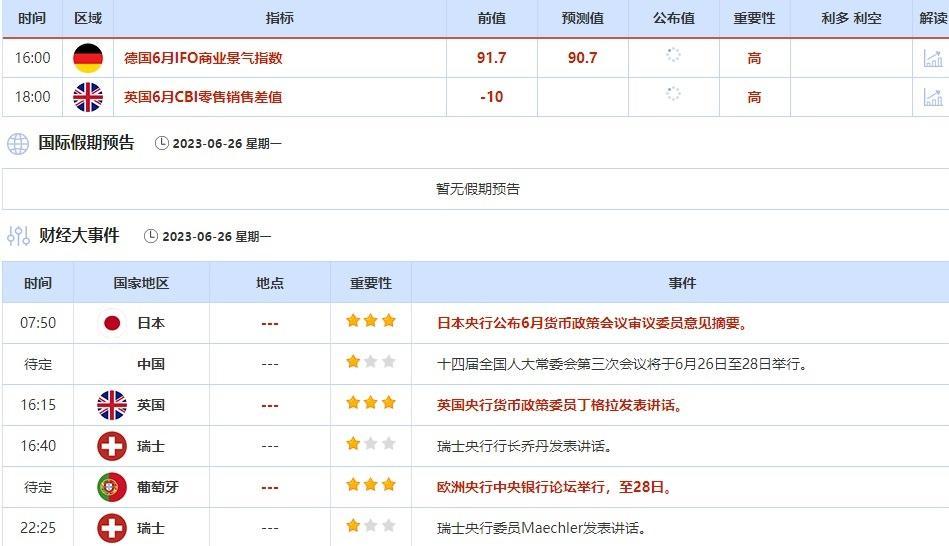
Key data and events on Monday
Institutional Perspectives Summary
1. ABN Amro delays the expected Federal Reserve rate cut.
Bill Diviney, senior US analyst at ABN Amro, said: "We now expect the Fed to start cutting rates in March 2024, a quarter later than previously expected in December 2023."
2. Deutsche Bank: Weak services in the euro area, indicating that the European Central Bank's austerity policy is coming to an end.
Christoph Weil, senior economist at Deutsche Bank, said the unexpected sharp drop in the services PMI in the euro area was not conducive to the recovery of the economy in the coming months, which many expect. He said it showed that the ECB's interest rate hikes to date were increasingly slowing economic growth and that the economy would contract in the second half of the year. The data may also have spooked ECB policymakers, as ECB officials expect the euro zone economy to grow significantly in the second half, making further rate hikes less likely after the central bank signalled a July rate hike;
3. JPMorgan Chase downgrades its forecast for the economic outlook for the euro area.
JPMorgan cut its third-quarter quarterly adjusted gross domestic product forecast for the eurozone to 1.25 per cent, from 1.5 per cent, and its second-quarter quarterly adjusted gross domestic product forecast to 1.25 per cent, from 2 per cent.
4. Wells Fargo remains cautious about the medium-term outlook for the pound.
Nick Bennenbroek, international economist at Wells Fargo, said: "For the UK, the combination of low growth and high inflation, combined with the prospect that the Bank of England will ease monetary policy significantly next year, is why we are cautious about the medium-term outlook for sterling/dollar."
Please indicate the source: https://www.daoctech.com/fxnews/374.html
Disclaimer: The content of this article does not represent the views of the Institute of Foreign Exchange. The content is for reference only and does not constitute investment advice. Investors operate accordingly at their own risk.