
Industrial Forex: Is US core inflation actually below 3%?
At 8:30 PM on Wednesday, the US will release its June CPI dataIf core inflation falls slightly below 3%, the Federal Reserve will breathe a sigh of relief, and the stock market will followforeign exchange marketIt will rise, and consumers will feel reassured by the rising cost of living.
And this is not just a dream.If price changes in the United States are measured in the way of the euro area, core inflation in the United States was already below 3% in MayBut measured against US practice, Wednesday's data is likely to show that core inflation was much higher in June, at 5 per cent year-on-year.
The United States and Europe use different methods to calculate inflation data, but the Bureau of Labor Statistics also uses European methods to calculate price increases in the United States, although the statistics remain vague.
"Hypothetical" data to blame
Currently,The results of these two measures of US inflation are very differentInvestors believe they have grasped the current consensus that core inflation is falling, but not fast enough for the Federal Reserve
The core inflation rate in the United States (excluding volatile food and energy) is measured by the standard consumer price index (CPI), compared to the harmonized consumer price index (HICP) commonly used in Europe.2.3 percentage points higher。That's the biggest gap ever.。
The main reason is that Europe's HICP index excludes homeowners' "hypothetical" rental costs, which account for about a third of the core US CPIThis sub-item is called "Landlord equivalent rent"Or estimating rents, which has long been criticized.
Excluding these "hypothetical" data, US core inflation looks mostly good, at just under 3 per centThe Federal Reserve mainly focuses on core inflation because food and oil prices are so volatile that it is difficult to tell whether the economy is addressing inflationary pressures
So why is everyone still so worried about inflation?
This answer may have something to do with prejudiceHowever, the most important thing in the market isFears that the economy is overheating and confidence that inflation will fall to the 2% target is low。
This bias is that the CPI index has been established in the United States for a long time and is widely used.The Bureau of Labor Statistics publishes its own HICP inflation data as an experimental indicator that many economists and investors are not even aware of.
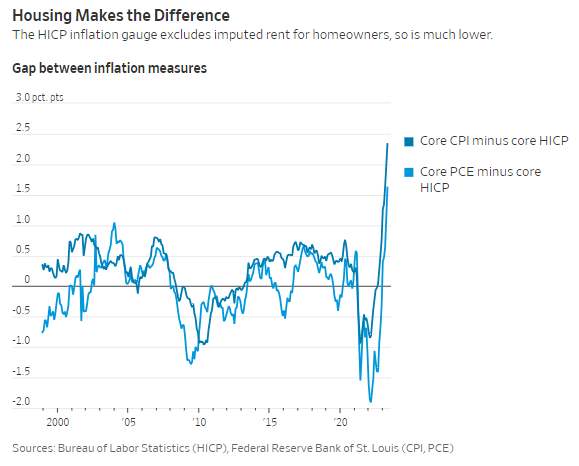
What's even more confusing is,Although the Federal Reserve's inflation target is based on the Bureau of Economic Analysis's (BEA) Personal Consumption Expenditures Price Index (PCE), the CPI takes almost all the focusPCE data is currently lower than CPI, but the so-called "hypothetical data" still has a large impact on the former
But for now, there is no sign that the Fed thinks the HICP is any better, and it is unlikely to change the measure without political controversy. The inflation data have already been seriously questioned by some economists, who point out that improvements in the way inflation is measured typically keep inflation below traditional measures.
The data is too confusing!
The most important question these indicators attempt to answer is whether core inflationary pressures are strong enough to require further dampening of the economy. Does a strong job market mean that workers with rising wages can spend more, thereby maintaining demand and allowing companies to raise prices?
If so, the Fed will have to keep raising rates. Lower HICP inflation suggests that the issue of a strong job market is not as worrisome as the CPI.
ButHawks worry that persistently higher wage growth will continue to drive up inflation as companies pass on higher costs.In addition,Inflation persistently above 2% could drive up inflation expectations, which in turn could lead to higher wage demands.
Alternatively, will companies cut spending, hire less and resist compensation demands when faced with more expensive borrowing costs?
If that's the case, wages will slow, demand will fall, and the Federal Reserve will relax, at least as long as the slowdown doesn't turn into a recession.
The doves point to tentative signs of fewer jobs, a rise in initial jobless claims and a slowdown in wage growth for hourly, low-skilled and low-wage workers, the most in demand, as well as reassurance that consumer and investor inflation expectations are not far from the Fed's 2 per cent target.
As the saying goes, long-term must be divided, and long-term must be combined. If indicators that once "went hand in hand" start to become irrelevant, after a while, the two may converge again.CPI and PCE are likely to decline in the direction of HICPDue to the fact that rent increases have slowed down.
Unfortunately, even if core inflation does fall further,The CPI and personal consumption spending indicators that investors and the Federal Reserve are concerned about will remain too high.
In addition,Inflation is not the only area where economic signals are mixedMany of the usual indicators of economic conditions and direction tell different storiesThis is by no means a good place to be when trying to figure out where the market is headed next
Please indicate the source: https://www.daoctech.com/fxnews/412.html
Disclaimer: The content of this article does not represent the views of the Institute of Foreign Exchange. The content is for reference only and does not constitute investment advice. Investors operate accordingly at their own risk.