
Supply rebounds, oil prices still rise? How diesel cracking and shipping premiums hijack global asset classes
On Tuesday (October 20th) during the Asia Europe time slot, last night an article pointed out that although international oil prices have fallen, if they rebound beyond expectations, it will put pressure on major assets. Today, oil prices have indeed rebounded beyond expectations. At this time, strong performing varieties should be given priority attention.
This also raises a question, why are oil prices still high despite the recovery of crude oil supply?
Affected by both inflation and slowing economic growth, global investment products are still plummeting.
In fact, even if the supply of oil prices rebounds, rigid costs such as shipping and insurance premiums will still significantly push up oil prices, while the shortage of diesel is jointly constraining global inflation resilience and economic growth space.
The difficulty in quickly filling the diesel gap caused by the shortage of fractions in crude oil supply has shifted the focus of the game between the oil market and the macro level from crude oil to diesel cracking price differentials.
Therefore, the final issue of energy navigation is still the geopolitical issues of the United States, Iran and Saudi Arabia in the Middle East, as well as the settlement process of the Russia-Ukraine conflict in Europe.
Diesel expectations fall short, and reserve buffer space hits bottom
One of the core themes of previous market transactions was the loose expectations of the United States waiving relevant sanctions and promoting the flow of Russian diesel into the spot market, but currently this positive news has not been realized as expected.
US Energy Secretary Wright has made it clear that there is currently no Russian diesel on the market, and it remains to be seen whether Russia will release diesel.
Although the US side is simultaneously negotiating with the UK to release its diesel inventory plan, the disposal of storage is only a short-term emergency measure with limited volume, and cannot fundamentally bridge the global distillate oil gap.
At the same time, the traditional safety card of US crude oil reserves has significantly weakened.
The latest data shows that the crude oil inventory of the US Strategic Petroleum Reserve has dropped to 282.7 million barrels, a new low since October 1982, significantly narrowing the operational space for relying on large-scale reserve releases to hedge against oil price shocks.
The stalemate between Russia and Ukraine suppresses refinery repairs, making the diesel shortage difficult to solve in the short term
The root cause of the ongoing shortage of diesel in this round is the continuous damage to Russia's secondary refining facilities, and the long repair cycle for the damaged hydrogenation equipment that produces diesel.
Due to the lack of unity in the positions of the United States and Europe on Ukraine's aid and conflict resolution, the Russia Ukraine front has become deadlocked under the game, and the pace of resuming Russia's refined oil exports has been continuously constrained.
According to a research report by domestic securities firms, the global refining capacity is unlikely to improve significantly in the short term, and the gap between diesel supply and demand is difficult to quickly alleviate. Diesel prices are prone to remain high, which continues to bring moderate upward pressure on US inflation.
Multiple shipping risks coexist in the Middle East, and geopolitical premiums continue to disrupt the market
The US Iran negotiations have yet to find a ceasefire step, and Iran's senior officials have stated that the country needs to rely on its control over the Strait of Hormuz to maintain national security, and the risk premium in the strait continues to exist.
Except for the Strait of Hormuz, the military actions of the Houthis further amplify the uncertainty in the Middle East.
In recent weeks, Houthi militants have launched multiple attacks on airports, oil facilities, Aramco related bases, and military targets within Saudi Arabia, claiming to have carried out six rounds of strikes.
Saudi Arabia has not yet announced significant facility damage, but security fears have spread to the outside worldAUSFOREXSaudi Arabia has cancelled next week's global investment conference and extended online teaching arrangements for schools in Riyadh and surrounding areas, dampening regional investment confidence.
In addition, the Houthi armed forces are competing for strongholds around the Red Sea and the Strait of Mandeb. This waterway serves as a key alternative shipping route for the Strait of Hormuz, and if passage is obstructed, it will further compress the alternative route for exporting crude oil from the Gulf.
The increase in crude oil production in the Americas continues to materialize, and the focus of energy pricing is gradually shifting westward, which is beneficial for the US dollar in the long run
In fact, there have been positive changes on the supply side. US Energy Secretary Wright revealed that crude oil flow in the Strait of Hormuz has returned to about 80% of pre war levels.
Rystad Energy data also shows that under the guidance of the American "Tangroism" energy strategy, the oil production capacity in the Americas continues to break records, with production in the United States, Canada, Brazil, Venezuela, and Suriname increasing. It is expected that the total crude oil production in the Americas will increase by 10% within two years.
It is worth noting that the tight balance of global refined oil in this round has objectively raised the voice of the United States in the global energy market, and the global oil pricing center is gradually shifting from the traditional Gulf oil producing areas to the South American and American regions.
Most of the newly added crude oil and refined oil exports in the Americas use the US dollar settlement system, which continues to consolidate the circulation of the petrodollar. This is the underlying logic that supports the US dollar index in the medium to long term.
Pay attention to the turning point of oil prices, marginal improvement may come quickly
The market is prone to a misconception that crude oil and diesel have completely severed ties, and even if crude oil falls, diesel will maintain high prices.
But in reality, oil prices and diesel are still highly correlated, and the easing of the US Iran conflict will quickly affect diesel pricing.
Even though Russian diesel has not yet entered the market, as long as the situation in the Middle East cools down, crude oil shipping insurance and bypass premiums fall, crude oil prices will decline. With the diesel cracking price difference remaining high, the cost of crude oil to the factory will directly increase the real processing profits of non Russian refineries in the Americas.
The abundant processing profits will drive refineries to tap into their existing production capacity potential: delaying planned maintenance, adjusting process parameters to improve diesel yield, restarting some idle hydrogenation units that were previously economically insufficient, and making every effort to release diesel supply.
The downward trend in crude oil costs and the release of supply elasticity from the refining end will jointly drive diesel prices to fall with crude oil, thereby easing inflationary pressures. Of course, this path has a clear upper limit and is essentially a short-term overdraft on existing facilities. The amount of incremental capacity that can be released is limited, and the speed and intensity of alleviating the gap are far inferior to the landing of US Russian negotiations and the direct flow of Russian diesel into the spot pool.
Summary and Technical Analysis:
The market needs to clarify two different repair threads, which have completely different rhythms of impact on the oil market and diesel cracking price difference.
The first is that substantial breakthroughs have been made in the US Russia negotiations, with Russia releasing diesel in bulk to the outside world.
This path can directly fill the supply gap of distillate oil and is the fastest and strongest solution to suppress the price difference of diesel cracking. It focuses on tracking the data of Russian diesel shipment and the cross-border flow of Kpler distillate oil.
The second is the easing of the situation in the Middle East, with fewer attacks in the Strait of Hormuz and the Strait of Mandeb, and a decrease in premiums for crude oil shipping insurance and waterway detours, driving down crude oil prices.
The decline in crude oil costs will increase the processing revenue of overseas refineries such as those in the Americas, incentivize refineries to maximize diesel output, drive diesel prices to weaken synchronously, and indirectly alleviate the shortage of refined oil products. The effectiveness of this path is relatively slow, and the supply increment is constrained by the existing upper limit of refining elasticity.
In addition, the coordinated release of finished oil storage by the United States and the United Kingdom is only a short-term emergency measure, with limited buffering effect, and it is difficult to change the supply-demand pattern in the medium and long term.
In the medium to long term, it is necessary to continuously track the implementation of increased crude oil production in the Americas, the progress of repairing damaged hydrogenation units in Russia, and be alert to OPEC's use of production reduction tools to hedge against price declines.
Technical aspect: International oil prices have recovered from the previous decline gap, while effectively breaking through the box. In the future, oil prices can still see a high line, and the strong upward trend will remain unchanged without breaking the 5-day line.
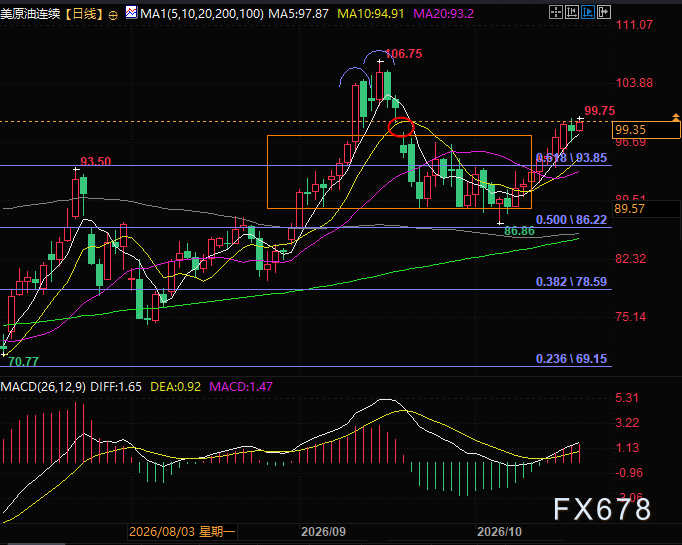
(WTI Crude Oil Main Daily Line Chart, Source: Network)
At 16:13 Beijing time, the main WTI crude oil price is currently at $99.34 per barrel.
Please indicate the source when reprinting: https://www.daoctech.com/fxnews/5290.html
Disclaimer: The content of this article does not represent the views of the Institute of Foreign Exchange. The content is for reference only and does not constitute investment advice. Investors operate accordingly at their own risk.