
Gold Weekly Review: Gold prices recorded the largest weekly increase in the past four weeks. The "Palestinian-Israeli" situation has added new variables, and the goal is to see the 2,000 mark
Gold recorded its biggest weekly gain in four weeks as expectations grew that the Federal Reserve would end its monetary tightening as the dollar and Treasury yields weakened.
Last Friday (November 17), gold prices remained stable, and spot gold closed down 0.03% at $1980.65 an ounce after rising to a two-week high earlier in the session. Prices rose about 2.2% last week.
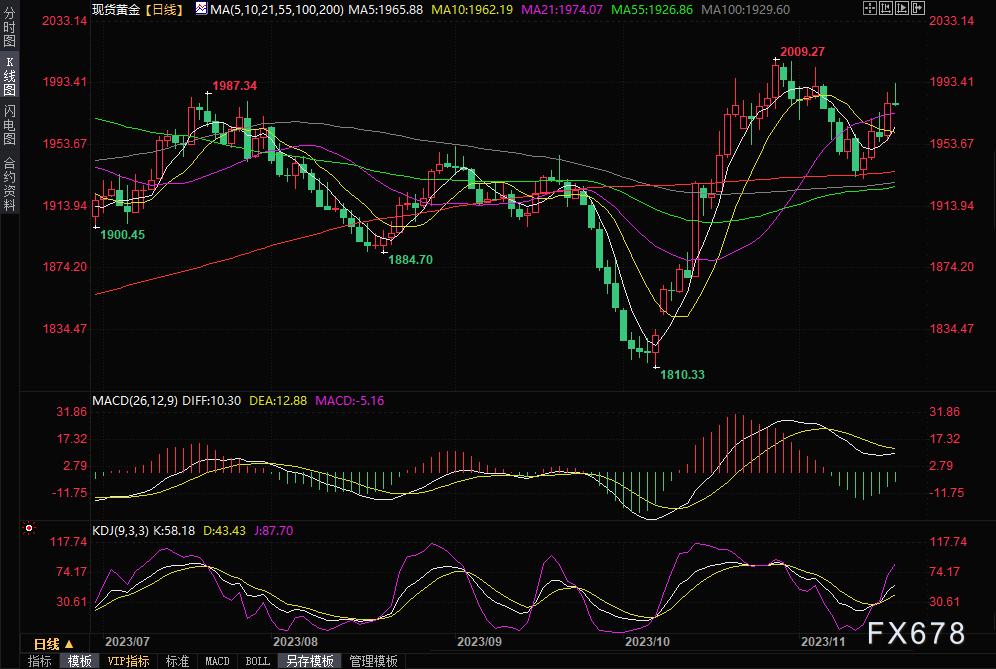
(Spot gold trend chart)
Everett Millman, chief market analyst at Gainesville Coins, said on Friday: "There is a lot of potential for gold to continue to rise, but before the next rally, gold will have to move a bit lower and possibly test the $2,000 level at the same time. The data released this week confirms the fact that the Federal Reserve may end interest rate hikes, which will boost gold prices. Where gold prices go will depend on the upcoming data and how the market reacts to it."
Highlights of the week review
Last Monday (November 13), before the release of the US Consumer Price Index (CPI), the price of gold (XAU/USD) rose slightly due to the weakness of the US dollar and the decline in US Treasury yields. Due to the decline in US Treasury yields, the dollar weakened as a whole, and the price of gold rose due to some buyers.
While the Israeli-Palestinian conflict continues, political risk remains muted based on market reaction. However, an escalation of the conflict remains and could be positive for gold. Meanwhile, gold traders are expecting some clues from a Federal Reserve spokesperson.
Last Tuesday (November 14), the price of gold rose due to the slump in US Treasury yields caused by the weak US inflation report, which put pressure on the US dollar. Spot gold was reported at 1963.00, an increase of 0.86%.
The US consumer price index showed annual inflation falling to 3.2 per cent in October from 3.7 per cent in September, below market expectations of 3.3 per cent. Core inflation also slowed to 4 per cent from 4.1 per cent, the lowest since September 2021. The data dented expectations of the Federal Reserve raising rates before the end of the year and boosted market expectations for its first rate cut since 2020.
Last Wednesday (November 15), the price of gold came under selling pressure due to the slower-than-expected decline in retail sales data in the United States in October. Spot gold corrected after hitting a weekly high of $1975.22/oz. The failure to hold above $1970 was mainly due to the correction of the dollar and the rebound in US Treasury yields. Spot gold closed down 0.19% at $1959.25/oz.
In terms of US economic data, the producer price index (PPI) fell by 0.5% in October, missing the expected increase of 0.1%. The annual growth rate also fell from 2.2% to 1.3%. In addition, the core PPI data was lower than expected. The data are in line with the Consumer Price Index (CPI) data released last Tuesday, indicating that inflation is cooling. Retail sales fell by 0.1% in October, while a sharp decline of 0.3% is expected.
The economic focus reinforced the evidence that drove the dollar lower on Tuesday, although the impact was different on Wednesday, likely due to a pullback. For now, risk appetite remains, U.S. bonds are strong, and the dollar remains fragile, all of which could support further gains in gold prices.
On Thursday (November 16), spot gold rallied sharply and resumed its gains. Boosted by the weakness of the dollar and the decline in Treasury yields, gold prices broke through the $1975 resistance level and jumped to the highest level in more than a week. Prices rose more than $20, also driven by technical factors. Spot gold settled 1.12% higher at $1981.11 an ounce.
Thursday's data showing a softening labour market, combined with recent inflation data, reinforced the view that the Federal Reserve is unlikely to raise interest rates further. The unfavorable US economic data exacerbated the decline in US Treasuries, which are often seen as the cost of holding non-yielding metals, causing prices to surge. Treasury yields closed at a weekly low, with the two-year bond rate falling to 4.83%, while the five- and 10-year yields fell 4.43% and 4.45% respectively.
This week's outlook
The latest Kitco News weekly gold survey shows that retail investors remain overwhelmingly bullish in the coming week, while the same percentage of market analysts have shifted to a neutral assessment of gold's near-term outlook.
Last week, 12 Wall Street analysts participated in the Kitco News gold survey. As in the previous week, three experts (25%) expected gold prices to rise in the coming week, but only one (8%) predicted prices to fall. The vast majority (67%) are neutral on gold in the coming week.
Meanwhile, Kitco's online poll generated a total of 595 votes, with market participants more optimistic than the previous week's survey. 394 retail investors, or 66 per cent, expect gold prices to rise in the coming week. Another 125 respondents, or 21 per cent, expect prices to be lower, while 76 respondents, or 13 per cent, are neutral on the near-term outlook for precious metals.
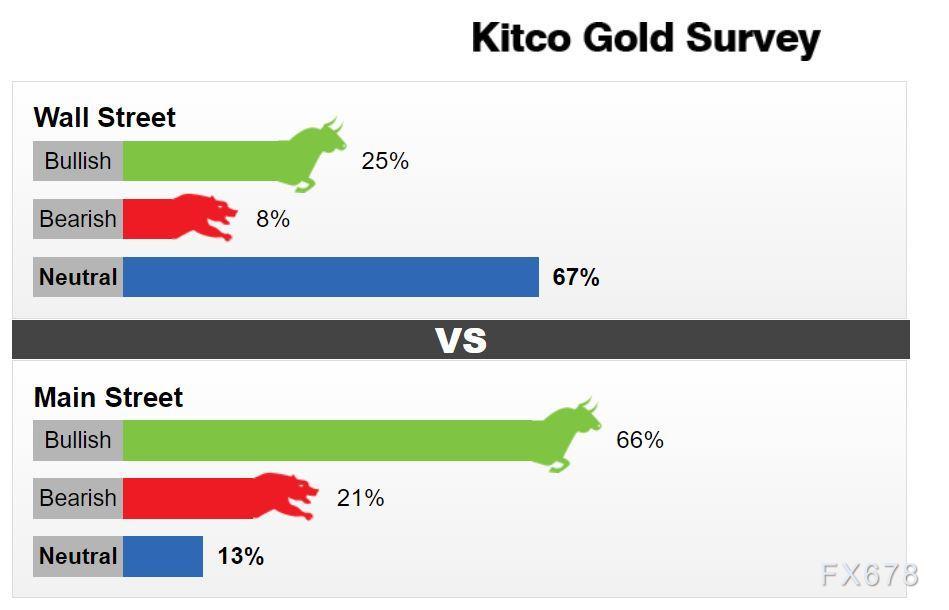
(Image credit: Kitco)
This week will be a short week of trading and economic data releases, as Thursday is the U.S. Thanksgiving holiday, which means most of the activity will be compressed into the first three days. Highlights include the release of the latest FOMC meeting notes and October existing home sales data on Tuesday, followed by Wednesday's release of October durable goods data, November consumer confidence data from the University of Michigan, and weekly initial jobless claims.
Please indicate the source: https://www.daoctech.com/fxnews/985.html
Disclaimer: The content of this article does not represent the views of the Institute of Foreign Exchange. The content is for reference only and does not constitute investment advice. Investors operate accordingly at their own risk.