
Risk sentiment dominates the market, with the dollar frantically testing the edge of a four-month low
On Friday (November 17), Canadian industrial inflation data and US real estate data went head-to-head, but overall, risk sentiment appeared to be the main driver of the market's momentary move. US building permits and US housing starts both exceeded expectations, helping to arrest the dollar's slide earlier on Friday and limit the Canadian dollar's gains. After suffering its biggest drop in nearly two months on Thursday, the Canadian dollar continued its decline on Friday, falling to a half-year low.
The dollar index continued its downward trend and fell below the 104.00 range, now trading at 103.92, down 0.46% and about 1.60% for the week.
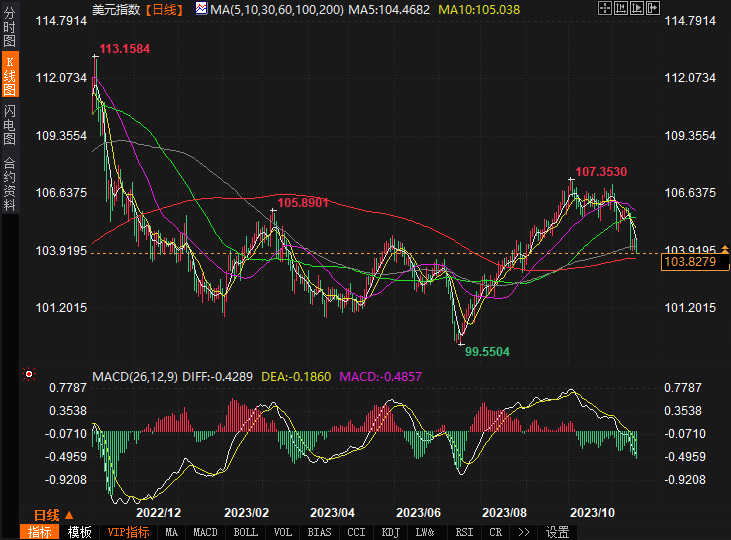
(Dollar index trend chart)
The dollar, which closed down a week and is testing the edge of a four-month low on dovish bets on the Fed, is driving markets today.
Weak US inflation data and weak economic activity data were the main reasons for the dollar's decline. With the US economy showing signs of inflationary pressures and the labour market cooling, the market expects the Federal Reserve to stop raising interest rates, leading to the weakening of the dollar throughout the week.
Investors continue to digest the data reported this week. The US Bureau of Labor Statistics reported that the core consumer price index (CPI) in October did not meet market expectations. The overall data increased by 3.2% year-on-year, which was lower than the consensus market expectation. In addition, the core producer price index (PPI) in October did not meet expectations. On the other hand, retail sales in October were better than expected. The number of initial jobless claims in the United States rose to 231,000 in the week ended November 11, exceeding expectations. US industrial production missed expectations, falling 0.6% month-on-month, which was higher than expected.
Data released on Friday showed better-than-expected housing starts and building permits in October. The United States reported 1.487 million new building permits, better than expected 1.45 million and better than last month's data. U.S. monthly housing starts also improved, with 1.372 million compared with expectations for 1.35 million. In September, new housing starts started 1.346 million.
Speaking on Friday, Susan Collins, president of the Boston Fed, was seen as hawkish. "There will be no abandonment of further tightening," she said. "It all depends on incoming data." However, she cautioned against prematurely declaring a victory over high inflation and stressed the importance of patience. She said the Fed needed to stay on course to fight inflation and that "if we can get to our desired target, we will be on the path to 2 per cent inflation." "I don't rule out further tightening." On the labour market, Ms Collins pointed to positive signs that the labour market was gradually reaching equilibrium.
Ms Daly said she and her colleagues were unsure whether inflation was moving towards the 2 per cent target. "We are unsure whether inflation is on track to return to 2 per cent. We are unsure of the length of the policy lag and whether it has passed or has not yet been fully realised." There are also uncertainties about economic forecasts, the transmission mechanism of monetary policy and economic fundamentals such as the neutral interest rate. "We need to be gradualist when uncertainty is high and the risks to our target are more'ambiguous'," Ms Daly said. She urged policymakers not to act quickly when patience was needed.
Meanwhile, US 10-year Treasury yields fell to 4.43 per cent, their lowest level in two months, while US 2-year yields climbed to a day high of 4.87 per cent.
Strategists at MUFG said "downside risks" to the dollar were growing as the Fed ended monetary tightening and "we want to maintain some of our exposure to further dollar weakness." They added that the case for the Fed to end its tightening cycle was growing stronger and "we now believe that the previously mentioned window for renewed dollar strength may now be closed. US data and global economic growth conditions will remain key in determining further dollar weakness going forward".
According to the CME FedWatch tool, there is zero chance of a 25 basis point rate hike in December. The market is betting that the rate cut will come in May, if not March, 2024, earlier than expected.
As sellers are taking control, the dollar index maintains a bearish technical bias, indicating the possibility of further downside.
Next week, the United States will release durable goods data for October and Standard & Poor's PMI data for November.
USD/CAD is now trading at 1.37157, down 0.28%. USD/CAD is down about 0.5% this week.
Canada's industrial inflation data was better than expected. The Canadian dollar rebounded on risk appetite.
"Confidence in the end of the Fed tightening cycle should be positive for the rest of the world's currencies, especially those that are very sensitive to rising interest rates," ING analysts said in a note.
On Friday, the Canadian dollar sought to recover some of Thursday's losses and gain some support from higher crude buying, but downside risks remain.
Canada's raw material price index fell 2.5 per cent in October after rising 3.9 per cent in September (revised to 3.5 per cent), while industrial prices also fell 1 per cent month-on-month in October, down from 0.4 per cent.
Rumors of further sanctions on Russian crude oil exports by the European Union and rumors that OPEC is likely to extend the production cut plan until next spring, crude oil prices rose sharply on Friday, closing up more than 4%, becoming a strong support for the rise of the Canadian dollar.
A week of back-and-forth trading kept the Canadian dollar hovering in Friday's mid-range. The overall Canadian dollar was also trading at a moderate level for the week as the dollar drove momentum in the broader market.
The current USD/CAD position is in the 1.3750 area, but with a weak push from USD/CAD bidders, CAD buying is under threat.
After experiencing its largest decline in nearly two months on Thursday, the Canadian dollar continued its decline on Friday, falling to a half-year low and now trading at 5.2564, down 0.15%.
Please indicate the source: https://www.daoctech.com/fxnews/984.html
Disclaimer: The content of this article does not represent the views of the Institute of Foreign Exchange. The content is for reference only and does not constitute investment advice. Investors operate accordingly at their own risk.