
Why was the pound "crushed" by the euro when the pound rallied sharply after the non-farm cold in the United States in July?
On Monday (August 4), during the Asia-Europe session, the pound fell slightly by 0.11% against the dollar, and is now trading near 1.3267. Affected by the US July non-farm employment data, the exchange rate rebounded by 0.58% in the previous trading day, but the cross exchange rate with the euro depreciated by 1%, casting a shadow over the pound bulls.
Interest rate cut plan: the trigger for the pound's weakness against the euro
The Bank of England plans to cut interest rates for the fifth time in this round on Thursday (August 4). In the context of the CPI still reaching 3.6% in June (above the 2% target) but the labor market has cooled significantly, it plans to cut the base rate by 25 basis points from 4.25% to 4.00%. Due to weak economic growth - after the export boost from US companies' early stocking in the first quarter of 2025 faded, the growth rate slowed significantly in the second quarter, and the unemployment rate is expected to continue to rise. On the policy trade-off, although inflation is sticky, most policymakers believe that maintaining high interest rates too quickly may exacerbate job losses and lead to inflation below the 2% target for a long time.
External risks weaken the pound's fundamentals
The external risks and long-term challenges are significant: despite the UK-US tariff agreement, the level of tariffs in China, India and other countries is uncertain, which may disrupt UK inflation and growth through the supply chain; the budget at the end of 2025 may increase taxes, superimpose trade uncertainty, further inhibit investment and hiring, and weaken the fundamentals of the pound.
The depreciation of the pound under triple pressure may become the norm
In the medium-term trend, economic weakness, policy differences, and external shocks form a triple depreciation pressure. If inflation stickiness remains unabated and the economy is sluggish, the market may question the effectiveness of policy and accelerate the decline of the pound; a split vote in the Monetary Policy Committee (such as 5-2-2 or 7-1-1) may blur the signal and amplify volatility. If interest rates are cut faster than expected (such as another 25 basis points in the fourth quarter), sterling weakness will become the norm. Moreover, US tariffs on other economies could push up UK import costs, exacerbate imported inflation, and make it harder for the central bank to balance "interest rate cuts to stabilize growth" with "anti-inflation", further weighing on the pound; as global trade frictions and geopolitical conflicts heat up, rising safe-haven demand for the dollar and the recent rise of the euro will also indirectly weigh on the pound.
Institutional and technical consensus: clear downside for the pound
Institutional forecasts and technical aspects also point to depreciation: Morgan Stanley and others believe that the combination of economic weakness and continued interest rate cuts, the pound may fall to 1.27-1 against the dollar before the end of the year; Dutch International Group (ING) pointed out that if the Bank of England further opens the door to easing, the pound may fall to 1.20-1; technically, falling below the key support of 1.320 may trigger a programmed sell-off and accelerate the decline.
To sum upAlthough the short-term inflation may fall, the trade situation may slow down or make the pound rebound, but the Bank of England interest rate cut plan, economic weakness, interest rate spread widening, external risks and other factors determine that the pound is facing the risk of depreciation, which is difficult to fundamentally change in the short term.
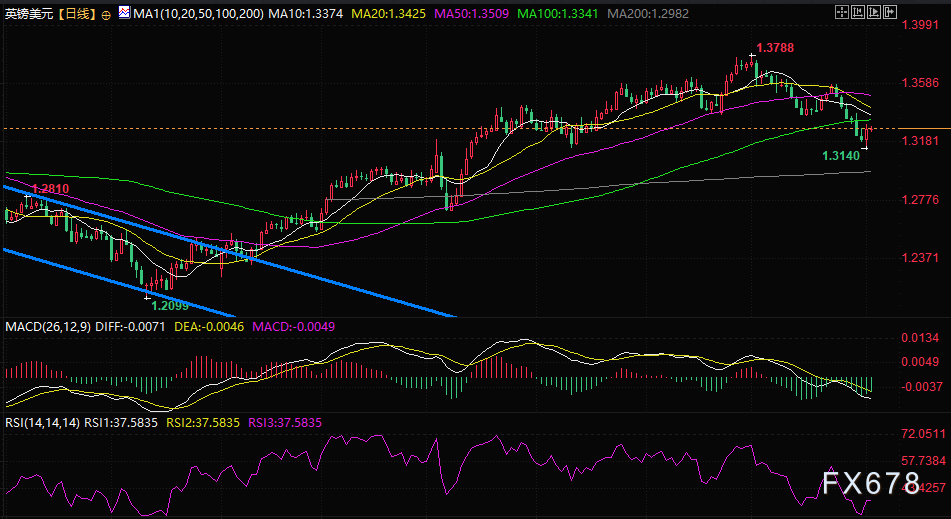
Pound US daily chart, source: Internet
At 17:06 Beijing time, the pound was trading at 1.3282/83 against the dollar.
Please indicate the source: https://www.daoctech.com/fxoutrade/1676.html
Disclaimer: The content of this article does not represent the views of the Institute of Foreign Exchange. The content is for reference only and does not constitute investment advice. Investors operate accordingly at their own risk.