
How much leverage should a foreign exchange trader use?
The importance of leverage in managing foreign exchange risk is often underestimated. Traders should consider how to use the right leverage to ensure long-term profitability. Although the available leverage is very large, it does not mean that the maximum leverage must be used all the time.
Mitchell has a business school degree and has been trading in multiple markets since 2005, providing educational services to traders. His articles have been widely published and he is a member of the Canadian Association of Market Technicians and the Association of Technical Analysts. He is the author of the e-book "Forex Strategy Guide for Day and Short-Term Traders", which introduces traders to Forex basics, success tips, and price action trading strategies.
somebrokerOffering leverage of up to 500:1, it is not surprising that "how much leverage to use" is a common question asked, especially by novice forex traders. Most traders realize that leverage is a double-edged sword, magnifying profits and losses. How much leverage to use is appropriate, depending on the size of the account and the type of trade. However, we should first set some basic rules for money management.
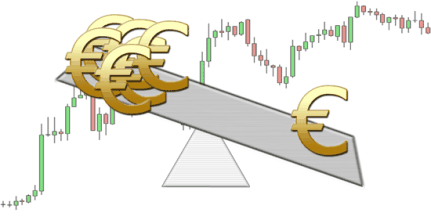
Capital management and leverage
The amount at risk should not exceed 1% of the deposit. Risk is the difference between the bid price and the stop price, which is magnified several times by the size of the position. For example, let's say you buy EURUSD at 1.30 and the stop loss is set at 1.29, which is 100 basis points below the bid price. 1 standard lot of EURUSD is worth $10 per basis point change, 1 mini lot is worth $1 per basis point change, and 1 micro lot is worth $0.1 per basis point change. Therefore, the risk of trading 1 standard lot is $1000 (100 basis points multiplied by $10), 1 mini lot is $100, and 1 micro lot is $10. If you trade multiple lots, then the risk is also doubled. If you don't understand what basis points are and how to calculate them, read the article "Calculating the Value of Basis Points".
The amount at risk should not exceed 1% of the deposit. In the example above, if the risk of the trade is $1000, then the account size should be at least $100,000. If the risk is $100, the account size should be at least $10,000, if the risk is $10, the account size should be at least $1000.
Based on some management guidelines, we can start to consider the question of how much leverage should be used, depending on the size of the account and the type of trading.
How much foreign exchange leverage to use
The easiest way to explore leverage is to provide examples to understand how much leverage you should use for different account sizes and trading types. Here are some examples:
10,000 USD Account - Short Term Trader
10,000 USD account size, the trader can take a risk of $100 (1% of 10,000 USD). If the trade risk (difference between the bid price and the stop price) is 300 basis points, the trader can take a trade of 3 micro lots with a risk of $90. In this case, no leverage is required. Making this trade means investing $3000 (3 micro lots) and the account size (10,000 USD) is much larger than the trade amount.
If the difference between the stop loss level and the bid price is 75 basis points, the risk you can take is still $100, in this case you can take 1 mini lot (risk is $75) and 3 mini lots (risk is $22.50). You trade 1.3 mini lots in total, and that risk is $97.50, which is below the $100 risk you can afford. 1.3 mini lots are worth $13,000, and you only have $10,000 in your account, so you need to use leverage. In this case, at least 2:1 leverage is required, because then you can trade 20,000 dollars (10,000 $2), which is certainly enough to trade 13,000 dollars.
If you hold multiple positions at the same time, you will need to use larger leverage, such as 5:1 and 10:1. Each trade can have a different stop loss level, so it is better to set slightly higher leverage than insufficient leverage. Even if you can use more leverage, you don't have to use it.
If you are short-term traders with $1,000, read the article "Short-term Forex Trading with Less than $1,000" for more details on successful trading with small amounts of money.
10,000 USD Account - Day Trader
Because the EURUSD currency pair usually fluctuates between 90 and 130 basis points on the day, traders will probably not risk more than 10-20 basis points on a single trade. Losses on a single trade should be kept below 1% of the account value. A trade with a risk of 20 basis points means that traders can make 50 micro lots or 5 mini lots, with a risk of $100 in EURUSD trading.
5 mini lots are worth $50,000, so leverage is required (only $10,000 in the account). Risk is well controlled, so having leverage available is a huge advantage for a trading strategy in this case. Traders are very likely to build multiple positions at similar risk levels. If a trader holds two similar positions, it means deploying $150,000 in the market. Therefore, traders will need a minimum leverage of 15:1, but the maximum can even be 30:1 (traders can deploy positions of $300,000) or 50:1. Other than that, almost no one uses more leverage.
Larger or smaller accounts can repeat the same situation.
If you only have $1,000 in your account and want to trade on the day, you may want to use leverage of 20 or 30:1. Similarly, you risk $10 per trade, and your position size will be one-tenth of the above example.
$5000 Account - Scalping
Insisting that the risk cannot exceed 1% of the deposit, the trader can take a risk of $50 per trade (1% of $5,000). Scalpers usually have less risk per trade (basis point aspect). Let's say the trader risks 10 points per trade. This means that in EURUSD trading, 5 mini lots can be traded. If they lose 10 basis points in 5 mini lots, they lose $50, or 1% of the account amount.
The cost of 5 mini lots is $50,000, so 10:1 leverage is required to make this trade. This may work just as well when making multiple trades at once. If creating 3 positions at once, this means deploying 150,000 dollars, at least 30:1 leverage, you can use 50:1 leverage to leave room, but only if you are holding multiple positions. If you are making one trade at a time, then 15 or 20:1 leverage will suffice.
Why do brokers offer such high leverage?
Why do Forex brokers offer leverage of up to 500:1? The answer is very simple. It is to lure traders into thinking that they can make a profit in a desperate way for $100. In the case of Eurodollar, the cost of 1 micro lot is $1000 and 1 mini lot is $10,000. Therefore, it costs at least $1000 to open an account, which means that traders need to use leverage in order to establish a minimum position. Most novice Forex traders carry the delusion that they will risk much more than 1% of their principal to trade, and leverage provides them with the conditions. Crazy high leverage makes people think that they can create miracles and get rich overnight, but this kind of thing rarely happens.
Summarize - you shouldHow much foreign exchange leverage to use?
In the example above, you can work out how much leverage you need to use based on account size and trade type. Many traders may find that they don't actually need leverage, but it's nice to have leverage available. You have leverage available in your account, but don't necessarily use it very much if you don't need it. There's always a lot of trading in the market, so there's no need to go all out on one trade, take a lot of risk, or use too much leverage. 50:1 leverage is already too high for most traders. 20:1 is suitable for most day and short-term traders. Forex trading involves a lot of risk. Using too much leverage doesn't just mean huge losses, but also the possibility of liquidation. By limiting the risk of each trade to 1% of the principal, traders will find it less necessary to use the huge leverage offered by brokers.
Please indicate the source: https://www.daoctech.com/fxschool/1012.html
Disclaimer: The content of this article does not represent the views of the Institute of Foreign Exchange. The content is for reference only and does not constitute investment advice. Investors operate accordingly at their own risk.