
The short-term "match point" of palm oil is coming: the technical side sends a buy signal, but high inventories are still a hidden bomb
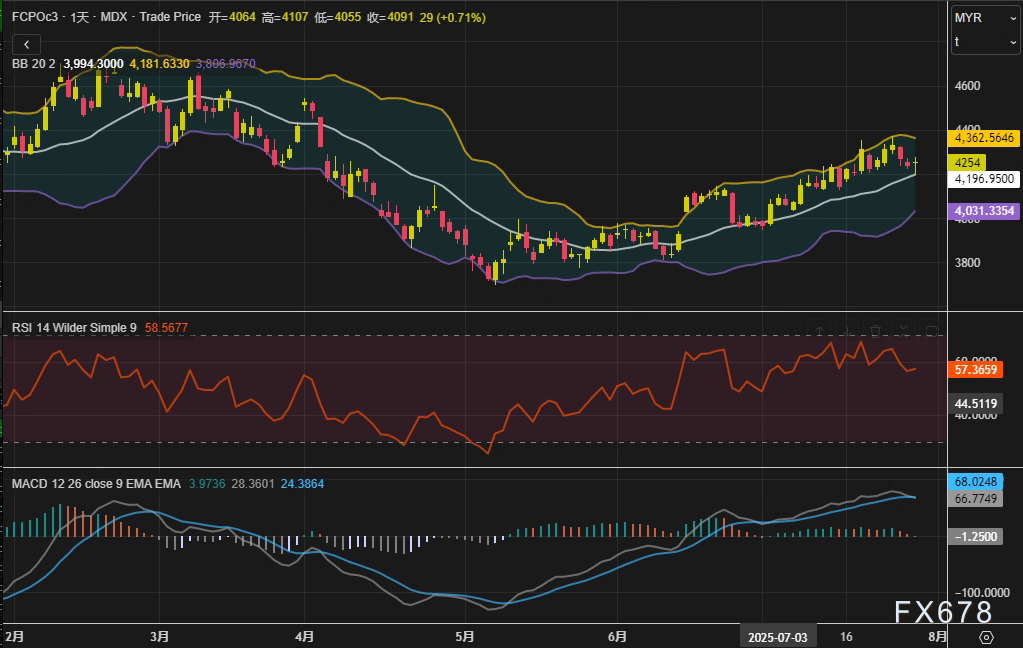
On Tuesday (July 29), the Malaysian Derivatives Exchange (BMD) palm oil futures ended a two-day losing streak. The main October contract (FCPOc3) closed at RM4,254/ton, an increase of 0.28% during the day. Technical indicators showed that the mid-rail of the daily Bollinger channel was at RM3,994, the RSI (14) remained at the neutral range of 58.57, and the MACD bar narrowed to 3.97, suggesting that the short-term momentum has been restored. Market participants pointed out that low buying and short position squaring were the main reasons for pushing up prices.

Price Support under Supply and Demand Game
Despite the recent pressure on palm oil inventories, the market's sensitivity to the cost side has increased significantly. On the one hand, international crude oil prices have stabilized and rebounded, strengthening the cost-effective advantage of palm oil as a biodiesel feedstock. On the other hand, the ringgit exchange rate weakened slightly by 0.07% against the US dollar, indirectly increasing the purchasing willingness of overseas buyers. It is worth noting that the main soybean oil contract (DBYcv1) on the Dalian Commodity Exchange rose by 1.38% in the day, the palm oil contract (DCPcv1) rose by 0.61%, while the Chicago Board of Trade (CBOT) soybean oil price fell slightly by 0.11%, reflecting the short-term demand preference for vegetable oil in Asian markets.
"Some investors believe that the current price is close to the technical support level, and short covering behavior further amplifies the rebound," said a trader in Kuala Lumpur. This view is in line with the performance of the market. After two consecutive days of correction, palm oil futures were bought near the RM3,907 lower track of the Bollinger Channel.
Institutional Perspectives: Balancing Points in Differences
Analysts at prominent institutions are divided on the outlook. "Production growth in Indonesia and Malaysia is likely to slow in the third quarter, and inventory pressure will gradually ease if exports remain at current levels," LMC International believes. The agency particularly highlights weather disturbances in major producing countries, such as localised drought in Sumatra, as a potential positive factor.
However, Goldman Sachs Commodities Research was cautious: "Global vegetable oil inventory-to-consumption ratios remain at five-year highs, and high inventories in China and India could dampen import demand." India's palm oil imports fell 12 per cent month-on-month in June, the data showed, but the country's upcoming Diwali stocking season could inject new variables into the market.
Short-term drivers and long-term concerns
From the perspective of trading logic, the current market is more concerned with immediate supply and demand changes rather than forward expectations. Volatility in crude oil prices and policy adjustments in major producing countries remain key catalysts. The Malaysian government recently reaffirmed that it will maintain zero export tariffs on crude palm oil in September, which will help stabilize market share. However, if the expectation of high soybean production in South America in the fourth quarter materializes, the substitution effect of soybean oil on palm oil may re-depress prices.
Technically, there is obvious resistance in the 4250-4300 ringgit range. If it breaks through, it may test the high point of the year. On the contrary, if it loses the 4150 ringgit support level, it is not ruled out to step back on the 4,000 ringgit psychological mark. For professional traders, in the context of multiple variables, closely tracking the origin inventory data and macro capital flow is still the core basis for formulating strategies.
Please indicate the source: https://www.daoctech.com/fxschool/1665.html
Disclaimer: The content of this article does not represent the views of the Institute of Foreign Exchange. The content is for reference only and does not constitute investment advice. Investors operate accordingly at their own risk.