
Gold trading reminder: the Federal Reserve's September interest rate cut expectations continue to heat up, and gold prices hit a new high for a week and a half
Affected by the weak US economic data, the Federal Reserve's interest rate cut expectations and the intensification of global trade tensions, spot gold on Monday (August 4) continued its rally last Friday. The highest intraday hit $3,385.26/ounce and closed at $3,373.38/ounce, the highest level since July 24. It rose by about 0.3% and rose for three consecutive trading days. On Tuesday (August 5), spot gold fluctuated at a high level in early Asian trading and is currently trading around $3,378.16/ounce.
First, the US economic data is weak, and interest rate cuts are expected to ignite the gold fever
1. The job market has deteriorated sharply, and the economic signal is not optimistic
The recent US jobs report for July was disappointing, with non-farm payrolls growing less than expected and the first two months' data revised down sharply by 258,000 jobs. This suggests that the US labour market is experiencing a significant slowdown and that the resilience of the economy is facing challenges. Daniel Pavilonis, senior market strategist at RJO Futures, pointed out that the weak jobs data provides a strong case for the Federal Reserve to cut interest rates. Market expectations for a September rate cut have rapidly increased, and according to the CME FedWatch tool, traders believe that the probability of a September rate cut has soared to 94.4% from 63% a week ago, and even the probability of another rate cut in December is increasing.
2. The delicate balance between inflationary pressures and expectations of interest rate cuts
Meanwhile, US PCE inflation data recorded a 0.3 per cent increase in June, up from an upward revision of 0.2 per cent in May. The persistence of inflation provides additional support for gold, a traditional inflation-fighting asset that tends to be a haven for investors in an environment where inflationary pressures coexist with the expectation of interest rate cuts. Pavilonis stressed that the combination of inflation headwinds and interest rate cuts expectations makes the bullish outlook for gold clearer.
3. US bond yields fluctuate, strengthening the attractiveness of gold
US Treasury yields tumbled in the wake of the jobs data, with the 10-year Treasury yield falling to 4.202 per cent, its lowest level since July 1. A low yield environment has weakened the opportunity cost of holding interest-free assets such as gold, further driving gold prices higher. Jim Barnes, head of fixed income at Bryn Mawr Trust, said the market was digesting a range of economic data and changes in labour market conditions had investors reassessing the Federal Reserve's policy path, providing a favourable market environment for gold.
Global trade conflicts are escalating, and geopolitical risks are driving up demand for safe havens
1. Trump's tariff policy has caused market shock
US President Donald Trump recently announced a new round of tariffs on dozens of countries, and made it clear that they would remain in place, particularly the 25 per cent tariff on Indian goods. The decision was related to India's large purchases of oil from Russia, which Trump criticized for making huge profits by reselling Russian oil and ignoring the moral considerations of the situation in Ukraine. India responded by saying that its energy imports were for domestic economic stability, and accused the US of "unjustifiable" actions. The tit-for-tat trade dispute has exacerbated tensions in global markets, driving up demand for gold as a safe-haven asset.
2. As geopolitical divisions intensify, gold becomes a safe haven
Trump also described the BRICS group, of which India is a member, as an organization "hostile" to the United States, further deepening the geopolitical divide. A spokesperson for the Indian Ministry of Foreign Affairs stressed that India will continue to take all necessary measures to safeguard national interests and economic security. Since the outbreak of the Russia-Ukraine conflict, India has maintained close relations with Russia due to energy needs, which has not only triggered diplomatic friction with the West, but also brought uncertainty to the global trade landscape. In the context of rising geopolitical risks, investors tend to allocate their funds to safe assets such as gold to hedge against potential market fluctuations.
Third, the volatility of the US dollar and the stock market provides side support for gold
1. The dollar's rebound is blocked, and gold benefits
The dollar failed to extend its rally after weak jobs data, the resignation of Federal Reserve governors and Trump's firing of the head of the Bureau of Labor Statistics. The dollar index edged up just 0.06% to 98.73, indicating market concerns about the outlook for the US economy. Juan Perez, head of trading at Monex USA, pointed out that there are signs of a slowdown in various sectors of the US economy, and the fragility of the dollar could lead to further declines. A weaker dollar is usually positive for dollar-denominated gold because it reduces the cost of buying gold for non-dollar holders.
2. The rebound in the stock market has not masked economic concerns
While all three major US stock indices posted their biggest one-day gains since May 27 on Monday, that was more about low buying following an earlier sell-off than broad optimism about the economic outlook. The S & P 500 and Nasdaq have hit record highs recently, but weak jobs data and Mr. Trump's policy uncertainty have kept markets cautious. Gold, an asset less correlated with equities, tends to attract more money when market volatility intensifies.
IV. The future outlook for the gold market
1. Strong short-term bullish momentum
Gold remains strong in the short term, driven by expectations of interest rate cuts by the Federal Reserve, geopolitical risks and a weaker dollar. Spot gold touched an intraday high of $3,385.26 an ounce, showing the market's enthusiasm for gold. Technically, gold prices have broken through key resistance levels and are expected to further challenge the psychological level of $3,400 an ounce in the short term.
2. The value of medium and long-term investment is highlighted
In the medium to long term, the investment value of gold remains significant. Global economic uncertainty, the continued fermentation of trade conflicts, and the potential recovery of inflationary pressures have all provided solid support for gold. In addition, the expected easing of the Federal Reserve's monetary policy may further weaken the US dollar and US Treasury yields, creating favorable conditions for the continued rise in gold prices. Investors should pay close attention to the latest developments of the Federal Reserve's September meeting, as well as the follow-up developments of the Trump administration's trade policy.
3. Investment strategy advice
For investors looking to position themselves in gold, the current market environment offers a good opportunity to enter the market. You can participate in the market by purchasing physical gold, gold ETFs or gold-related stocks. At the same time, you need to be vigilant against the risk of correction caused by short-term market fluctuations. It is recommended to adopt a strategy of building positions in batches to reduce costs. Long-term investors can use gold as a safe-haven allocation in their portfolios to hedge against economic and geopolitical risks.
Summarizing: The Multiple Drivers Behind the Gold Boom
The continuous rise of the gold market is not accidental, but the result of a combination of expectations of interest rate cuts by the Federal Reserve, global trade conflicts and geopolitical risks. Weak US economic data provided the basis for interest rate cuts, with low yields and a weak dollar further strengthening the attractiveness of gold. At the same time, Trump's tariff policy and geopolitical disagreements have exacerbated market uncertainty, driving up safe-haven demand for gold. Looking ahead, the bullish momentum of gold is expected to continue. Investors should seize this opportunity and allocate gold assets rationally to cope with the complex and changeable market environment.
This trading day will release the US June trade account and the US July ISM non-manufacturing PMI data, investors need to pay attention.
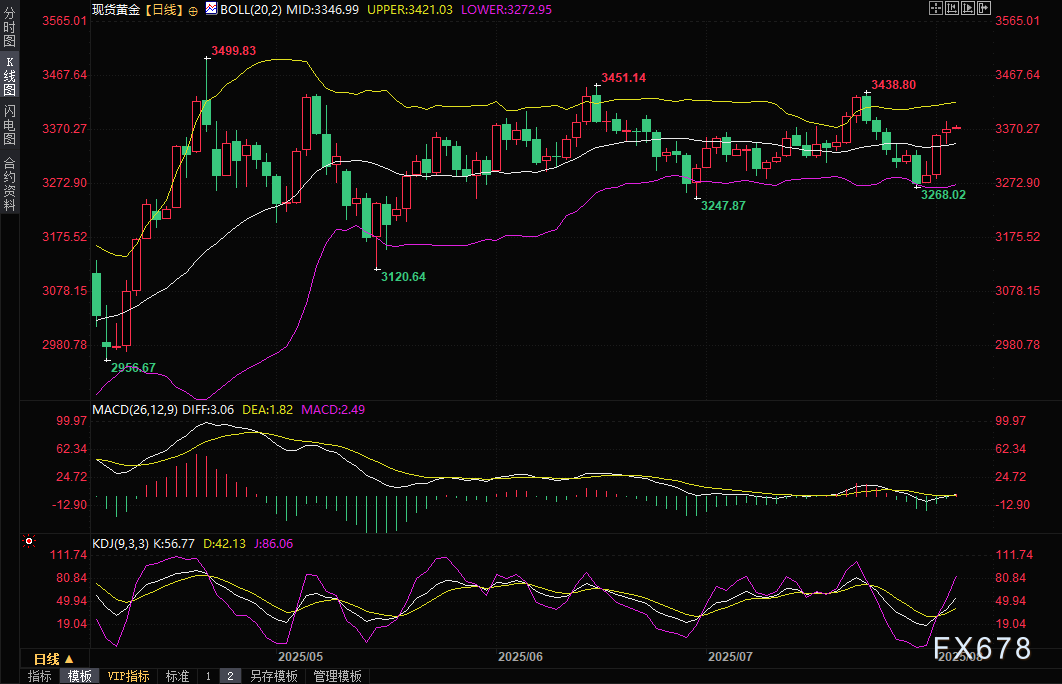
(Daily chart of spot gold, source: Internet)
At 07:25 Beijing time, spot gold was trading at $3,377.85 per ounce.
Please indicate the source: https://www.daoctech.com/fxschool/1680.html
Disclaimer: The content of this article does not represent the views of the Institute of Foreign Exchange. The content is for reference only and does not constitute investment advice. Investors operate accordingly at their own risk.