
Non-agricultural lightning triggered a technical counterattack, and the gold short-term repair was in place?
The trend of gold last week can be described as "first suppressed and then rose". Under the background of the Federal Reserve maintaining interest rates unchanged and the overall strong economic data, the market once strengthened its expectations for the maintenance time of high interest rates, and the price of gold fell under pressure, reaching a minimum of 3,270 US dollars. However, the US non-farm data released last Friday was significantly worse than expected, which caused the market sentiment to turn sharply. The US dollar and US bond yields both fell, and gold ushered in a strong rebound. It closed back above 3,350 US dollars. The technical aspect formed a short-term counterattack pattern, indicating that the short-term trend may reverse.

Fundamentals
The Federal Reserve stayed put as scheduled last week, but the statement and officials' remarks maintained a hawkish tone. Chairperson Powell emphasized that inflation has not yet fully eased and "is not ready to ease policy." At the same time, the annualized GDP growth rate in the second quarter reached 3%, and the ADP private employment growth was also strong, solidifying market expectations of continued tightening. Gold was under pressure at the beginning.
But the turning point came last Friday. The non-farm payroll increase in July was only 73,000, far below market expectations, and the previous value was revised down to 258,000, and the unemployment rate rose to 4.2%. The weak report raised market concerns about the economic outlook. The CME FedWatch tool shows that the probability of interest rate cuts in September jumped to nearly 70%, compared with less than 30% previously. The emergence of the inflection point of interest rate expectations triggered a strong rebound in gold.
In addition, the United States and the European Union reached a tariff agreement to some extent to suppress safe-haven demand, but this round of gold prices rely more on the adjustment of policy expectations rather than the increase in geopolitical risks.
Technical aspects:
From the daily chart, after a long period of sideways trading, gold finally showed a key rebound signal. Last week, the lowest fell below $3,270, and it quickly recovered after briefly touching the lower track of Bollinger, forming a "false break" signal. The current price is stable above the medium track (3340.11), which brings confidence to the bulls to recover.
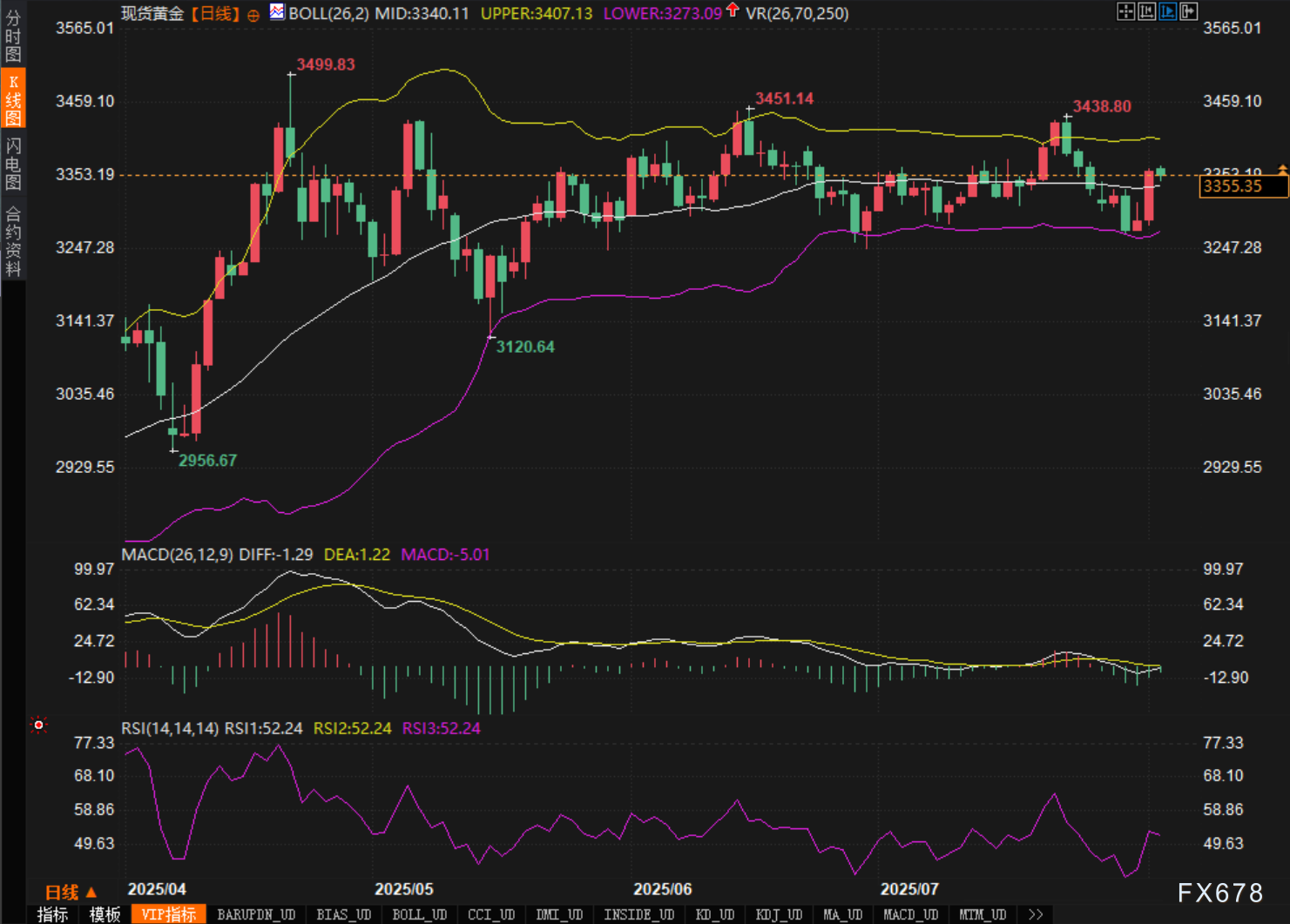
The MACD indicator shows that although the main line (DIFF) is still below the signal line (DEA), the distance between the two has narrowed, and the kinetic energy of the green column has also weakened significantly, indicating that the end of the divergence is approaching the golden fork, and the technical rebound has the potential to continue.
The RSI index has also rebounded from the oversold area and is currently at 52.24, initially standing on the central axis, breaking the previous weak pattern. The analysis believes that if the follow-up momentum follows, it is expected to push the gold price to test the upper rail resistance of $3,407, breaking through this level will open up more upside space.
In terms of support, the short-term focus is on the support of the Bollinger mid-rail at $3,340 and the previous low at $3,270; the resistance level is concerned with the $3,450 and the previous high at $3,499.
Market sentiment observation:
From a market perspective, Friday's price action has clearly reflected a "mood reversal". Previously, the consensus that interest rates remained high for a long time had suppressed the attractiveness of gold, and funds flowed to the equity market and short-end bonds. However, as the non-agricultural data stalled and the market recalculated the policy path, gold became a safe-haven and beneficial asset to hedge against interest rate uncertainty.
However, it is worth noting that the reversal of sentiment is still in the early stages, the Federal Reserve has not yet released a clear dovish turn signal, and inflation data is still uncertain. Although market sentiment has been repaired, if the follow-up data does not continue to cooperate (such as this week's ISM services PMI higher than expected), gold's upside space may still be limited.
The market is currently in a kind of "loose expectations but no consensus" middle ground, where emotions are warm and beliefs are not solid.
Outlook for the future market:
The short-term outlook:
From the perspective of daily structure and indicators, gold is expected to continue this round of rebound. Analysts believe that if the service PMI or inflation data continue to weaken this week, the Federal Reserve's interest rate cut expectations in September will further heat up, which is expected to help gold prices break through the $3,400 line. In short-term operations, traders are concerned about whether the bulls' momentum can continue to increase and break through the previous high of $3,451 to form a new rising band.
Long-term outlook:
Despite the recent recovery in the price of gold, from the perspective of macro trends, the world's major central banks have not yet fully turned to easing. The Federal Reserve remains cautious and inflation stickiness has not been eliminated. As a hedge asset, the mega-cycle trend of gold is still in a critical turning point. The analysis believes that if the Federal Reserve's attitude continues to be dovish in the future, the price of gold may strengthen in the middle line; otherwise, this round of rebound may only be a technical backdraw in weakness;
The key variables are still: the pace of inflation decline and whether the labor market continues to weaken, only the macro signal forms the expectation of "systemic relaxation", and the gold side is expected to truly break away from the consolidation range and restart a new round of trend prices.
Please indicate the source: https://www.daoctech.com/fxschool/1681.html
Disclaimer: The content of this article does not represent the views of the Institute of Foreign Exchange. The content is for reference only and does not constitute investment advice. Investors operate accordingly at their own risk.