
Crude oil trading reminder: Although EIA inventories fell more than expected, oil prices rose and fell, maintaining a volatile adjustment
Oil prices rallied slightly in Asian markets on Thursday after five consecutive days of decline, with Brent crude futures up 0.7 per cent at $67.47 a barrel and US WTI crude up 0.9 per cent at $64.97.
The move came after the two oil benchmarks fell to eight-week lows on Wednesday amid concerns that the US could increase energy sanctions against Russia.
News of possible high-level talks between the US and Russia injected some relief into markets as White House officials revealed that US President Donald Trump could meet Russian President Vladimir Putin next week, although the US remains prepared to impose "secondary sanctions" on Russia, possibly covering Asian countries, to force Moscow to back down on Ukraine.

"Even if there are signals of diplomatic talks, the market cannot rule out the potential impact of new trade tariffs on the crude supply chain," said Hiroyuki Kikukawa, chief strategist at Nissan Securities.
U.S. crude oil inventories fell sharply, providing substantial support for the oil market. According to data released by the U.S. Energy Information Administration (EIA), U.S. crude oil inventories fell by 3 million barrels in the week ended August 1, and total inventories fell to 423.70 million barrels, far exceeding the market's previous estimate of 591,000 barrels.
The main reason for the decline in inventories is the increase in US crude oil exports and the sharp increase in refinery operating rates. In particular, refinery utilization on the Gulf Coast and West Coast rose to the highest level since 2023, reflecting the still solid domestic refining demand.
Despite the positive inventory data, market sentiment remains subject to multiple uncertainties. The current OPEC + consortium plans to further increase crude oil supply, which may put pressure on oil prices in the medium term.
"With OPEC + maintaining its production increase plan, the outcome of the US-Russia talks still uncertain, and a new round of tariff strikes on India and Asian countries, investors may continue to choose to wait and see in the short term," Kikukawa added.
Sanctions could extend to India and Asian countries, altering global crude oil trade. Mr. Trump announced on Wednesday that he would impose a 25 per cent tariff on Indian imports, citing continued imports of Russian crude. The tariff will take effect 21 days after August 7.
In addition, Trump also said that if Asian countries do not stop buying Russian crude oil, they may adopt punitive tariff policies similar to those of India.
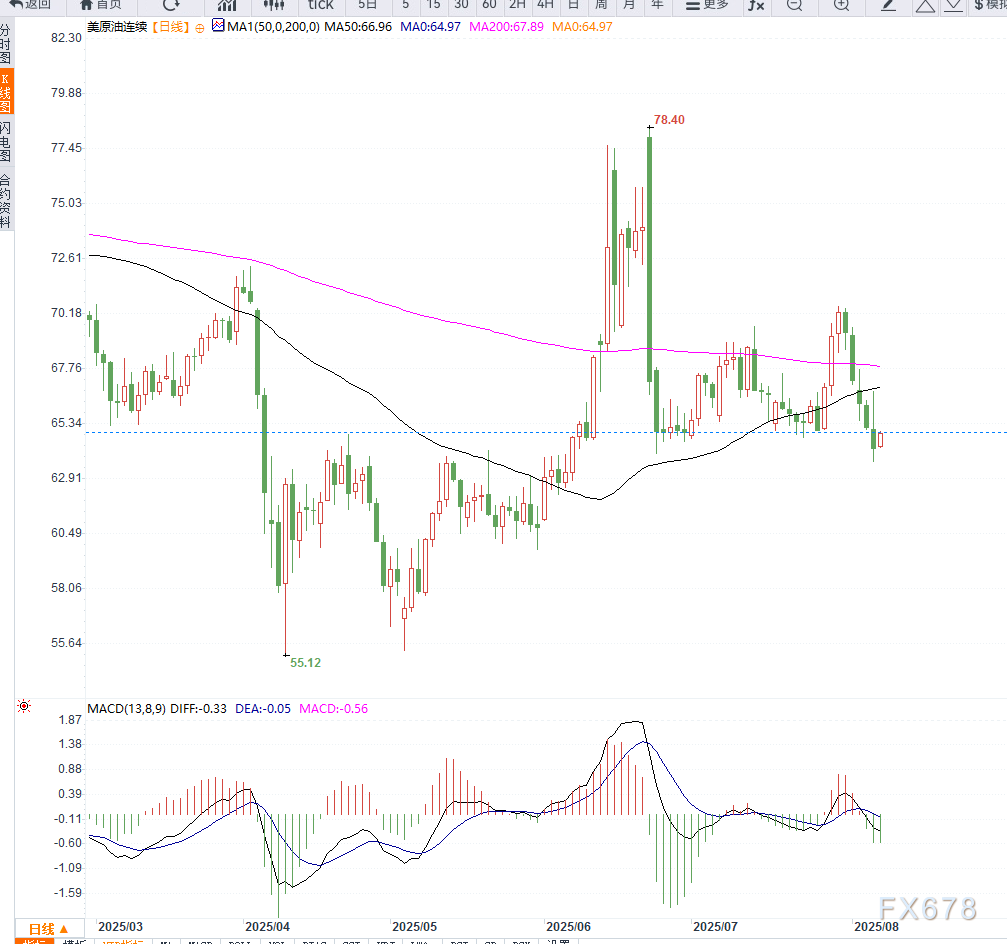
From a technical perspective, the daily chart of U.S. crude oil (WTI) shows that the price has gained initial support near $64, and it is expected to build a double bottom in the short term. The current K-line has closed a long shadow positive line for two consecutive days, showing that the bulls are actively undertaking in the $60-64 area, and the MACD indicator tends to converge below the zero axis, indicating that the downward momentum has weakened;
If the follow-up price stands firm at the 20-day moving average (about $66), it is expected to challenge the $70 integer mark. On the contrary, if it falls below $60, it will open up further downside and test the previous low support.
Editorial opinion:
The current rebound in oil prices is based on the decline in inventories and the market's game of negotiation expectations, but the variables that really affect the medium and long-term oil prices are still the rhythm of OPEC + production increase and the evolution of global geopolitical risks. As the United States further links energy issues to trade policy, Asian countries' crude oil import strategies may encounter a more complex decision-making environment, which may reshape the regional energy market structure.
Please indicate the source: https://www.daoctech.com/fxschool/1687.html
Disclaimer: The content of this article does not represent the views of the Institute of Foreign Exchange. The content is for reference only and does not constitute investment advice. Investors operate accordingly at their own risk.