
Gold trading reminder: US inflation is moderate and interest rate cuts are released, bulls are eager to move, pay attention to the speech of Federal Reserve officials
In early Asian trading on Wednesday (August 13), spot gold fluctuated slightly, and is currently trading around $3,351.15/oz. On Tuesday (August 12), gold prices edged higher, closing up 0.16% at $3,348.02/oz. This small fluctuation seemed calm, but it was due to the dovish performance of the latest US inflation data. The data not only maintained the expectation of the Federal Reserve's interest rate cut in September, but also triggered multiple chain reactions such as the weakening of the US dollar, the adjustment of bond market yields, and the record rebound of the stock market. Combined with the good news of the extension of the Sino-US tariff truce, the gold market is at a key turning point. Investors need to pay close attention to the producer price index (PPI) and retail sales data to be released this week to seize potential investment opportunities.
Inflation data mildly releases pressure, and gold's safe-haven charm is emerging
The consumer price index (CPI) in the United States rose 0.2% month-on-month in July and rose 2.7% year-on-year, which was basically in line with market expectations but slightly lower than some economists' forecasts. This data shows signs of easing inflationary pressures after a 0.3% increase in June. In particular, the core CPI (excluding food and energy) rose 0.3% month-on-month to 3.1% year-on-year, the largest increase since January this year, but the overall increase did not show a significant increase.
Bob Haberkorn, market strategist at RJO Futures, pointed out that this inflation performance was "mixed", but enough to support the Federal Reserve's path of interest rate cuts. The tame move in inflation has eased market concerns that tariff policy could push up prices, although the Trump administration has repeatedly emphasized the impact of tariffs, but data show limited transmission effect. This provides support for gold, as investors are more inclined to turn their money to gold to hedge against potential downside risks in an environment where inflation is not out of control.
In contrast, if inflation unexpectedly spikes, gold may face short-term pressure, but current data has solidified gold's position as a safe-haven asset, attracting buyers holding other currencies, especially as a weaker dollar further reduces the cost of buying gold.
The Federal Reserve's interest rate cut expectations are heating up, and gold bulls are full of confidence
The release of inflation data directly strengthened market bets on the Federal Reserve's September rate cut.
Traders raised the likelihood of a rate cut at the September 16-17 meeting to 94 per cent, from 86 per cent on Monday, according to CME Group's FedWatch tool. That expectation comes on the back of continued weakness in the jobs data - fewer jobs were created than expected in July and a sharp downward revision in previous months - combined with a solid performance in inflation that gives the Fed plenty of policy space.
Karl Schamotta, chief market strategist at Corpay, stressed that underlying inflation remained subdued, leaving room for manoeuvre in response to signs of labour market weakness. He further predicted that Federal Reserve Chairperson Jerome Powell would explicitly mention the possibility of a September rate cut at his Jackson Hole economic seminar later this month.
Expectations of a rate cut are a strong catalyst for gold, as lower interest rates reduce the attractiveness of the dollar and reduce the opportunity cost of holding gold. Gold has historically enjoyed a rally whenever the Federal Reserve enters an easing cycle. After the data, traders maintained bets on rate cuts in September and December, allowing bulls to build up in gold, even as markets remain cautious in the short term and wait for more economic indicators to validate.
A weaker dollar has become a driver of gold's rise
The dollar index fell across the board after the inflation data came out, hitting an intraday low of 97.89, the lowest since July 28. The weakness was directly supported by moderate inflation on expectations of interest rate cuts, as well as by the Reserve Bank of Australia's interest rate cut expectations and strong UK employment data.
Forex analyst Fawad Razaqzada analyzed in the report that if the Federal Reserve continues to cut interest rates, the spread between the dollar and high-yielding currencies will narrow rapidly, thus putting pressure on the dollar exchange rate. For gold, the weakness of the dollar means that gold denominated in other currencies has become cheaper, stimulating demand from international buyers. The world's largest increase since October, but the overall increase has not been significant.
Bob Haberkorn, market strategist at RJO Futures, pointed out that this inflation performance was "mixed", but enough to support the Federal Reserve's path of interest rate cuts. The tame move in inflation has eased market concerns that tariff policy could push up prices, although the Trump administration has repeatedly emphasized the impact of tariffs, but data show limited transmission effect. This provides support for gold, as investors are more inclined to turn their money to gold to hedge against potential downside risks in an environment where inflation is not out of control.
In contrast, if inflation unexpectedly spikes, gold may face short-term pressure, but current data has solidified gold's position as a safe-haven asset, attracting buyers holding other currencies, especially as a weaker dollar further reduces the cost of buying gold.
The Sino-US tariff truce has been extended, ushering in breathing space for the gold market
China and the United States extended their tariff truce by 90 days to November 10, avoiding steep tariffs on each other's goods, a news that was largely ignored by currency markets but injected stability into the gold market.
Reports of Washington's tariffs on imported gold bars had pushed US gold prices to record highs on Friday, but Mr. Trump's clear statement on social media that he would not tax imports sent gold prices down more than 2 per cent on Monday. Now the decision to extend the truce has eased trade tensions and reduced the latent risk of rising inflation.
Matt Bush, US economist at Guggenheim Investments, said that the inflation data suggest that the tariff transmission effect is limited, which tells us that the Federal Reserve's 2% inflation target is not off track.
Richmond Fed President Barkin warned that aggressive consumer buying could mitigate the impact of tariffs on inflation, but it could also trigger a cycle of falling demand and rising unemployment.
For gold investors, this extension provides valuable breathing space, avoiding the short-term market panic caused by the escalation of the trade war, while strengthening gold's attractiveness as a hedge against geopolitical risk.
Outlook attention
Although the market will focus on this week's PPI, unemployment benefits, and retail sales data in the short term, in the long term, the Federal Reserve's easing policy and geopolitical uncertainty will continue to support the upside potential of gold.
In addition, this trading day will welcome Richmond Federal Reserve President Barkin, Chicago Federal Reserve President Goolsbee, and Atlanta Federal Reserve President Bostick to speak, and investors need to pay attention.
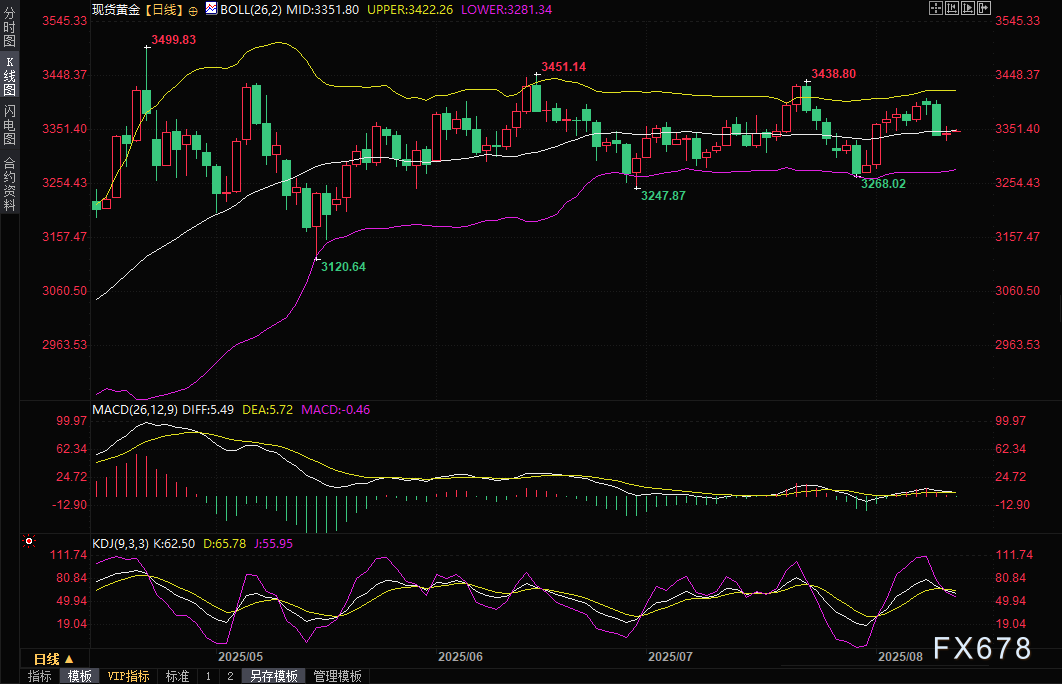
(Daily chart of spot gold, source: Internet)
At 07:40 Beijing time, spot gold was trading at $3351.39 an ounce.
Please indicate the source: https://www.daoctech.com/fxschool/1695.html
Disclaimer: The content of this article does not represent the views of the Institute of Foreign Exchange. The content is for reference only and does not constitute investment advice. Investors operate accordingly at their own risk.