
Gold trading reminder: The US Treasury Secretary's remarks "lock in" interest rate cut expectations in September, the continued decline of the US dollar helps gold prices rebound, pay attention to PPI and initial request data
On Thursday (August 14), in the early trading of Asian markets, spot gold fluctuated narrowly, and is currently trading around $3,360/ounce. The rebound in spot gold prices on Wednesday was blocked, and it once touched the $3,370/ounce mark during the session. Finally, it closed at $3,355.90/ounce, an increase of 0.24%. US Treasury Secretary Vincent believes that the Federal Reserve may cut interest rates by 50 basis points in September. The general consensus reached by the market for the Federal Reserve to cut interest rates in September has promoted the continued weakness of the US dollar index and the decline in US Treasury yields, providing support for gold prices. However, the continued record high of US stocks and the potential easing of geopolitical tensions have suppressed the safe-haven demand for gold to some extent.
The US Treasury Secretary "ignited" the fire of expectations for a 50-point interest rate cut in September
The US Consumer Price Index (CPI) data for July showed that inflation rose modestly, rising only slightly, which is basically in line with market expectations. More importantly, this data shows that the Trump administration's large-scale tariff policy has not yet been significantly transmitted to the commodity price level, avoiding a sharp surge in inflation. Such a mild inflation environment provides solid support for the Federal Reserve to start cutting interest rates in September.
Investors quickly adjusted their expectations, almost completely digesting the possibility of the Federal Reserve cutting interest rates next month, and even began to bet that the rate cut could reach 50 basis points.
In an interview with Bloomberg, Treasury Secretary Vincent Bescent made clear that the Federal Reserve was likely to cut interest rates in a series and start an easing cycle by 50 basis points, adding to market optimism and sending gold prices higher.
Because the opportunity cost of holding gold falls significantly during the rate-cutting cycle, investors are more inclined to shift their funds into this non-interest-bearing asset to hedge against potential economic uncertainty. In addition, the weak performance of the non-farm payrolls data in July also exacerbated the pressure signal in the labor market, putting Federal Reserve policymakers under more easing pressure.
Nikos Tzabouras, senior market analyst at Tradu, pointed out that it is this combination of data that has made gold move unusually strong, and investors are closely watching the upcoming producer price index, unemployment claims and retail sales data this week for further verification of the path of interest rate cuts.
A weaker dollar is a direct catalyst for gold's rise
Affected by the Federal Reserve's interest rate cut expectations, the dollar index fell for the second consecutive trading day this week, falling by 0.28% on Wednesday, hitting an intraday low of 97.61, a new low of more than two weeks. This weak trend directly reduced the cost of purchasing gold by overseas buyers, thus stimulating the recovery of demand. The weakness of the dollar is not accidental, but is due to the heating up of interest rate cut expectations by the Federal Reserve and political pressure from the Trump administration.
President Trump renewed his public criticism of Federal Reserve Chairperson Jerome Powell for failing to cut interest rates early and even considering a lawsuit over the mismanagement of the Fed building renovation, a political intervention that added to the selling pressure on the dollar.
Canada's Scotiabank Chief Monetary Strategist Shaun Osborne believes that Washington's pressure on the Federal Reserve has reached a considerable degree, which has not only affected interest rate adjustments, but also indirectly pushed down the dollar exchange rate.
Meanwhile, US 10-year Treasury yields fell 5.3 basis points to 4.24 per cent on Wednesday, while the two-year yield also slipped 4.2 basis points to 3.689 per cent. The fall in Treasury yields further reduces the opportunity cost of holding gold, as its attractiveness as a zero-yielding asset increases significantly in a low-yield environment.
Vail Hartman, a U.S. interest rate strategist at BMO Capital Markets, stressed that while tariff policy could gradually transmit inflation in the coming months, the calm in July has inspired calls for more rate cuts, especially as the labor market begins to come under pressure.
Signals of geopolitical détente weaken gold's safe-haven appeal
Although gold has benefited from loose monetary policy, the potential easing of geopolitical factors has weighed on its demand as a safe-haven asset to some extent.
President Trump will meet with Russian President Vladimir Putin on Friday to discuss ending the war in Ukraine, sparking optimism that the conflict will cool. European and Ukrainian leaders have communicated with Mr. Trump ahead of the meeting, hoping to push for a ceasefire without harming Ukraine's interests.
In addition, the 90-day extension of the tariff truce between China and the United States also eased tensions over global trade frictions. These developments have led investors to temporarily reduce their safe-haven allocation to gold in favor of risky assets. Goolsbee, president of the Chicago Fed, said the Fed was working to assess the short- or long-term impact of tariffs on inflation, which would directly affect the timing of interest rate cuts.
The president of the Atlanta Federal Reserve Bank pointed out that the US economy is close to full employment, which provides the Federal Reserve with "luxury conditions" not to rush to adjust policy. However, these remarks also suggest that if geopolitical risks further ease, gold's upward momentum may face challenges, because safe-haven demand is one of the traditional supports for gold prices.
US stocks hit a new high, weakening safe-haven buying demand
In stark contrast to gold, the strong performance of U.S. stocks. The S & P 500 and Nasdaq set new closing highs for the second day in a row on Wednesday, with the Dow Jones Industrial Average up 1.04% to 44,922.27, the S & P 500 up 0.32% to 6,466.58 and the Nasdaq edging up 0.14% to 21,713.14. The Russell 2000 index of small-cap stocks rose nearly 2% to a six-month high.
The rally was driven by the "near certainty" that the Federal Reserve would cut interest rates, with CME's FedWatch tool showing traders had fully digested expectations of a 25 basis point cut in September. While tech stocks showed some signs of weakness, such as pullbacks from Nvidia, Alphabet and Microsoft, Apple rose 1.6 per cent on reports of its foray into artificial intelligence robotics.
Katherine Bordlemay, co-head of asset management at Goldman Sachs, pointed out that although the current valuation of US stocks is high, profitability is still the key, and the degree of return differentiation has reached the highest level in the past 30 years. Although the stock market's enthusiasm has attracted funds into risky assets, it has depressed the safe-haven demand for gold.
Outlook
Looking to the future, if the expectation of a 50-point interest rate cut in September further heats up, gold is expected to continue its strength or even challenge a higher threshold; but if geopolitical risks unexpectedly escalate or economic data exceed expectations, gold prices may also face a correction.
Investors should keep a close eye on Powell's remarks at the Jackson Hole symposium next week, as well as potential adjustments by the Trump administration to the successor of the Federal Reserve chairperson, which could be turning points for gold prices.
This trading day focuses on the change in the number of US initial jobless claims and the performance of the US PPI data in July. Friday focuses on the meeting between Trump and Putin.
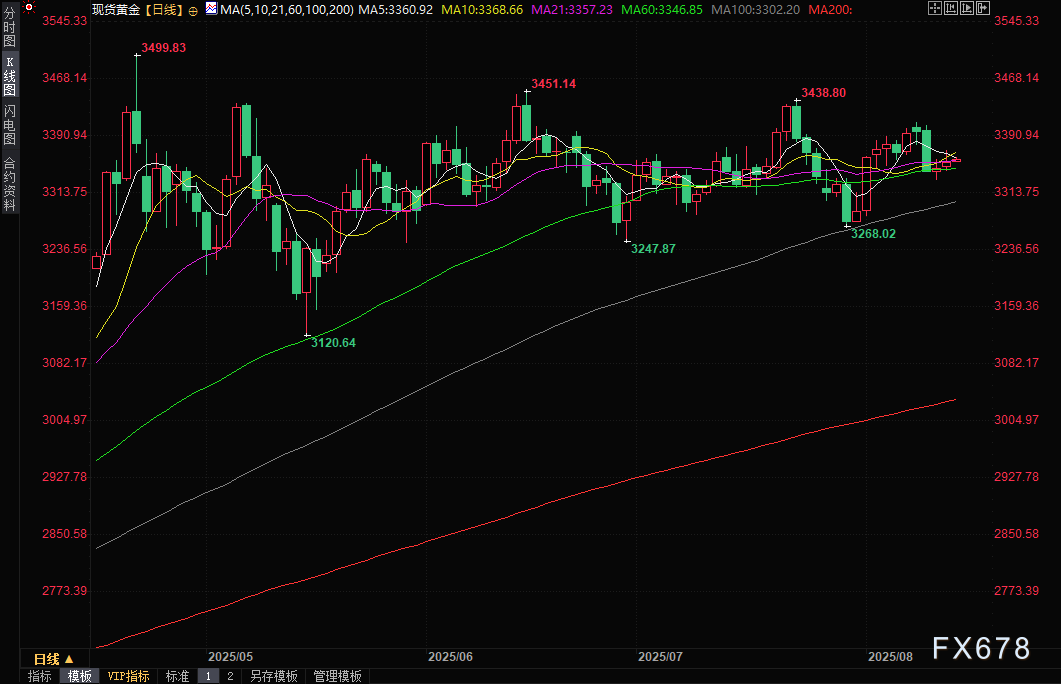
(Daily chart of spot gold, source: Internet)
At 07:37 Beijing time, spot gold was trading at $3361.61 an ounce.
Please indicate the source: https://www.daoctech.com/fxschool/1702.html
Disclaimer: The content of this article does not represent the views of the Institute of Foreign Exchange. The content is for reference only and does not constitute investment advice. Investors operate accordingly at their own risk.