
The 30-year British bond broke 5.68%, why did the pound stall in an instant?
On Tuesday (September 2), the pound fell sharply against the dollar in early European trading, hitting a low of 1.3425 and returning to around 1.3430 in the short term; this was accompanied by a rise in long-term interest rates again - the yield on 30-year British government bonds rose to a range high of 5.67% to 5.68%, a new high since 1998; the 10-year yield was 4.78%. On the same day, the yield on German 30-year government bonds also rushed to a stage high of 3.3840%. The simultaneous rise in long-term interest rates, superimposed on the autumn budget expectations, caused the risk premium of sterling assets to rise passively, and the exchange rate was significantly under pressure.
Fundamentals:
The central paradox of recent events is not growth per se, but the accelerating feedback loop of "fiscal-inflation-interest-rate-asset prices". For starters, the yield on 30-year gilts rose another three basis points to 5.67 per cent on Tuesday, reaching a new 27-year high of 5.68 per cent in London trading. Long-term borrowing costs are at the top of the G7, reflecting a combination of concerns about the stickiness of inflation, the stock of debt and the need for incremental funding. Jim Reid, head of macro research at Deutsche Bank, puts it bluntly as a "slow-moving vicious circle": doubts about debt sustainability push up yields, which in turn worsen fiscal dynamics and strengthen them negatively. Second, the 10-year UK bond yield rose to 4.78%, and the yield curve continued to steepen under the long end, indicating that medium- and long-term risk premiums are being repriced.
At the fiscal level, Chancellor Reeves faces a dilemma ahead of the autumn budget: to stabilize the fiscal path through spending cuts and tax increases, or to choose a more moderate pace to avoid a second shock to the economy. Jefferies' Mohit Kumar believes that "tax increases are inevitable, but further tax increases may be counterproductive", echoing the market consensus on "narrowing policy space". At the same time, higher expectations for defense and infrastructure spending across Europe have pushed the 30-year yield on German bonds to a high of 3.3840% since 2011, and the spillover effect of rising European interest rates has also boosted the UK debt.
In the foreign exchange market dimension, the pound fell 0.85% against the dollar in early London trading to 1.3425, mainly due to the expansion of risk premiums triggered by high long-end interest rates, while "pre-budget uncertainty + the growth cost of high interest rates" depressed the neutral valuation of the pound. The analysis pointed out that as the 30-year British bond yield rose to 5.68%, the pound experienced a "sharp decline", which is consistent with the historical law of higher elasticity of foreign exchange to interest rate end points and term premiums. Overall, the fundamentals are switching from a one-line narrative of "how high interest rates reduce inflation" to a multi-line narrative of "how fiscal credibility drives down the term premium", which has a greater and more direct marginal impact on the exchange rate.
Technical aspects:
From the observation of the 30-minute K-line chart, the Bollinger Band showed a bandwidth change of "narrowing first, then expanding", with the middle rail reporting 1.3528, the upper rail 1.3584, and the lower rail 1.3472. The exchange rate touched the upper rail many times at the 1.3549 line and failed to break through the volume. Then a long solid downward K-line directly penetrated the middle rail and penetrated the lower rail. The lowest probe reached 1.3425, and the current return is near 1.3430. MACD shows that the DIFF is -0.0016, the DEA is -0.0006, and the histogram is -0.0019. The kinetic energy of the air is in the expansion stage. The DIFF is significantly located below the DEA, and the "dead fork continuation" below the zero axis has not shown any signs of passivation. The RSI (14) reading is only 14.0679, entering the extreme oversold range, suggesting a short-term technical rebound or "dead cat jump" time window, but in the context of Bollinger band aperture expansion, the slope of the mean reversion may be slow.
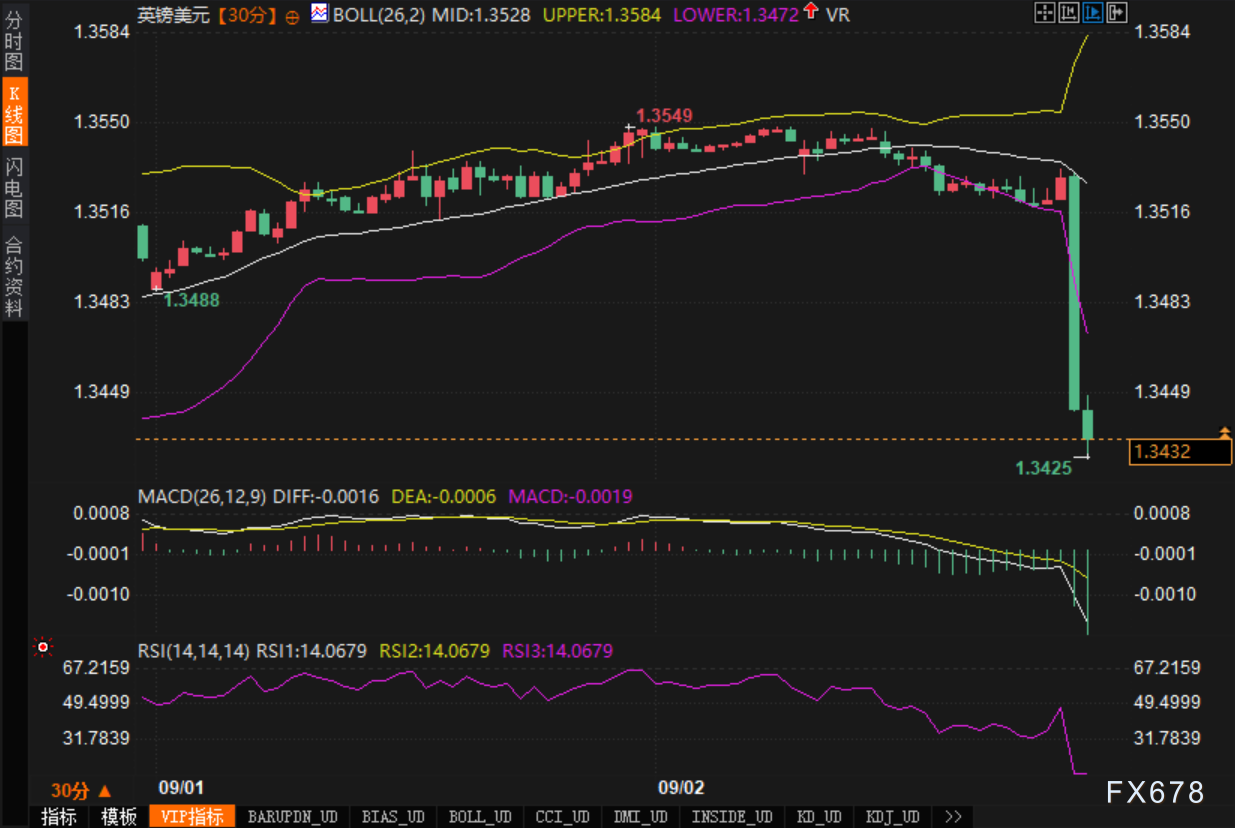
In terms of price: 1.3425 is the main static support in the current session. If it is effectively broken, the psychological level of 1.3400 will enter the field of view. Above, attention is paid to 1.3472 (Bollinger lower rail back measurement) and 1.3528 (Bollinger middle rail/dynamic resistance), above which is the front height/upper edge of the box at 1.3549. Only by standing firm above 1.3528 and completing the quantitative verification can the short-term short-term bear trend change from the "acceleration section" to the "finishing section". Until then, the technical structure still points to "intermittent rebounds in the downtrend" rather than trending V-shaped reversals.
Market sentiment observation:
"Term premium repricing" on the interest rate side is dominating foreign exchange risk factors, and the market is more sensitive to fiscal credibility and budget details than conventional macro data. Volatility in equity markets and moderate widening of credit spreads together point to a "cautiously bearish" risk appetite environment.
The core of sentiment is not a single data surprise, but the "verifiability of the policy path": the market tends to observe whether the budgetary framework can reduce future supply pressures, and then give a positive rerating of the exchange rate. At this stage, sentiment indicators and price behavior are "strengthening in the same direction" - a new high in long-end yields → a fall in the pound → further calibration of fiscal risk premiums, forming a negative spiral feedback. It is worth noting that the extreme oversold of the RSI indicates that the short-term reflexivity may increase. Once the news is slightly positive, the technical rebound triggered by short covering may be relatively rapid, but the sustainability still depends on whether long-end interest rates can peak and fall as soon as possible.
Please indicate the source: https://www.daoctech.com/fxschool/1880.html
Disclaimer: The content of this article does not represent the views of the Institute of Foreign Exchange. The content is for reference only and does not constitute investment advice. Investors operate accordingly at their own risk.