
Inflation in the United States is suddenly cold, the door to interest rate cuts is open, and global asset carousing?
On Friday (October 24), the US dollar index continued to rise in a row, closing up four days a week until the US released the originally delayed September CPI data in the evening.
The market generally expects that the year-on-year increase in the core CPI in September will be the same as the previous month, remaining at 3.1%, indicating that the market's expectations for core inflation are relatively stable, while the actual announcement is 3.0% less than market expectations. It is worth noting that most Federal Reserve officials believe that there is no need to pay too much attention to the rise in inflation. Many officials said that the impact of tariffs on inflation is temporary, which is actually setting aside the rhetoric for if inflation exceeds expectations in advance, and inflation is less than expected, which further opens up the market's imagination for the Fed's follow-up interest rate cuts.
Affected by this, the dollar index quickly fell by 0.3% and is currently trading around 98.86, down 0.05%.
Euro carnival, take the opportunity to pull up
Early on Friday, the initial PMI performance in the euro area was better than market expectations, but the euro still lacked effective upward momentum and did not perform significantly. At the same time, the French CAC40 and European Stoxx 600 indices all opened higher and lower, while with the release of US inflation data, the euro, together with the part of the morning PMI exceeding expectations, was vented, rising more than 0.3% in one fell swoop, and national indices also directly hit a new intraday high.
In the bond market, in addition to Japan's 10-year bond yield fell by 1 basis point, most of the bond yields of other major economies rose, and the global risk-free interest rate was generally strong, indicating that the market risk appetite rose slightly.
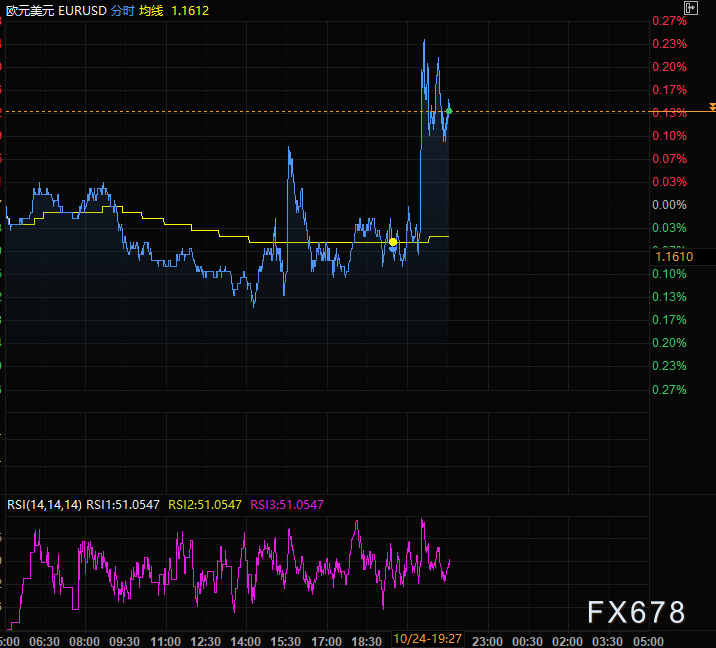
(EUR/USD daily chart)
The Federal Reserve will place greater emphasis on the labor market
From the perspective of risk balance, the risk of further deterioration of the labor market has become the focus of the whole market, which also provides support for the Federal Reserve to maintain its easing tendency.
The current market has basically digested the expectation of the Federal Reserve to cut interest rates next week, and since the silence period before the meeting has officially opened, Federal Reserve officials can hardly change market expectations through public remarks, and short-term policy expectations will remain stable.
The Federal Reserve itself is in a difficult situation where inflation and growth are the lesser of each other, and it can only find excuses for inflation. After the release of the CPI, the Federal Reserve will reduce its inflation-related worries and focus on economic growth.
The US core CPI for September excluding housing released today was also lower than expected, which will exacerbate the potential suppression of the data on the dollar. The follow-up US preliminary PMI for October, combined with the final value of the University of Michigan Consumer Confidence Index and the Kansas City Federal Reserve Service Industry Survey, have limited impact on the market. Unless the data shows a sharp correction beyond expectations, it will be difficult to change the current market trend.
At the same time, the market needs to pay close attention to next Tuesday's Conference Board Consumer Confidence Index as a supplement to the US economic growth data.
A weaker dollar will provide accommodative global monetary conditions
The release of the US CPI below expectations is a good medicine for the global economy. Affected by the US CPI below expectations, gold, US stocks, and European stock markets collectively rose.
Krishna Srinivasan, director of the Asia-Pacific Department of the International monetary fund (IMF), recently warned in an interview that if the global financial environment is tightened due to the strengthening of the US dollar and rising interest rates, the resilience of Asian economies to resist US tariffs may face severe challenges, and they need to be vigilant against the impact of changes in the external environment on the regional economy.
Mr. Srinivasan pointed out that if the US Federal Reserve continued to cut interest rates and the dollar weakened, Asian central banks would have the policy space to support their economies by easing monetary policy without worrying about the risk of capital outflows, which would provide a favorable external environment for Asian economies.
Previously, the market environment of low interest rates and falling long-term yields has helped Asian governments and companies obtain financing at low cost, thus alleviating the economic pressure caused by the US tariffs to some extent.
IMF Asia-Pacific Economic Outlook
Growth in the Asia-Pacific region is expected to reach 4.5 per cent in 2025, slightly lower than last year's 4.6 per cent but up 0.6 percentage points from the forecast value in April, according to the IMF's latest Asia-Pacific Economic Outlook 2025 report, released on Friday, driven by strong export performance in Asian economies, many of which have accelerated shipments of goods to avoid higher US tariffs and unleashed demand ahead of schedule.
However, the report also clearly warns that the downside risks facing the Asia-Pacific economy are significant, with growth expected to slow to 4.1% in 2026, and growth momentum may gradually weaken.
In terms of inflation, even in the context of the post-epidemic recovery in demand and the Russian-Ukrainian conflict pushing up raw material prices, the price level in Asia continues to be lower than that in other parts of the world.
Srinivasan pointed out that this phenomenon shows that Asian central banks have the ability to stabilize inflation expectations and keep inflation down, and the core reason is that the public trusts these central banks to be free from government intervention and maintain policy independence.
Summarize:
"The super-core services CPI excluding housing - a key indicator of underlying US inflation trends - stood at 3.2 per cent year-on-year in August for the second month in a row, indicating that progress towards the Federal Reserve's 2 per cent inflation target has stalled. This month's drop to 3.1 per cent shows that progress in controlling inflation has not been affected.
The current upside risk to prices has not intensified further, leaving huge policy space for the Federal Reserve to cut interest rates by another 25 basis points or more next week (lowering the target rate range to 3.75% -4.00%).
In addition, restrictive monetary policy may exacerbate the already fragile employment situation and lead to a further downward revision of the federal funds rate futures board on DingTalk. From a fundamental perspective, the downward trend of the dollar has not changed, and the short-term rebound may not be sustainable. "
Technical analysis:
It can be seen from the daily line of the US dollar index that although the US dollar index continued to rebound this week, it still closed below the key trend line for three consecutive days (the previous head and shoulders pattern neckline). At the same time, this rebound has not yet risen beyond the 100-plus short line, or even the 99.36 key level of the 50% non-agricultural negative line.
Overall, the US dollar index is still in a rebound pattern, and there is no sign of a reversal.
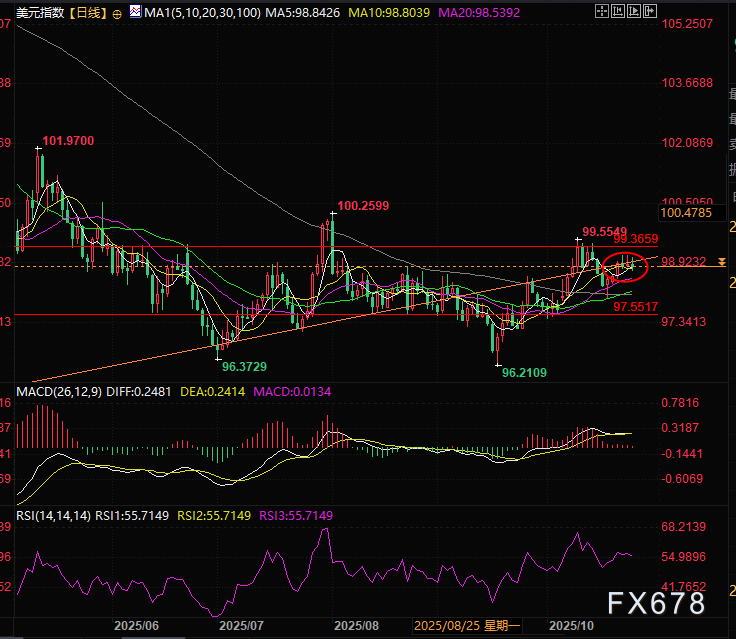
(Dollar index daily chart, source: Internet)
At 21:29 Beijing time, the US dollar index was trading at 98.86.
Please indicate the source: https://www.daoctech.com/fxschool/1935.html
Disclaimer: The content of this article does not represent the views of the Institute of Foreign Exchange. The content is for reference only and does not constitute investment advice. Investors operate accordingly at their own risk.